The Pinail Trail

Last year, whilst trawling a few fellow dragonfly enthusiasts’ websites, I discovered an interesting looking nature reserve in France called La Réserve Naturelle du Pinail or the Pinail Trail for Anglophones. Of the 90+ species of Odonata in France, this site boasts 48 of them. One of my goals this year was to visit the place and investigate.

The reserve lies about 130kms/80mls ENE of Arçais, where we would be visiting our friends early on in the trip so first prize would have been to visit it on the way to Arçais. That would have been a little early in the dragonfly season, though, so our plan was to go there after Arçais and before heading further south. Regrettably the weather did not look good for Odos the day we left Arçais so we abandoned plan B as well and headed south anyway.

We did, however, manage to tear ourselves away from our favoured dairy sheep farm and called in for a day on the way back north. After 500kms/315mls we found that the campsite at Bonneuil-Matours left a little to be desired but, since we were there for a specific purpose, it was OK. It was even beside a river with its own set of damselflies. 🙂
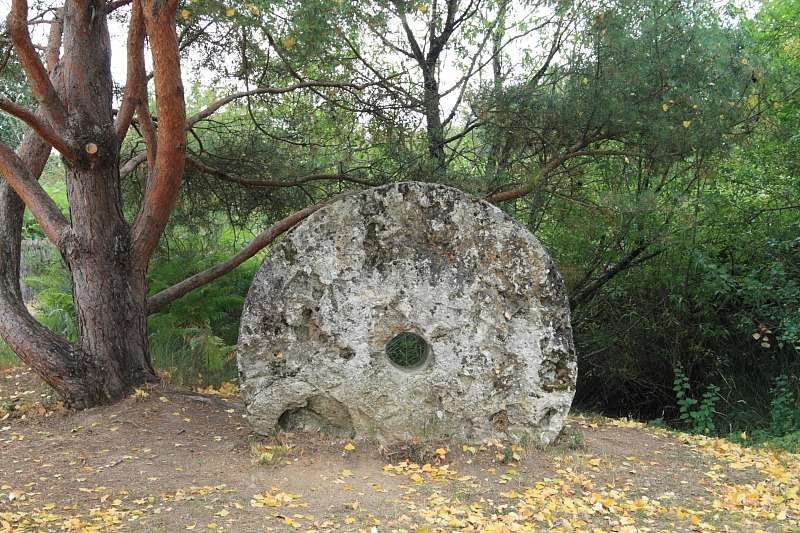
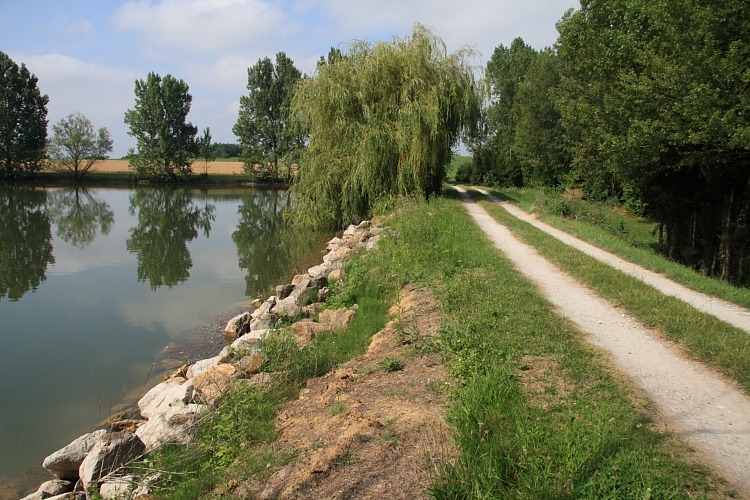
IMG_1806_Pinail_TrailThe weather wasn’t great now, either, but at least this would serve as an orientation visit. We popped of relatively early in the morning to see what we could learn. The Pinail is a fascinating landscape of hundreds, maybe thousands, of small ponds. Following the development of the windmill, a lot of mills needed a lot of millstones and they were hewn from the land that now constitutes the Pinail Trail. The ponds that supposedly support all the dragonflies are the depressions left behind by the excavating of the millstones.
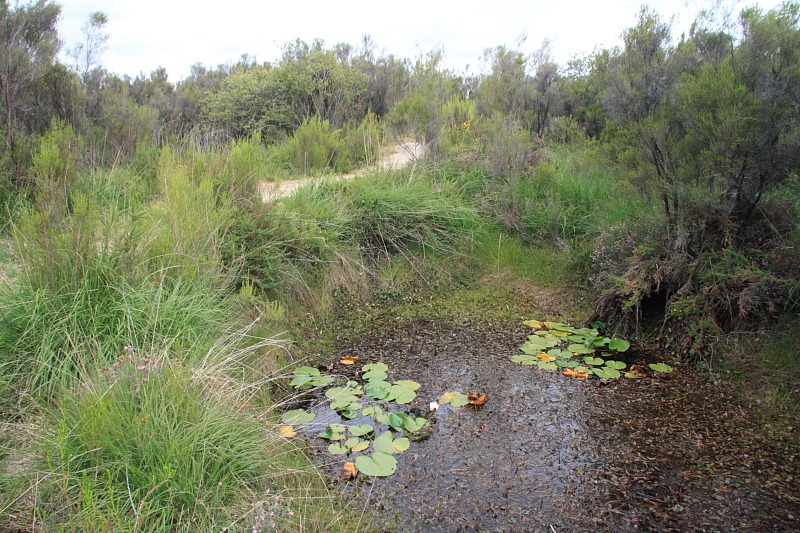
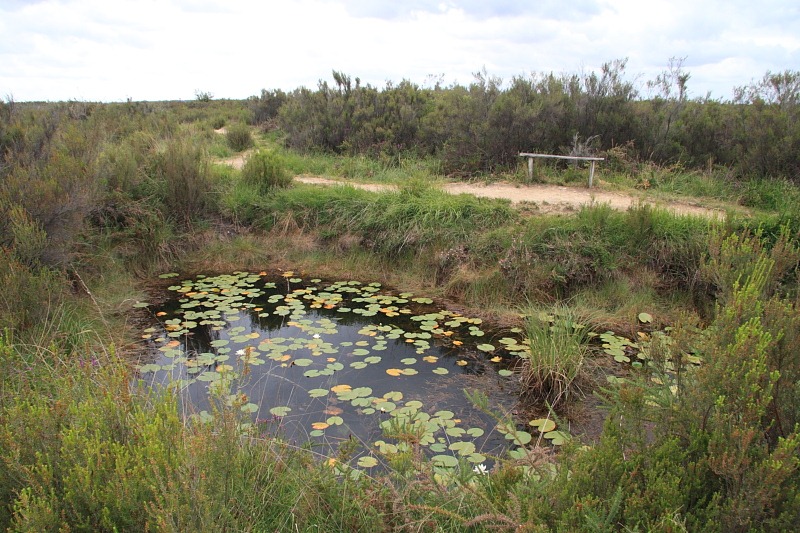
IMG_1748_Pinail_Trail IMG_1780_Pinail_Trail The first thing we noticed on entering the trail was that the water levels were disturbingly low. Some of the smallest ponds were actually dry. The Pinail was certainly suffering from the spring sécheresse [drought]. As we made our way around the shorter of two trails (~1.7kms) though, the larger ponds still had water and did show signs of life, though nothing like the number I would have expected from such a rich environment.
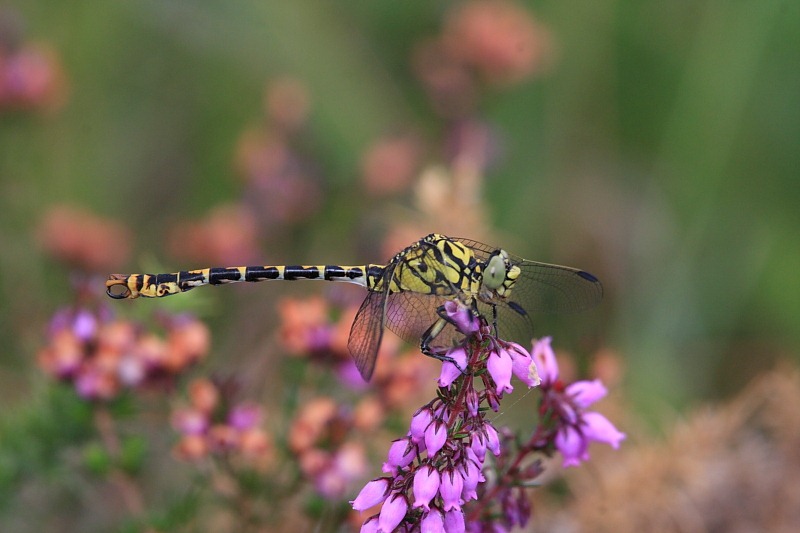
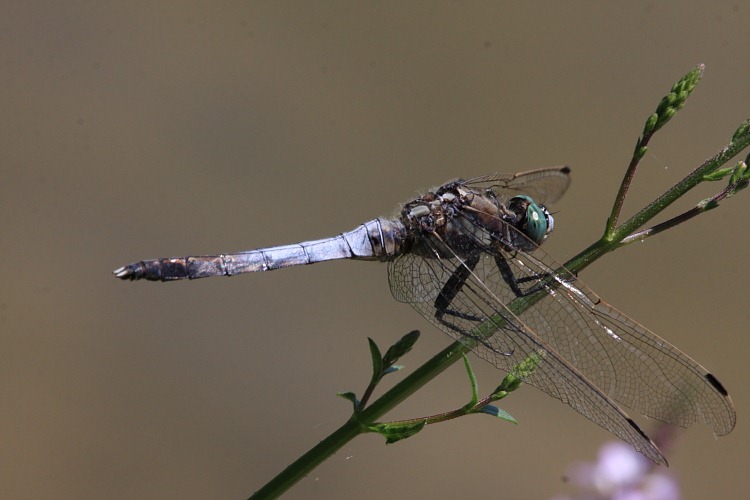
IMG_0873_Green-eyed_Hooktail Our first Odo spot made the entire trip worthwhile, though. At first I though I was focussing on another Clubtail (Gomphus) but it didn’t look quite right. as usual, I tracked it as it moved from perch to perch in the vegetation, snapped away and worried about identification later. This turned out to be a Green-eyed Hooktail (Onychogomphus forcipatus). [Ed: if that’s not a mouthful, I don’t know what is!] Though not uncommon, it was a new species for us and that’s always a thrill. Fabulous looking character, no? Just look at the vicious looking appendages at the end of the abdomen designed for grasping his mate. Talk about rough sex – ouch!

We returned in the afternoon for a second spin round to see if we could find one of its rarer inhabitants, the Dainty White-faced Darter (Leucorrhinia caudalis). Though Francine fancied that she spotted one, it scarpered as she raised her camera. We never found it or another one again.

In the words of a famous governor of California, “I’ll be back”.

Posted in 2011 Spring Tagged with: , , , ,

Beer o’Clock

The press is on strike. Now there’s a thing. We have been unable to buy our French newspaper, Aujourd’hui, with the weather maps for the coming four days. Quite why the press thinks that a strike would adversely affect many people given today’s access to information on the Internet is beyond me but there you have it – on strike they are. IMHO, since I do not care if Mrs. Brown’s cat has been stuck up a tree, a press strike simply saves our wasting too much paper. We hooked ourselves in to farmer Luc’s free wifi and checked out the weather forecasts.

When to head north is always a source of debate for us. We have to be in Normandy on Saturday evening for a ferry on Sunday at about midday. It can be done in two days but we’re wondering whether to pause en route to check out the Pinail Trail near Poitiers. The Pinail is home to some fairly special Odos and, after careful studying of the weather maps on Meteo France, the source of the weather maps withheld by the on strike press, we have decided to drag ourselves away from our beloved sheep farm at Fanjeaux and head north tomorrow to enable a 1-day visit.

IMG_1386_Beers We returned from Bram market just before midday, paid Nadine for her hospitality and settled down for a relaxing beer o’clock. 12 0’clock midday is beer o’clock, assuming that it is warm enough. Today, it is warm enough even though the sky is dull. Here, with the aid of a little fill-in flash, are our chosen beer o’clock tipples, Francine favouring the Dutch Hoegaarden import (a white wheat beer), myself favouring the pleasantly malty Pelforth Blonde.

It is worth a few words, all personal opinion, about the state of beer brewing. In my view the Belgians have always been the masters of beer but Britain had an enviable reputation. We risk losing it. I like stronger beers, not because I like getting rolling drunk but because I prefer the flavour of stronger brews. For me, beer needs to be at about 5% ABV before it is really worth the time and effort. SO-called “session beers” at about 3.5% have always been a complete waste of time and money. There is a disturbing trend in England to reduce the alcohol content of beers in the UK these days, where 4% beers appear to be becoming popular. Even Stella Artois, ruined under license in the UK and always a pale shadow of the Belgian original, has reduced in strength from 5.2% to 5.0% with and equivalent reduction in flavour. Sad stuff!

France has never, as far as I’m aware, been held in high regard as a brewing nation but, once you get away from the boring regular Kronenberg and “33” products much loved of supermarket-raiding British day-trippers, it is actually very good. Many years ago I discovered Lutèce, a splendidly dark, malty Parisian brew clocking in at 6.5%. More widely known are their Bière-du-Garde and Jenlain offerings, all very tasty.

Back to my Pelforth which is reasonably widely available in supermarchés. Pelforth actually produces three beers, blonde, ambre and brune. The blonde, at 5.8%, is the weakest of the three. The brown is, I think, 6.5%. Here is a nation that understands that beer should be sipped and appreciated rather than glugged in vast quantity until one’s stomach is unpleasantly distended.

DSCN0039_PregnantI love this sign on the cans, too. With the alcohol at 5.8%, this is clearly a warning to men that they shouldn’t drink so many cans that they start trying to make women pregnant. The Hoegaarden carries a similar symbol but it is smaller, presumably because Hoegaarden is weaker (4.9%) thus making the risk lower.

Technorati Tags: ,
Posted in 2011 Spring Tagged with: ,

Space at a Premium

Last year farmer Luc’s lake was not looking healthy enough for his liking. Most of the fish in it had died and much of the lake’s surface was covered with weed. Mind you, it did support a large population of damselflies and an utterly enormous population of frogs, despite Marcel (Luc’s father) trying to trap them for the plate, which sang more or less constantly all night long. We find the frogs’ singing acts like a lullaby and sends us to sleep though other campers have disagreed rather strongly.

Luc made an arrangement with a local pisciculture man who has a fish farm near Bram just a few kilometres away. He has stocked the lake with some enormous Grass Carp that cruise around resembling nuclear submarines eating the weed. The fish man, in exchange for this service, breeds Koi Carp in Luc’s lake. There are thousands of the tiny beggars which, when a little bigger, he will take out, grow on and sell, Koi being quite valuable fish.

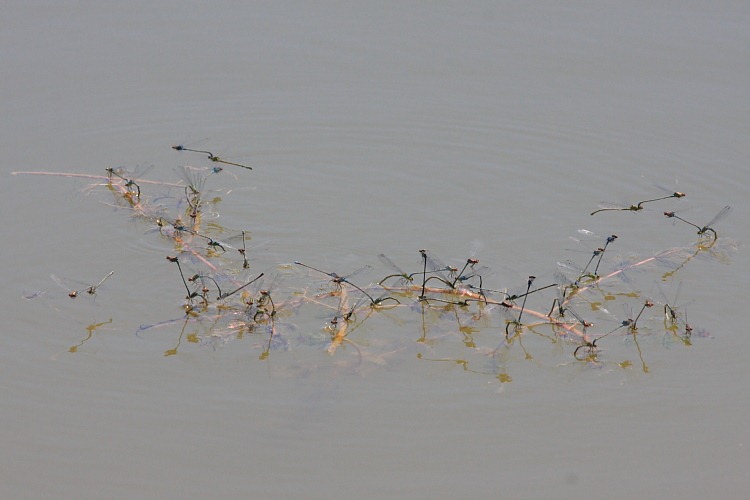
IMG_0829_Ovipositing IMG_0850_Ovipositing I am a little concerned than the natural balance of the lake has been somewhat overcorrected. There are so many voracious, large grass Carp that there is now very little weed. Whilst the water may, indeed, look very clear, damselflies need some floating weed on which to perch and oviposit [lay eggs]. One result is that any small remaining patch of weed tends to attract a dense collection of damsels in tandem all trying simultaneously to  lay eggs. Today, I even saw one pair land on another pair, using the first female’s wings as a perch, and start trying to oviposit, seemingly in her face. “Get your damned eggs out of my face!”

A related concern is the effect of fish predation on the damsel and dragonfly populations. Both eggs and larvae are eaten by fish and, given the numbers of fish in the lake at the height of the dragonfly breeding season, I’m wondering how many will successfully mature for the coming years.

I’ll just have to return to monitor the situation. 😉

Posted in 2011 Spring Tagged with: , , , , , , ,

Lunch at Gruissan

Fanjeaux was suffering from the Pyrenean effect with overcast skies today whereas, 50mls/80kms away, the Mediterranean coast near Narbonne was expecting clear weather. A good time to go and finally investigate an area we’d been meaning to look at for some years. I’d have said “perfect time” were it not for the fact that it’s a Sunday. Being a sunny July weekend, the locals would be flooding beach-wards and, being a Sunday, the restaurants would most likely be full of locals enjoying the traditional French Sunday lunch out with the family.

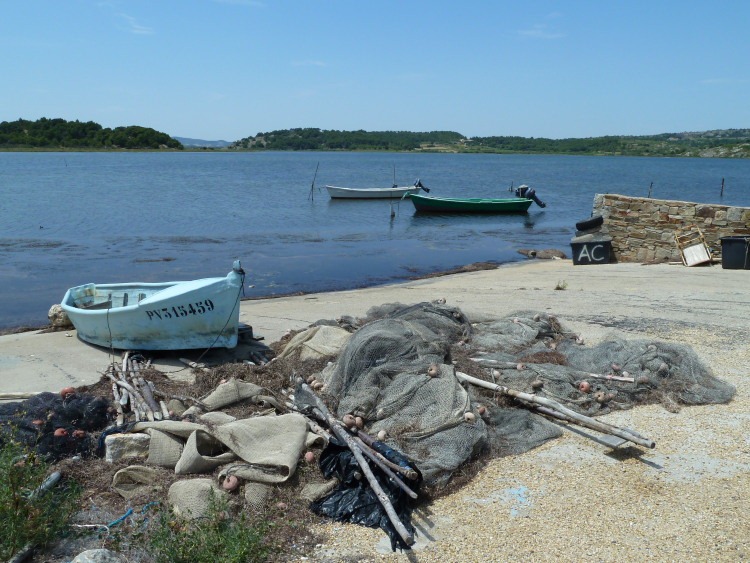
P1010350_Gruissan P1010365_Gruissan Gruissan lies about 10mls/16kms south of Narbonne. There was, as expected, plenty of traffic on the autoroute but our journey was easy enough and cruise control got us there relaxed in about an hour. We even found a handy parking place which, given the traffic entering the town, had begun to be a bit of a concern. Gruissan itself, the old section, was as delightful little fishing port on one of the several lagoons in this area. As with many French towns, the ruins of a castle dominate the buildings which cluster beneath it.

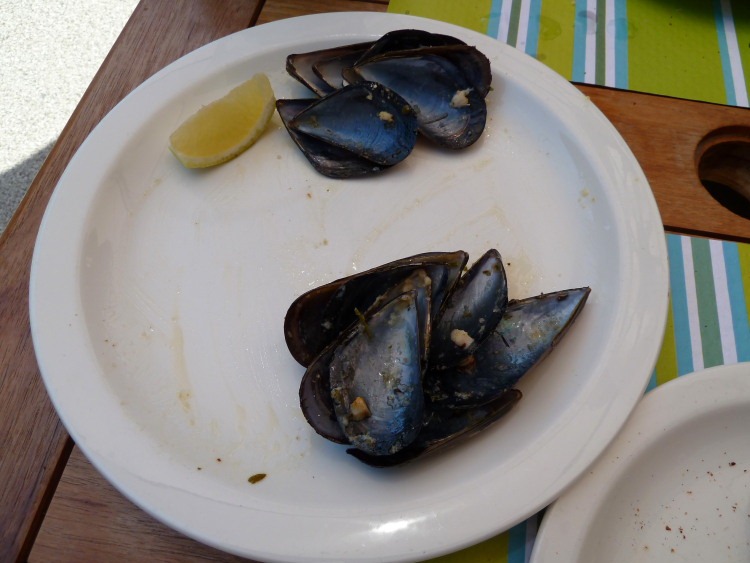
P1010358_Gruissan_Lunch P1010359_Gruissan_Lunch P1010360_Gruissan_Lunch On a wander around the town studying a few menus, the local speciality appeared to be seiche à la plancha [griddled cuttlefish]. A la plancha is more usually associated with Spain but, hey, we weren’t that far from the border. Francine eventually spotted a restaurant with more appeal than most and, happily, with a spare table for two. We nabbed it. I had to try the seiche and Francine couldn’t resist a brochette de coquille St. Jacques [skewer of scallops]. Just to get us in the mood, we shared a plate of grilled mussels as an aperitif but they were so good we finished them before the snappy camera could react. 😀 Francine’s scallops were excellent but my baby cuttlefish lacked something in the flavour department – a little disappointing. Nonetheless it was a very pleasant lunch and the four young French children on a nearby table behaved impeccably as their parents got on with the serious business of eating.

Technorati Tags: ,,,
Posted in 2011 Spring Tagged with: , , ,

Les Chateaux de Lastours

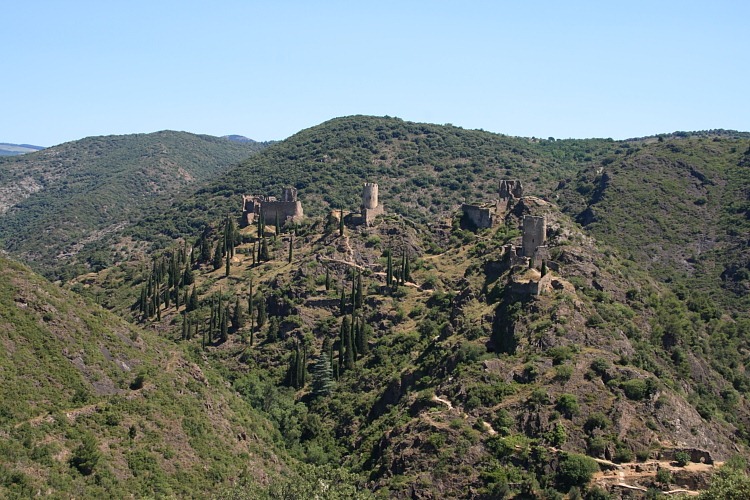
A spot of culture for today. North of Carcassonne and at the eastern end of les Montagnes Noires, is the reasonably precipitous valley of the river Orbiel. About half way up the valley is the village of Lastours boasting an unusually large number of châteaux for one small village: four.

The castles, originally three, have had an expectedly colourful history. They were Cathar castles which successfully resisted a siege by the crusaders of Simon de Montfort in 1209 during the religious wars, though they eventually negotiated a peaceful settlement having been besieged again by a different warmonger in 1227. [Ed: beats being burned at the stake, I suppose.]

The royal troops destroyed the village and original castles but built three new ones in different positions. Weird! The king “asserted his supremacy” [it says here] by building a fourth castle. Weirder! [Ed: you can never have too many castles, I say.] It is the ruins of these that we now see, and very impressive the sight is, too.

IMG_1503_Lastours You can, of course, clamber up paths to get a good close look at the stones from which the castles are constructed. Not being interested in stones, I can rarely see the point in so doing, though. In my view, attractions such as this are much more impressive when viewed from a more distant vantage point. Fortunately, some similarly minded person has constructed a belvedere on the opposite side of the valley which, for the princely sum of €2, provides this excellent view.

Technorati Tags: ,,
Posted in 2011 Spring Tagged with: , ,

Shrinking Violets

Yet another pair of Homo sapiens subspecies brittanicus arrived this afternoon but this pair was attempting to disguise itself as subspecies gallicus by travelling in a French registered car pulling a French registered trailer tent.

It’ll soon be time for us to move on so, once again, Francine and I were out armed with pixels searching out Odonata. On this trip, I have been religiously checking all apparent Black-tailed Skimmers (Orthetrum cancellatum) to make sure that they weren’t White-tailed Skimmers (Orthetrum albistylum) which, somewhat unexpectedly, look very similar to each other. Thus far, I had not noticed any White-tailed Skimmers chez nous at farmer Luc’s lake.

Hawk-eyed Francine was in the lead and disturbed a perched Skimmer. “That looks like a White-tail”, she said.

IMG_0743_White-tailed_Skimmer “B****r me, it is!”, I exclaimed, as it returned to its favoured perch and allowed me a decent look. Inwardly grumbling slightly at Francine’s fortune, I did a little rare gardening to rearrange the obscuring vegetation for a clear shot and began snapping away, reusing pixel after pixel, until I had a considerable collection of images from various angles to maximize my chances of a successful capture. Francine continued on her way to stake out Farmer Luc’s digue [dyke].

Satisfied that I had done the best I could with Luc’s sixteenth Odonata species, I slung camera and monopod over my right shoulder and set off to join Francine at the digue. I was distracted by our new arrivals struggling to connect to the electricity supply. From the male new arrival, in a rather plumy-sounding accent, “these sockets are upside down” drifted across the campsite on the breeze, and then continued, aimed at his female, “I need help”. His mate dropped what she was doing and attempted to go to his aid. [Ed: this is not the normal pecking order in matters technical for any subspecies of Homo sapiens.]

Mr. Plumy (lt. col., retd.) glanced up and spotted me with my monopod slung across my shoulder. “Do you work here?”, he enquired.

Now, here we are on a dairy sheep farm in rural southern France. Admittedly I do not look French but, were I to have been a local farm worker which, given his question, he suspected (my monopod across my shoulder probably resembled a yokel’s pitchfork), what is the chance that I would have understood his English with no attempt whatever to communicate in the local language? Remember, this pair was driving an entirely French-registered outfit so may well live in France.

I bit back my incredulity and replied, “no but I camp here”. He first went on to explain that there was “no electricity” in the “upside down sockets”. He’d tried three appliances, all to no avail, and produced an electric massager as an example ❗ which, he said, was alright this morning in the hotel. Fascinating. I checked the setting of the contact breakers and tried it at our pitch and eventually it whirred into life. I resisted the opportunity of a quick power massage and returned to Mr Plumy whereupon he produced an extension lead with an indicator lamp glowing orange, forcing him to change his claim to, “there isn’t much electricity because it won’t drive the massager”.

Mrs Plumy drove back up to the farm to assert the lamentable lack of electricity. I plugged the massager into all four “upside down” [not!] sockets and fired it up, still manfully resisting the opportunity of a power massage. “It’s all fine now”, I said and added that there was ample electricity to run the entire contents of our caravan simultaneously. With some relief, I left him with power as far as his first extension lead (with the pretty orange light) and trying to run it the remaining distance to his trailer tent as I continued on my way to join Francine.

Mrs Plumy returned across la digue and paused to ask if we were photographing frogs, adding that the entire site was apparently now without electricity. “We’ve had an entire week like this,” she added as my suspicions grew. Sure enough, Guillaume was now running on his leisure battery.

Famer Luc arrived, reset the main contact breaker which Mr. Plumy had undoubtedly caused to trip then, bless him, working entirely in English, went and debugged Mr. Plumy’s (lt. col., retd.) electrical efforts which appeared to centre around a portable refrigerator. This was probably more an act of self-preservation than generosity on Luc’s part, whose regular farming activity had been interrupted, but Luc and Nadine are very generous people. Luc gave me the key to the electricity control room in case of an encore. “Thank you”, said Mr. Plumy unabashed and in English. Clearly the Plumies were very far from being shrinking violets.

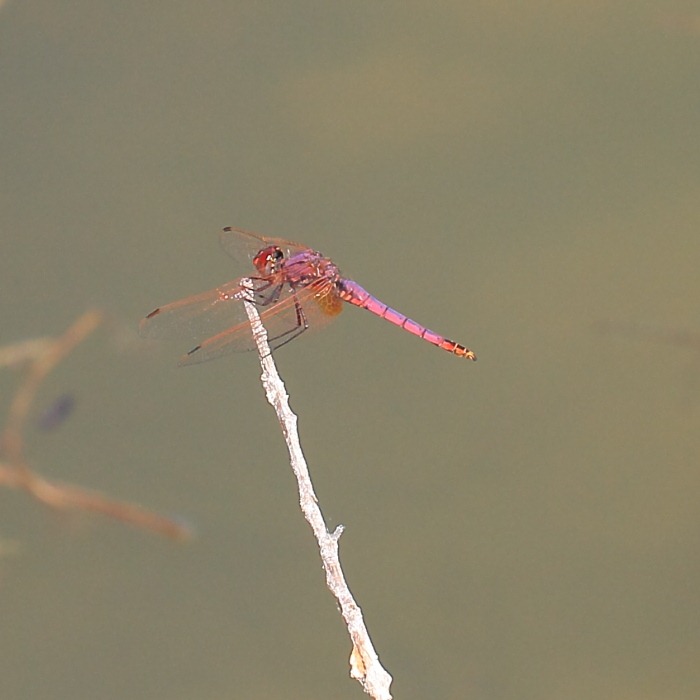
To cap it all, while I had been distracted trying to help the Plumies, hawk-eyed Francine had spotted an Odo she didn’t recognize but which she described as being, “like a Scarlet Darter but pink-coloured”. She grabbed a single, quite distant shot before it vacated its perch which was eventually reoccupied by a normally red-looking Scarlet Darter. Dubiously, we wondered if the apparent pink colouration had been a trick of the light.

IMG_1452_Violet-marked_Darter Strewth, no! When we loaded the shot and I saw it, this was very clearly an utterly stunning, never before seen by us and on the northern limits of its range, Violet-marked Darter (Trithemis annulata). Magnificent! I was glad we had a shot but was decidedly green at the gills for having missed it in the flesh.

I may be camping at la digue for the remainder of our stay. I may even change the end of our stay.

Posted in 2011 Spring Tagged with: , , , , ,

The Garden Effect

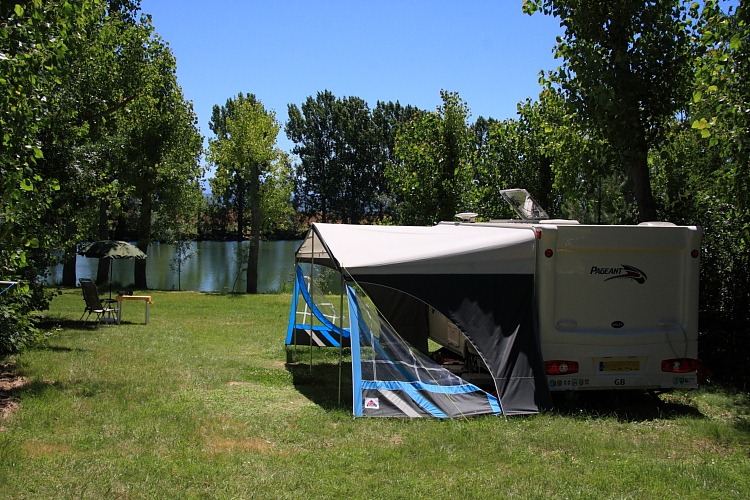
IMG_0595_Lakeside_pitch We are staying in pitch 20 of a sheep farm site at Fanjeaux. It is one of the four main, sought after lakeside pitches. To our right (as we look at the lake) is pitch 19. Pitch 19, being a hedged, well shaded but curiously triangular pitch, is most suited to tents. Pitch 19 is affectionately known as le jardin [the garden].

Up until yesterday evening we had seen two sets of campers arrive, choose to camp in the garden for several days, then depart for pastures new. On both occasions that new campers had pitched up in the garden, the weather collapsed and it rained. Superstitious suspicions grew.

Yesterday evening Nadine accompanied a lone young walker, his backpack almost as large as himself, down to the camp site to show him around. He is probably walking along the GR (Grande Randonnée) long-distance footpath which passes along the edge of the farm. After a tour of inspection, they went back to the farm to check him in. Shortly he returned and made straight for the garden where he erected a very neat, small, one-man tent before settling in for the evening. The wind increased and rain began lashing Guillaume’s roof.

Three out of three – the garden maintained it’s 100% record. 😉

IMG_1373_Combine_Harvester As well as his shared moissonneuse [combine harvester] giving him problems, farmer Luc is suffering a bit of a weather-disrupted harvest with the ups and downs of this June’s climate. I think we’ll suggest that he stops Nadine letting any further campers select the garden pitch.

Technorati Tags: ,,
Posted in 2011 Spring Tagged with: , ,

Four for Four

A wandering pair of Homo sapiens subspecies brittanica turned up this afternoon armed with their caravan and, as we were beginning another Odonata spotting sortie with cameras slung about various parts of our bodies, they began eyeing up the garden pitch – the pitch next to us with the rain curse.

“Oh, don’t go in there”, we began, jovially, “every time somebody arrives and pitches in there, it pisses with rain.”

“Really, how many times has it happened?” they asked, incredulously.

“Three, so far”, we said.

“Crumbs! How long have you been here?” they inquired.

“Two and a half weeks”, we clarified.

“Oh, well, we’ll break the pattern”, responded the lady of the couple, confidently, as she directed operations as to precisely where to pitch in the garden and in which direction to orient the caravan. [Ed: note that this is the normal pecking order amongst Homo sapiens individuals of all subspecies.]

We continued on our expedition as the new arrivals got themselves installed and settled.

An hour or so later, the skies towards the Pyrenees darkened noticeably. Shortly, we heard a distant rumble of thunder. Just occasionally the dark skies lightened but only briefly due to the illuminating effect of a flash of lightening. Rain began falling, gently at first but then more insistently. Francine and I jumped physically, startled by an almost simultaneous brilliant flash and loud, cracking report thunder in the valley below our campsite.

We laughed with thoughts of “told you so” running through our heads.

Technorati Tags: ,,
Posted in 2011 Spring Tagged with: , ,

Cherchez les Femmes

IMG_1365_Digue The track into our current blissful campsite crosses the top of farmer Luc’s digue [dyke]. The dyke holds back the water  and forms the lake beside which we are camped. I keep expecting the Dutch contingent to rush up to the dyke and habitually stick their fingers in it but, so far, this hasn’t happened. What does happen is that, for the two weeks that we have now been here, whenever we’ve walked on the grass beside the lake and walked or driven across the digue, flashes of bright red shoot up and zoom off.

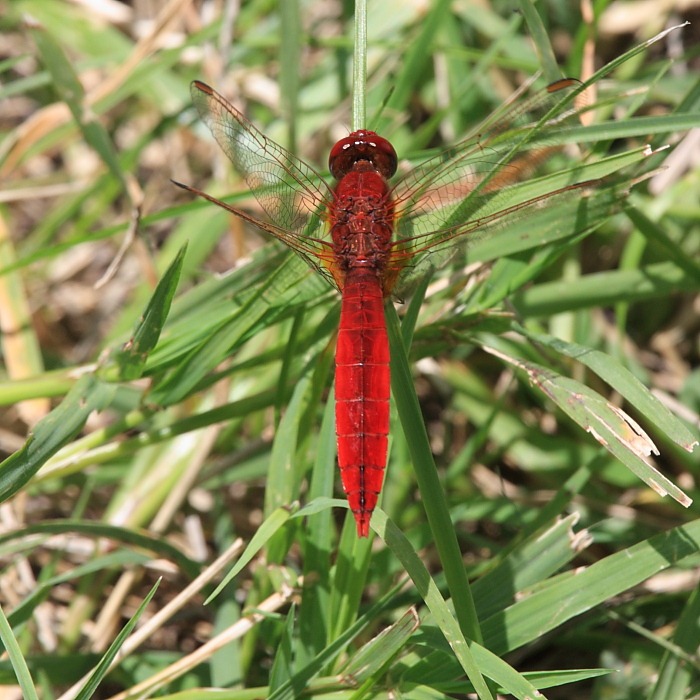
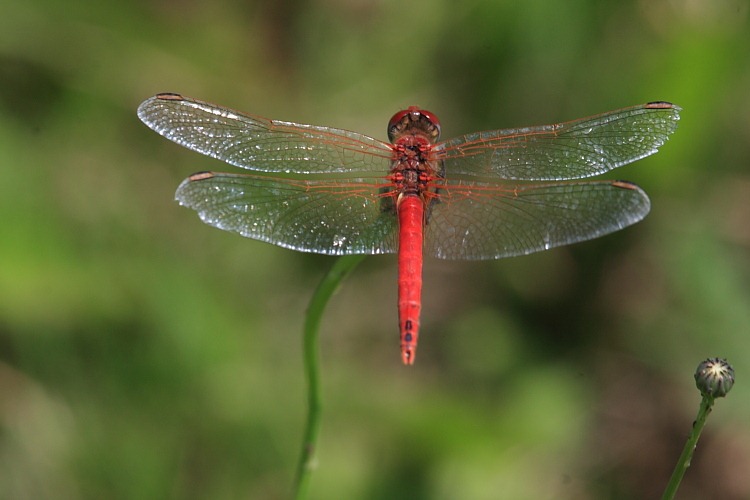
IMG_0219_Scarlet_Darter IMG_0221_Red_Butler Introducing Red Butler (left) and Scarlet O’Darter (right). “Red” is a male Red-veined Darter (Sympetrum fonscolombii) and “Scarlet” is a male Scarlet Darter (Crocothemis erythraea). Both these guys strut their stuff around the lake, sitting on the ground either on grass stems or on the stony track over the digue, producing flashes of red as they fly away having been disturbed or to give chase to a passing spot of lunch. The intense red of the appropriately named Scarlet Darters, which are particular numerous, produces a very impressive flash. On appropriate days, i.e. those which are warm and sunny, we’ve seen them for the whole of our two weeks. Our curiosity has been, where are their ladies?

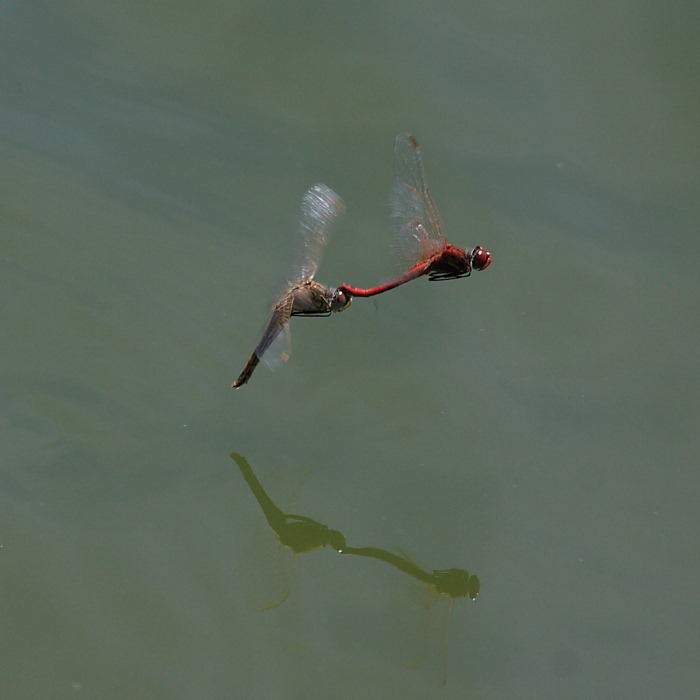
IMG_0501_Dam_BustersI’m not an idle dragonfly watcher but, up until very recently, on this trip I had not seen a single female of either Red or Scarlet. Then, just a couple of days ago I spotted my first female Red-veined Darter. Female dragons can be a little confusing to identify but I knew she was a female Red-veined Darter because she was firmly attached to her suitor, a male Red-veined Darter, who was leading her in their Dambuster-like ovipositing flight across farmer Luc’s lake. I can only hope that her bouncing eggs don’t blow a hole in Famer Luc’s dyke. If they do, there are several experienced hole-plugging Dutch on hand to stem the flood.

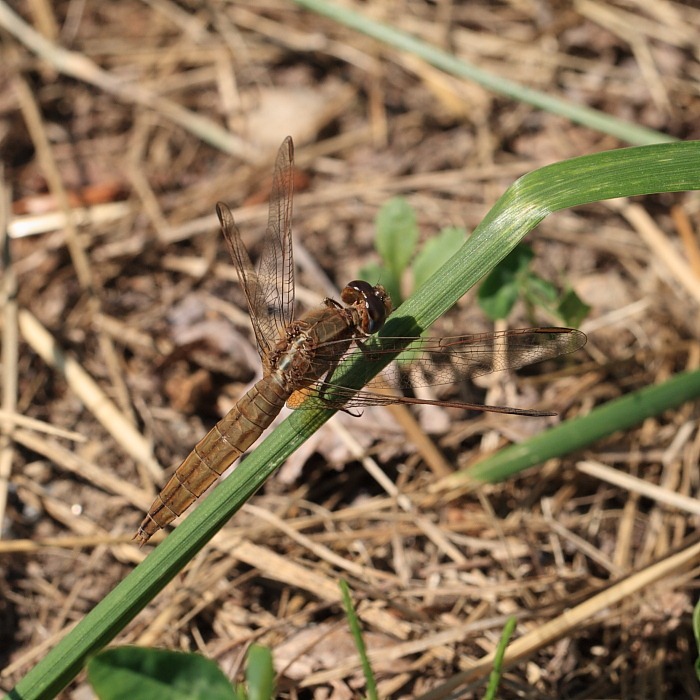
IMG_1342_Mrs_Scarlet_DarterThe dyke is a very sunny spot and therefore very attractive to our sun-loving friends. Today we were once again filling an idle hour or two checking out the action down at the dyke. As well as sun, there was also a very strong wind blowing down the lake and over the dyke so most of the action turned out to be dragonflies, and particularly the poor little weaker-flying damselflies, hanging on very firmly in the teeth of a gale. When the subjects are more reticent to fly, they can be a little easier to approach, though, and Francine, following my guidelines of “photograph it first and grab me second”, snagged this picture of a dragonfly she didn’t recognize. Joy! Just when we might have expected her to be Gone with the Wind, there she was, the long-sought-after Mrs. Scarlet O’Darter. Hardly the flashy, scarlet woman one might have expected but splendid in her apparent scarcity, nonetheless, and only the second I’ve ever seen. I certainly haven’t witnessed the Scarlets’ mating habits yet.

Given that it’s taken two weeks for us to spot a Scarlet Darter female and almost two weeks for a red-veined Darter female, I’m beginning to wonder if there may be some time delay between the male and female emergence schedules. Alternatively, the females may “hang out” somewhere different, approaching the males’ strutting grounds only when they are ready to mate. A third possibility, of course, is that we are blind and simply missed “the Misses”. Curious!

If any reader happens soon to be going on an Odonata spotting trip in the company of a specialist … 😀

Posted in 2010 Spring

Le Barrage de Soulcem

Our Saturday newspaper, Aujourd’hui, predicted une canicule [scorching heat] of a weekend. The little weather maps on the back page showed Bordeaux suffering the full ferocity of our nearby celestial nuclear fusion reactor with temperatures peaking at 39°C/102°F – not bad for Europe. When la chaleur grimpe [the heat climbs], so do Franco and Francine, into the Pyrenees, where an increase in altitude produces an accompanying reduction in temperature.

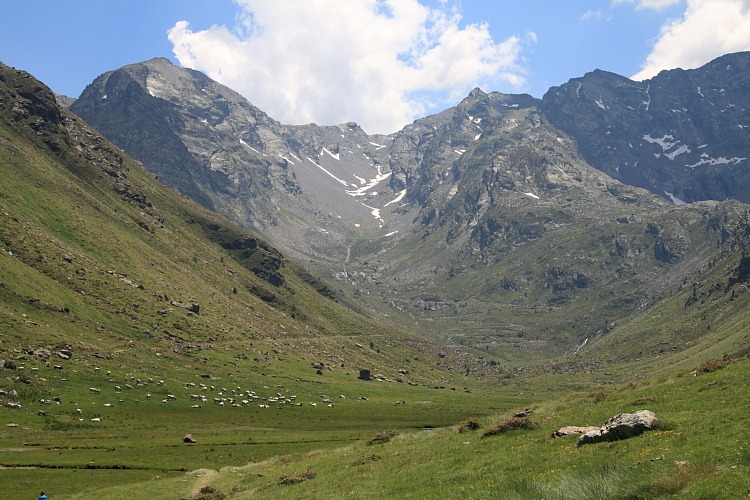
IMG_1281_SoulcemSo far our favourite destination is a high valley containing le barrage de Soulcem, one of almost countless dams in France managing their water supply. Above/behind the dam is a high alpine pasture with a heard of cattle with their bells a-jangling – very atmospheric. For the enthusiastic walker, there are also several challenging walking routes including a GR (Grande Randonnée) route to Andorra. Andorra lies up behind the ridge in this picture. The shot also graphically demonstrates the lack of winter snow that fell in the Pyrenees last winter; the “bowl” in the centre of the shot was full of snow this time last year.

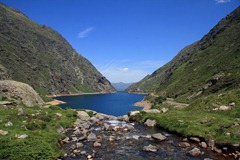
IMG_1248_SoulcemWhen any snows that do fall melt, this is where the water flows to. Also this time last year, we seem to remember that the barrage was pretty darn full of water. This year there is a significant chunk of the dam wall showing above the water line together with a wide “bath tub ring” around the lake with no vegetation. Clearly the lack of winter snow is not helping the effect of of an unusually dry spring. It’s going to take a while to make up the shortfall, methinks.

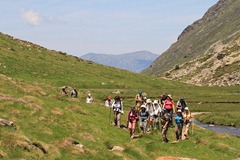
IMG_1285_SoulcemThe farmers and water managers may not enjoy the weather but the tourists certainly do. Naturally, being a Sunday, the place was crawling. Here’s a large group of walkers on part of the GR heading towards Andorra. That may not have been their destination, though, since several other routes branch off beyond this point.

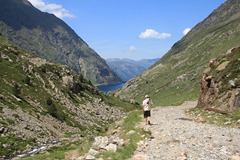
IMG_1288_SoulcemThe area is also a good hunting ground for for those interested in plants and critters. On this occasion, however, for some reason the critters were being most uncooperative and either refused to settle or zoomed off as Franco approached. There are times when I’m envious of the flower fans since their quarry tends not to run or fly away. It can flap about irritatingly in the wind, though.

I returned empty-handed (or should that be empty-compact-flash-carded?).

Technorati Tags: ,,,
Posted in 2011 Spring Tagged with: , , ,