New Walking Group

We had been put in touch with a Monday walking group, a group led by Helen who organizes walking holidays under the banner of Balanced Life Holidays. fancine had made contact and we were both keen to join in but on the day poor Francine needed to seek some medical assistance so our  car was spoken for. However, a friend offered me a lift so I could go and join in.

We met at nearby Parcent at 09:00, when conditions were decidedly cool, before driving up over the Col de Rates and into Tarbena, where the walk was centred. We set off in cool sunshine but the initial ascent up to the first peak, topped by a fort, soon warmed up both legs and lungs.

It soon began to feel good being back out walking again. The last couple of years have been a little troubled vis-a-vis walking, first with myself suffering from an 18-month attack of plantar fasciitis, followed by Francine damaging an Achilles tendon. I now always add a Scholl gel insole to any new shoes or boots and Francine still has to be careful about choosing her footwear. At last, though, we think we’re both up for it again.

The climb was worth it for the views back over Tarbena. Apologies for the crappy phone camera picture …

Tarbena from above

… [note to self: which I really must set back to 16×9, I hate that 4×3 nonsense.]

That first section was a there-and-back job with us descending back into Tarbena via the same route. We then struck out on the opposite side of Tarbena to ascend another small peak with similarly impressive views. I was taken by this sort of buttress-shaped rock formation seen across one of the orchards as we worked our way to the ascent.

Tarbena butress

Along with us, the temperature had now climbed enough for me to discard a fleece in favour of a cover-up shirt. It was, of course, necessary to sit together in a bar enjoying a refreshment. 😉

‘T was an enjoyable walk in a new, friendly company, an experience that I’d be keen to repeat. Hopefully, Francine will be with us next time. I’ll keep my fingers crossed for good conditions next Monday.

Technorati Tags: ,,,
Posted in 2017-2018 Winter

Last of the Few?

On 22nd December, the day after we arrived in Jalón, a search along the local river produce half a dozen or more Darters still active in the warm winter sunshine. Some debate ensued in a Spanish interest group and I’ve finally settled on the decision that these late season fliers are Common Darters (Sympetrum striolatum).

This identification makes sense. The Common Darters are the last on the wing in the UK where they often persist into November and occasionally, if conditions are good, into December. Such was definitely not the case this year.

In 2016 [Xmas 2015 trip] I did find a few individuals flying in Jalón on January 3rd, which was then my latest ever European record. Today, on January 4th and with an afternoon of bright, warm sunshine, I couldn’t resist another look along the local river to see if I could push that date a little further.

The first two spots where I had encountered them before Xmas produced nothing. I continued to draw blanks at the final two spots until, as I had given up and was returning, I spotted a lone male perched and hunting from a sunny stem at the ford where ovipositing had been going on previously.

Here he is. He even posed advantageously. He looked a bit lonely, possibly the last of the few, though there may well have been others that I’d missed. This handsome character now becomes my latest European record.

J18_1722 Sympetrum striolatum 2018

Posted in 2017-2018 Winter

Still Flying in the Marjal

It was a slightly breezy but, having found odos still flying at Jalón shortly after we’d arrived, we thought we’d go and check out one of our favourite haunts, the Marjal de Pego-Oliva. At this time of year, the fun is not so much in the species one finds – there’s really only one likely – but seeing just how long end of the season can be stretched.

We found no signs at our first stopping point, so continued to the main parking area and took to our feet. As we were walking along the initial stretch of the river, which had begun by looking distressingly quiet, one dragonfly zoomed past us only to disappear over the reeds. It looked like a female, brownish, and was in all likelihood a Common Darter (Sympetrum striolatum). It gave us cause to continue, though.

We saw nothing more along the river, but conditions were less than perfect, being very breezy. We struck out into a reeded area – well, bamboo, really – along a boardwalk where conditions were a little more sheltered. Francine spotted something fly but we lost it in the confusion of vegetation. Further around the curved boardwalk conditions improved further and we spotted several dragonflies basking on the warm boards. Bingo!

J17_1698 Sympetrum striolatum male

These were clearly Common Darters which rated as a new species on my list for this location. Happy camper.

Posted in 2017-2018 Winter

Christmas Piggy

One of our first purchases when we arrived in Jalón on Thursday 21st Dec, was the main event for our Christmas dinner. There are several pleasant things about running away from a British Christmas, not the least of which is the much lower key affair that Christmas is in Spain. From a culinary point of view, though, it’s also good to get into a country where more unusual [for us] food items are available. A traditional Christmas dinner in Spain tends to centre around sucking pig. They are available prepared and packed in all the supermarket, both frozen and fresh. Fortunately, since a whole sucking pig would too much for us, even though our friend Jim would be joining us, half sucking pigs, split lengthwise, are also available. We found a suitable looking fresh one with a best before date of 26th December so we didn’t need to freeze it. He was 3kgs and 28€ but, hey, it’s Christmas.

Xmas Piggy beforeChristmas Piggy 2017 was a bit larger than we’d attempted before but fortunately he just about fitted the almost useless oven. [Note to self: if we ever start spending longer here, we should buy a better oven.] I sat him on a bed of vegetables – celery, carrot, parsnip and onion – mainly to keep him off the bottom of the thin roasting pan and stop him burning; they weren’t going to be edible after 2½ hours. Here’s Christmas Piggy wearing some SPF 50 ear covers to stop them burning, too.

20171225_155345Following a random recipe, I also put some water around the vegetables which would “help keep the flesh soft”. It did. I have a feeling that it also kept some of the skin soft, which was a shame. One of the delights of a roast sucking pig is crisp, wafer thin skin. We did have some but I think last year’s attempt sin agua worked better. Anyway, here’s Christmas Piggy after 2½ hours sporting an intense Spanish sun tan.

While Christmas Piggy was relaxing, we demolished blinis topped with cream cheese and a selection of smoked fish: tuna, cod and salmon, all decorated with a little red fake caviar to give them a festive look.

Having next demolished a good chunk of the now relaxed Christmas Piggy, we set about seeing off Francine’s excellent Tiramisini. She first made those last year and they’ve become an instant favourite. Yummy!

Finally, some cheese followed by a brandy or two to settle the stomach.

Un Feliz Navidad. 🙂

Technorati Tags: ,,
Posted in 2017-2018 Winter

Sympetrum conundrum

That’s what I call my little December friend in Jalón: Sympetrum conundrum.

For a few years now, I’ve seen a Darter at a few points on the river that flows through Jalón. The first time I saw it was on 23rd December one year before we had bought Casa Libelule. Since then I’ve seen a red-bodied darter a couple of times in December, once even on 3rd January. Initially, it looked to me most like a Common Darter (Sympetrum striolatum).

After my initial sighting, earlier in the year I’d seen and clearly identified the Desert Darter (Sympetrum sinaiticum). This species looks quite similar to the Common Darter but for a couple of dark markings. I wondered if my suspect might be the Desert Darter somewhat changed, being more advanced in age in December.

Now I’ve seen it again but this time with a different wrinkle – this time I saw a tandem pair ovipositing. I snagged a couple of less than perfect in-flight shots. To me, the male didn’t look quite right for S. striolatum and the female certainly didn’t, being largely grey, Neither looked quite right for S. sinaiticum, either. My so-called brain worked overtime and wondered about the Vagrant Darter (Sympetrum vulgatum), in this case it would have been the Spanish subspecies (S. vulgatum ibericum). There are significant differences between S. v. ibericum and a regular S. vulgatum, in that it’s even more similar to S. striolatum. Very confusing.

Without trapping and examining, particularly the genitalia, differentiation gets quite difficult between some species. After due consideration and consultation with others more knowledgeable than myself, much as I’d like to have snagged a new species, I now think my conundrum is “just” a Common Darter (Sympetrum striolatum).

Enough scientific mumbo-jumbo, here are my Spanish friends still on the wing and ovipositing on 22nd December.

J17_1635  Sympetrum conundrumJ17_1669 Sympetrum conundrum

Posted in 2017-2018 Winter

Traditional Travel

In our modern world one can clamber onto a crammed cigar-tube of a jet aircraft and swap the cool winter clouds of the UK for the relatively warm sunny Mediterranean skies of the Costa Brava in a little over two hours. The process is so quick, even allowing for the now slow immigration process thanks to the invention of infernally inefficient automated passport reading machines, that one would hardly know one had changed countries.

Travelling in a slow and leisurely fashion makes for an entirely different psychological experience. In the days of Jules Verne and Around the World in 80 Days, travel required effort and took so long on slower forms of transport that one knew one was in a very different country. Our journey to Spain this time, running away from what would hopefully be the worst of the British winter, provided us with a flavour of that older world.

We’ve travelled on the ferry from Portsmouth to northern Spain before, always to Bilbao. This time our booking had us entering Spain through Santander instead. The timings of our sea crossing made us do things a little differently.

Our ferry departed Portsmouth at 08:45 on Tuesday 19th December. Checking in at 07:00, we could, technically, have awoken early on Tuesday, left home at about 04:30 and been fine. However, relying on British December weather not to intervene and make us miss that ferry was a little too risky so we chose to travel down to Portsmouth on the afternoon of Monday 18th, staying in a handy-dandy Travelodge just two miles from the port. Heck, I even treated Francine to a meal in the adjacent Toby Carvery on Monday evening. Do I know how to spoil a woman or what?

Other than scraping the frost off the car’s windows, Tuesday morning’s departure was a relaxing, unhurried affair. We checked in, moved from one queue [line, for the benefit of Amerispeakers] to another and eventually boarded Brittany Ferries Baie de Seine. The Baie de Seine is not a fast ferry, taking 28½ hours to reach Santander. [More modern bateaux do it in 24 hours.] One can do an awful lot of Sudoku puzzles on such a journey. Such a journey may be verging on the tedious but it is relaxing, especially being able to retreat from Joe Public to the privacy of ones cabin. We docked in Santander at 14:15 on Wednesday 20th December.

The boats on this route are not modern RORO [roll-on-roll-off] ferries. Unloading them takes a while. from docking to exiting the port, one needs to allow an hour. We were almost the last vehicle out. We hit the road at 15:00 on Wednesday 20th.

In the past, arriving at Bilbao at a similar time, we’ve driven straight through to Jalón, a journey of about eight hours. Santander, however, is an hour further west so we’d have been getting to Jalón at midnight had we done it in one hit, mostly in the dark. Instead we chose to drive for about three hours and overnight in a very nice Parador hotel at Calahorra in the Rioja wine region. We arrived at 18:00 just as the sun was dipping beneath the horizon – perfect timing.

Parador hotels are great and Calahorra proved an interesting town to wander around before dining in the hotel. We found a delightfully bustling bar (what am I saying?) that sold us glasses of perfectly drinkable red wine for 90¢ each, and that included a tapa of bread and Manchego cheese. Barking!

We left Calahorra on Thursday 21st and drove the remaining five hours to Jalon, crossing the 1000m plateau before descending to sea level just above Valencia on the Mediterranean coast, then the final hour down south to Jalón. We’d done the whole day’s drive under crystal clear blue skies, unsullied by a single cloud, until 50kms from our final destination when the grey stuff reared its ugly head. We couldn’t believe it. Bugger! No matter, as it turned out the skies did largely clear again as we finally headed up towards Casa Libelule in Jalón. We were here by 14:30 on Thursday in time to do some shopping for the evening meal, after leaving our UK home on Monday afternoon.

Essentially we’d taken four days to get here. This was more like travel of old. It felt good, relaxing and entertaining. Well, maybe not the 28½ hours on the ferry. Thank Darwin for Sudoku. 😀

Posted in 2017-2018 Winter

Farewell Busby

This morning we bade farewell to Busby, our Mercedes Sprinter 313 CDI campervan/bus. Busby was easy to drive and has served us faithfully without missing a beat – he has taken every opportunity to beat my head. 😀 Busby took a bit of getting used to but we did it, learning how to live with a campervan rather than loving it. A campervan will never replace our beloved caravan, Guillaume. A campervan does, however, enable a different sort of trip – this sort of trip.

On our 4-week journey around New Zealand, one week on North Island and three weeks on South Island, Busby has covered 4930kms/3080mls. We’d estimated 3000mls in our costings when planning for our trip – pretty damn close.

We now face an 11½-hour flight from Christchurch to Hong Kong followed by a 13-hour flight back from Hong Kong to the UK, all on Cathay Pacific. The seats will be bigger than Busby’s but I doubt I’ll sleep. We’ll see.

It’s been one hell of an experience.

Technorati Tags: ,
Posted in 2017 New Zealand, 2017 The Antipodes

Quake City

Our Christchurch campsite offers a few suggestions under the heading of, “what on earth shall we do today”. One of the suggestions is to visit “Museum – Quake City”. Well, for our last day in New Zealand, we skipped the museum but we did visit Quake City. We hopped on a Blue Line bus just outside the campsite. For NZ$8.00 each, it took us into Christchurch with no worries about parking Busby – we could leave him pressing the camp cat. We disembarked at the central bus interchange (i.e. bus station) which was well positioned for the sites that Francine had in mind.

_17C0283Any disaster is moving. Loss of life in the face of the forces of mother nature show our vulnerabilities; just how fragile we are. The centre of Christchurch, still suffering from the effects of the 2011 quake, is certainly a moving sight. The pattern of damage looks difficult to explain. Some old buildings that might have been expected to be damaged remain apparently unaffected. Whereas St. Paul’s Cathedral in London miraculously survived Hitler’s onslaught in 1940, Christchurch’s cathedral did not survive the 2011 earthquake. The open-ended skeleton remains.

_17C0264With an unusable original cathedral, the good people of Christchurch erected a “Transitional Cathedral” which has been tagged the Cardboard Cathedral. Visiting on a Sunday, a service was in progress so we couldn’t have a good squint but certainly some of the supporting structure of this modern piece of architecture was huge cardboard tubes. The external structure appears to be corrugated, translucent plastic with aluminium angle-sections at the edges. The shape is like an A-frame with different perspective triangles at either end. It’s simple, clean and elegant. I loved it, even as a confirmed atheist/anti-religionist, and admired the resolution of the inhabitants of Christchurch.

_17C0267Opposite the sharp end of the cardboard cathedral is what I suppose would be classed as an artwork, an artwork of 185 all-white chairs, each one symbolising a life that was lost in the quake. I presume the actual chairs chosen have some significance since one is a baby’s car seat and another is a wheelchair. They face the cardboard cathedral, almost like an audience awaiting a divine performance.

115 of the 185 lives lost were in the CTV, Canterbury Television, building, which collapsed leaving only the lift shaft standing and caught fire.

Six years on, several of the city blocks still remain empty awaiting, I presume, redevelopment, a testament to the devastation caused. The CTV site will not be redeveloped but is to be left as a memorial.

After an overdose of emotional content, we did wander around the Christchurch Botanic Garden before ending our visit on a brighter note in a bar serving Francine with a so-called sangria, a sangria with included both brandy and Cointreau. I’m pretty sure the Spanish wouldn’t put Cointreau into a sangria, though we’ve never actually had one. We’d better fix that oversight on our next visit to Spain which will be over Christmas and New Year.

Posted in 2017 New Zealand, 2017 The Antipodes

Levelling Ramp

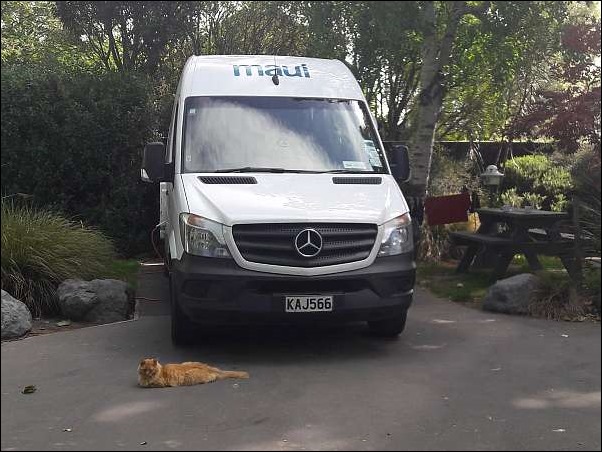
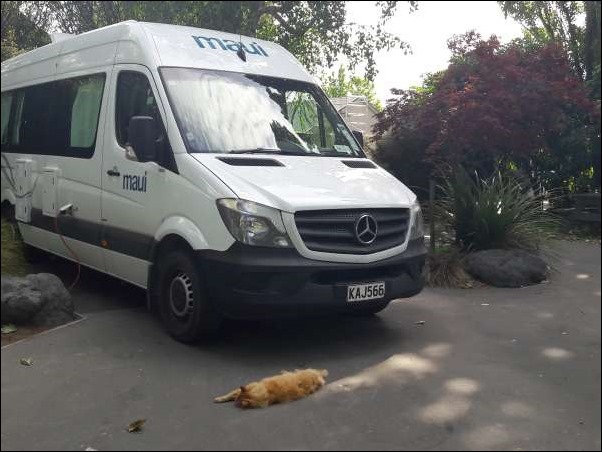
It seems that Busby may not have been quite as level as I had imagined, so the camp cat came into its own after all.

Here’s the camp cat positioned in preparation for levelling Busby.

Cat before

And here’s the camp cat after levelling Busby.

Cat after

Job done.

[No animals were harmed in the production of this post.]

Technorati Tags: ,,
Posted in 2017 New Zealand, 2017 The Antipodes

The Final Furlong

Today would be a conservative 160kms from Hanmer Springs to Christchurch. Apart from a 10-minute drive to hand Busby back to Maui on Monday, that’d be it.

We’d spent a relatively sloping night in Busby which leads me to comment on another feature of New Zealand camping. In Europe, certainly Britain, it is usual to use levelling ramps when pitching ones unit on sloping ground. Caravans need just one, to level from side to side because the nose jockey wheel levels adjusts up and down to level them lengthwise. Campervans generally carry two levelling ramps to be able to level in two axes. Until two days ago, after 3½ weeks of camping in New Zealand, I had not seen a single levelling ramp in use. We did see a pair, being used by a private camper van at the DOC site at Marble Hill. I was really quite amazed; the ground was frequently not level. Why does one need to be level? Well, doors swing on hinges downhill, sleeping in a sloping bed can be a challenge (or enjoyable, depending on the company), and cooking when all the oil flows to one edge of the frying pan is real pain in the kitchen. Why don’t they bother here? It beats me.

We began with two relaxing cappuccini [just showing off] in Hanmer Springs. Francine’s brother had reported that Hanmer Springs was “tired looking”. Not so, I’ve rarely seen anywhere less tired looking. I do find the letter grouping difficult, though: Hamner Springs would roll off the tongue better than Hanmer – N followed by M does not seem natural.

Before beginning our journey proper, we indulged in a 2km/1hr walk through Hanmer Heritage Forest which we completed in 30-minutes. Well, how can you make 2kms take 60 minutes? Maybe if we’d found any orchids for Francine to point her camera at but regrettably we didn’t.


_17C0253_17C0256Finally underway, we were heading for Christchurch – scary spiders, a big city. After a supermarket stop in Amberley, we followed a brown sign declaring “Scenic Inland Route”, to avoid the busy main road. “The Scenic Inland Route” turned out to be mostly straight, dull and decidedly un-scenic. It was, however, inland. By going inland it led us first to a picnic spot for lunch followed by a spectacle neither of us had ever before witnessed, a game of polo at Rangiora. How the rich live. We watched the poor old polo ponies, tails bound so they couldn’t swish away flies, being put through their paces before hitting the road again.

For the second time on our travels, we ended up on a road unknown to Kiwi Satnav; it was a motorway skirting Christchurch. Kiwi’s plot line went dotted, never a good sign, as our new route went off piste. As we approached known roads passing beneath us, with no exit in sight, Kiwi Satnav excitedly instructed us to “turn lift” [left, you may remember, for those with no Kiwi accent]. “I can’t bloody turn lift”, I thought. “Nor can I turn left, right or around.” The short motorway which, I suspect, may be New Zealand’s only motorway, dumped us near the airport. It was also near a second wetland reserve that we wanted to visit so, as they say over here, it was “all good”.

The wetland was OK but, as expected, we saw nothing new, just the standard two damselflies and a dragonfly which refused too be caught on pixels but which I suspect was the local Aeshna. As an odonata enthusiast, I could never live in New Zealand with so few species to observe. That’s true for wildlife in general here, really; there’s a paucity of it and most of what one does see is European and imported. It’s a country for scenery and, as such, has few equals, I think.

This last stop was within spitting distance of our campsite. We’ve checked into the Top 10 site at Christchurch and, perhaps because we’re here for two nights, we have a relatively spacious pitch with spikey plants between us and the neighbouring units. Reviews complaining about being able to shake hands across the minimal gaps had made me dread it. Where we are is actually fine and I breathed a sigh of relief. Also the pitch is level, otherwise, in the absence of any levelling ramps, I’d have to drive one wheel onto the camp cat to get Busby horizontal; it’s a fat cat and should provide considerable flexibility. If minor adjustment is needed, there is a second, thinner cat that might come in handy under another wheel.
Posted in 2017 New Zealand, 2017 The Antipodes