Agoraphobic Sheep

Our very amicable hosts, Luc and Nadine, run a dairy sheep farm. They have a troupeau [flock] of about 300 ewes whose milk is used for the production of Roquefort cheese. The farm land is used to grow food, largely Lucerne, and bedding material in the form of straw from Wheat. For much of year the sheep remain inside their bergerie [sheepfold] consuming the Lucerne and using up the straw.

P1010280_Agoraphobic_sheep In the summer months when there are a few fields with fresh grass to be eaten, Luc kicks his troupeau out of the bergerie into the fresh air. I say “kicks” because the sheep don’t seem very keen on the idea. They appear to prefer the apparent comfort and, maybe, the safety of their bergerie. This was ably demonstrated when we paused on our way out of the farm to snap a picture of them on the hillside. As Francine approached with her snappy camera, she stood by the gate into and, more importantly out of, the field. You could almost see the sheep thinking, “hooray, someone’s come to take us back to our bergerie” (in French, of course), as they excitedly began flocking towards the gate and Francine.

They looked quite disappointed when we left them there. Cute, in an agricultural kind of way. 🙂

Technorati Tags: ,,
Posted in 2011 Spring Tagged with: , ,

La Prise Reprise

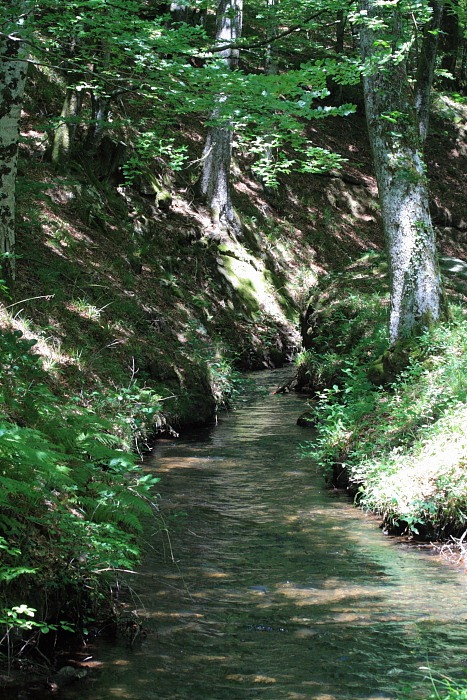
IMG_1027_La_Rigole About 32kms/20mls north of us in the Montagnes Noires is la prise d’eau d’Alzeau, literally the place where water is captured from the river Alzeau. It is the beginning of La Rigole. We’re familiar with the word rigole from the Marais Poitevin; un rigole refers to one of five sizes of waterway in the marsh. I think in the marsh un rigole is one of the larger canals. La Rigole, however, is specifically the small canal, between 2-3m/6-10ft wide, which was built to feed water into that great French engineering project, the canal du Midi. La prise itself is not especially spectacular, being a relatively modest sluice gate controlling the diverting of water from the river Alzeau into La Rigole, but the entire concept is intriguing. Building a canal of about 60kms/40mls through uneven countryside but with an even gradient calculated to deliver water at a gently flowing rate into the high point of the canal du Midi seems pretty clever to me.

We’d visited la prise on a previous trip and, being up in the mountains, found it to be a refreshing place to visit when life in the valley starts getting a little hot and humid. We knew of a shaded picnic spot beside a stone bridge with a handy, wooded, 3km/2ml footpath beside La Rigole up to la prise itself to walk off lunch. With wild flowers, demoiselles flitting in sunny glades, and assorted other dragonflies and butterflies en route, what more could we nature-lovers want? Not a lot so, on one of our not-so-many-so-far hotter days, armed with a baguette and some rilletes d’oie (potted goose), off we set once again to see what we could find.

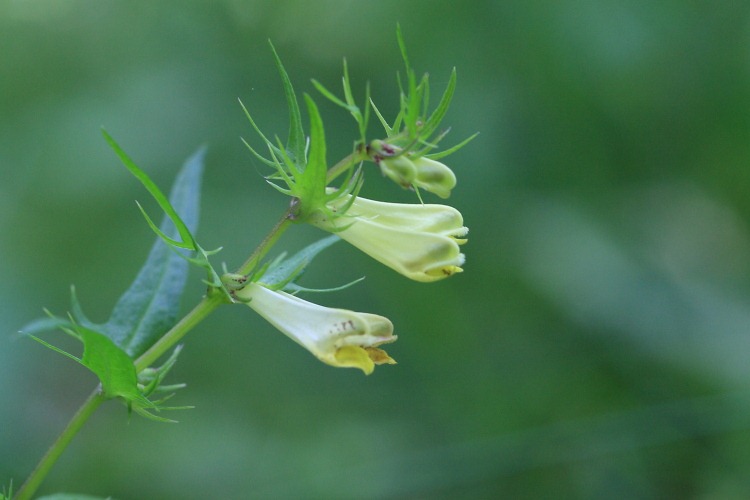
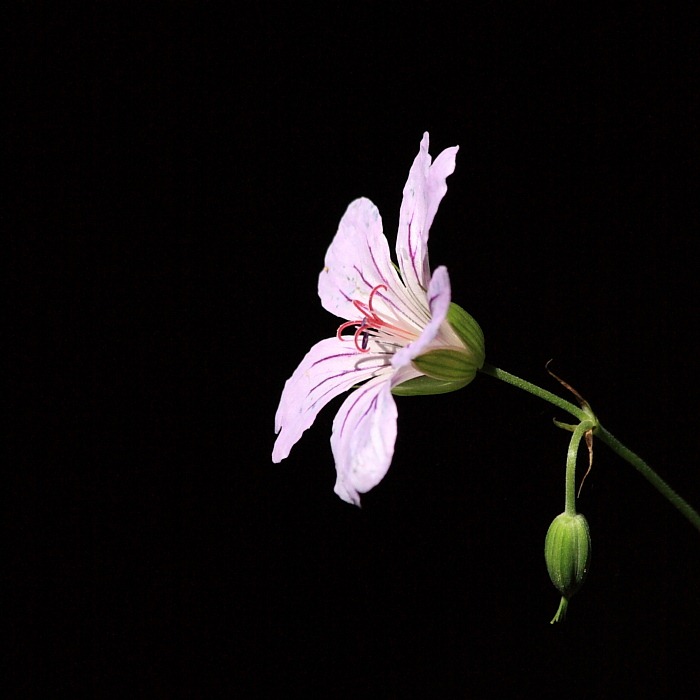
Blissful solitude, we shared the picnic area only with a few Beautiful Demoiselles and the occasional passing butterfly. After a most agreeable lunch, we sauntered up to la prise and back. “Up” takes about 2½ hours with frequent stops to exercise our cameras’ shutters, “back” takes about 30 minutes. Here are some of Francine’s results from exercising her camera’s shutter. 🙂

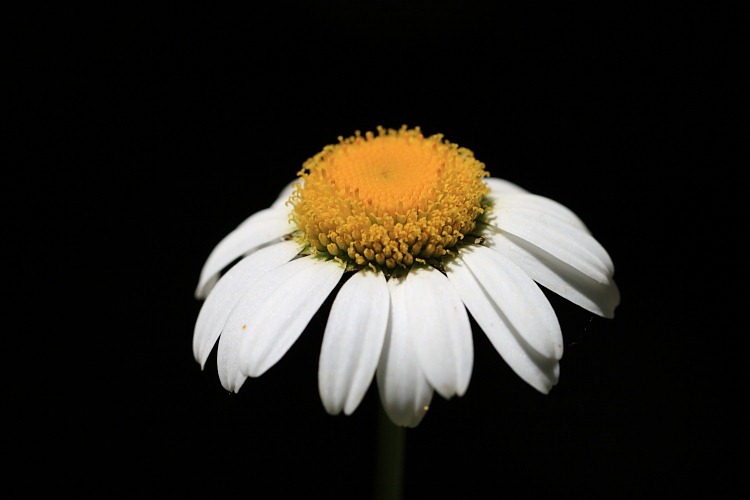
IMG_1013_Common_Cow-wheat IMG_1014_Large_Self-heal IMG_1031_Unknown_Cranesbill IMG_1040_Bladder_Campion_maybe IMG_1042_Ox-eye_Daisy

Posted in 2011 Spring Tagged with: , , , , ,

Pêches Plats

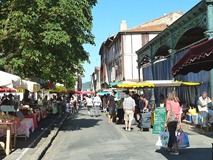
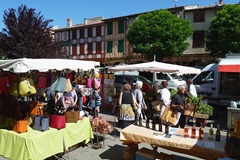
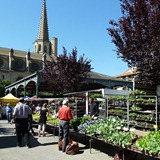
Mirepoix lies 18kms/11mls south of Fanjeaux where we are currently enjoying a very mixed bag of southern French weather. Mercifully, on market day (Monday) the weather was fine and hot. In addition to most French street markets being colourful affairs, Mirepoix is itself very colourful with many timbered 13th century buildings and cloisters. This makes it both a fascinating and, of course, a very popular destination. In early June, before the main tourist season, visiting on market day is quite enjoyable but in July and August we’re told it’s best avoided.

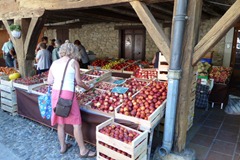
P1010282Mirepoix_market P1010289Mirepoix_market P1010290_Mirepoix_marketIn three different formats for a little variety, here’s a few pictures which will hopefully convey a little of the atmosphere and flavour of Mirepoix and its market. A couple of the pictures show some of the old metal market halle in and around which much of the modern market clusters. The spire of the Cathédrale de St. Maurice towers above the lot.

P1010286_Mirepoix_marketP1010300_Peche_plat We wanted to visit Mirepoix market on this occasion for two specific purchases: a field guide to mountain wild flowers, to help Francine identify vegetation she found in the Pyrenees, and some pêches plats [flat peaches]. Francine had spotted les pêches plats on previous occasions but had avoided them thinking that they might be all stone and little fruit. However, having spotted a local making off with several kilos of the things at Bram market recently, she thought, “they must be fine, we’ll try some”. [Ed: this is actually unsound logic – I’ve tried a pied pané, a breaded pig’s trotter, and all I could find edible were the breadcrumbs.] Not only did the pêches plats have very small stones but their flavour was wonderful, a little more perfumed than regular peaches. The season is short and we wanted some more while they were available. Here’s Francine raiding one of the many fruit stalls, carefully selected as having French rather than Spanish pêches plats.

Technorati Tags: ,,,
Posted in 2011 Spring Tagged with: , , ,

Pyrenean Picnic

Mountains make a useful escape from days which may be getting hot and sticky in the valleys but you have to pick the right day. The valley may be hot and humid but mountains tend to attract weather and if they have their heads in the clouds, stay away. Fortunately, from our hospitable sheep farm, we can see the Pyrenees so we’re able to tell when the time is right. Today looked good.

On our last visit we fell in love with the high mountain scenery of the plateau de Soulcem and its barrage [dam]. Today we thought we’d investigate a different high valley so Francine scanned the map and found a likely suspect. An hour’s drive got us to Tarascon-sur-Ariège and we began the 25-minute climb up towards the barrage de Riete. It wasn’t a long journey up but progress is necessarily low, the mountain valley roads being mostly single track and very sinuous. There are occasional places to pass but they seem few and far between, especially when one is nervous about opposing traffic. I was praying that I didn’t meet another vehicle coming down when we came across a car stopped beside the road (in one of the rare passing places, of course) with a horse box attached. Clearly I was more nervous than the locals.

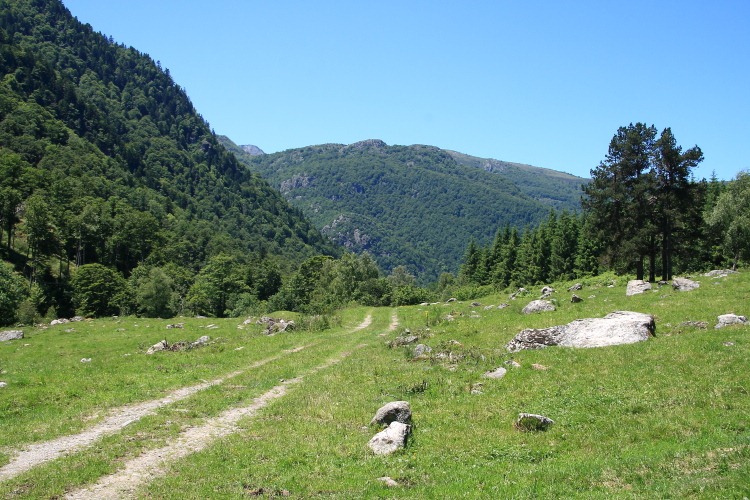
IMG_0994_PyreneesHaving passed very few folks other than those with the rather unexpected of horse box, we eventually began seeing cars abandoned with flair near people indulging in the classic French pique-nique. Such indications are useful in letting one know when one has arrived somewhere worthwhile. We found a spare grassy plateau beside the tumbling mountain stream that runs down the centre of every such valley, below the ever present French barrage of course, and set about lunch.

This valley was pleasant enough but didn’t seem to us to have the majesty and grandeur of the more popular Soulcem valley. In such weather, though, the Pyrenees are utterly magnificent and it’s easy to become blasé about the scenery. It was really beautiful and provided Francine with some plant photo-opportunities some of which are causing an identification conundrum; she’s keen on a specialist book to help her decipher what she’s seen. Any excuse to spend money and expand the library. 😉

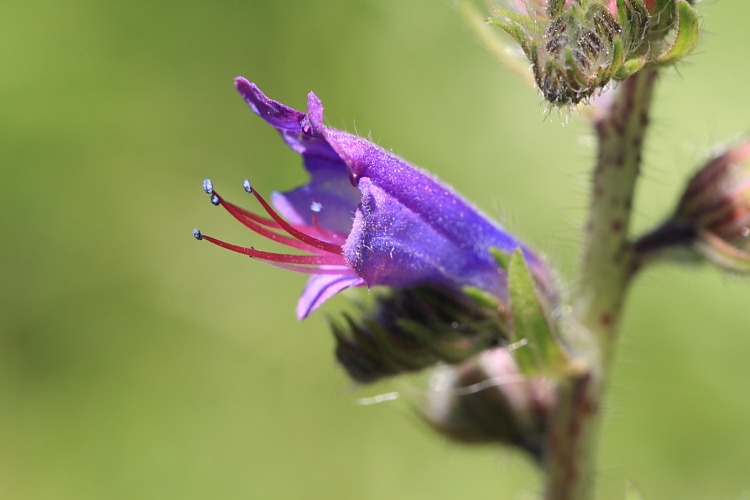
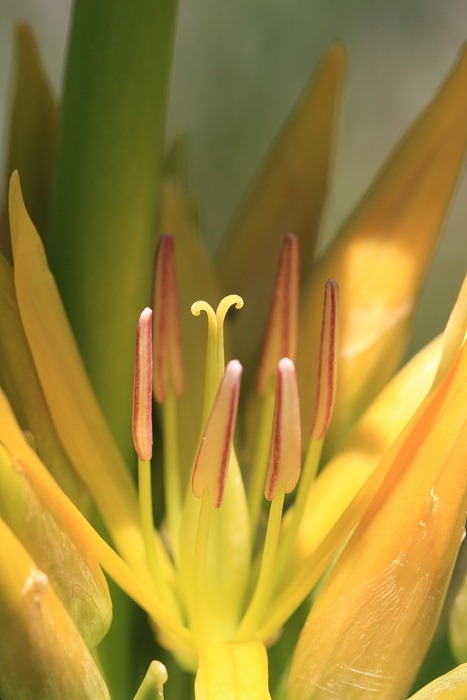
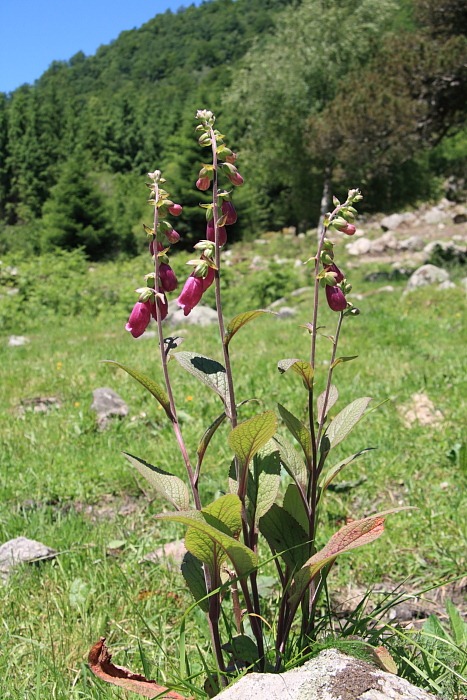
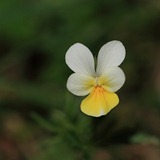
IMG_0975_Pyrenean_plant IMG_0980_Pyrenean_plant IMG_0997_Foxglove IMG_1003_Field_Pansy On the left are a couple of familiar suspects, a Foxglove (Digitalis purpurea) and a Field Pansy (Viola arvensis) looking painfully cute. On the right are a couple of Francine’s more artistic shots (as opposed to identification shots) of suspects that are awaiting her hoped-for specialist field guide.

As we began our return journey back down to the valley floor, I fell in behind another car also heading downwards. I formulated the theory that, if you headed up in the morning, everyone else would also be heading up and you’d be unlikely to meet a vehicle travelling in the opposite direction. Similarly, if you headed down in the afternoon, all the other travellers would also be heading down after their picnic. Just then, a car squeezed past both of us heading up towards the barrage. Bang goes another theory!

Posted in 2011 Spring Tagged with: , , , , ,

Manual Dexterity

Many years ago we visited an area of France called La Brenne which is noted for its breeding population of Purple Herons. Still using the excellent but very slow (50 ASA) Fuji Velvia film in those days, and not having enough lens, though we saw Purple Herons I failed to capture a decent picture of one. The trip also preceded my interest in dragonflies though I did get a rather poor picture of a dragonfly which I recently suspected to be a White-tailed Skimmer (Orthetrum albistylum). The White-tailed Skimmer doesn’t occur at home and is difficult to distinguish from the Black-tailed Skimmer (Orthetrum cancellatum) so, this trip, I’ve been keeping a close watch on all suspects in the hope of securing a decent photograph to replace my earlier poor effort.

Whilst I quite like my camera, there are situations in which I find it frustratingly annoying. Its most irritating behaviour is when the autofocus logic steadfastly refuses to focus on an admittedly very narrow subject such as a damselfly. Even though the damselfly is closer, it frequently insists on focussing on the background instead. It just doesn’t seem to “see” something as thin as a damselfly. It serves as regular reminder of a comment I once heard made by Andy Rouse, a professional wildlife photographer now using Nikon equipment, that “even a Canon could focus on that”. Interesting!

Its other frustrating feature is the manual exposure exposure setting which, other than for flash shots, I never use. Naturally, any decent camera would include a manual exposure facility but what’s frustrating about it is that I seem to manage inadvertently to set my camera to manual exposure mode on occasion. I can only imagine that it happens when putting the camera away or taking it out of its rucksack. User error!

IMG_0168_Overexposure Whilst at Figeac, I was tracking a suspect which did, indeed, turn out to be a White-tailed Skimmer. After cruising up and down the bank for a while it finally settled on some grass causing Franco to leap hastily into action and fire off two quick shots before it once again took to the wing. I was thrilled – my long-awaited decent shot of a White-tailed Skimmer. My delight was short lived as I noticed the camera had been set on manual exposure and the image was hopelessly overexposed. I’ve got to show you this un-doctored version to give you a laugh. It could be somewhat recovered by post-processing but would never be great with the burned-out areas. I was livid!

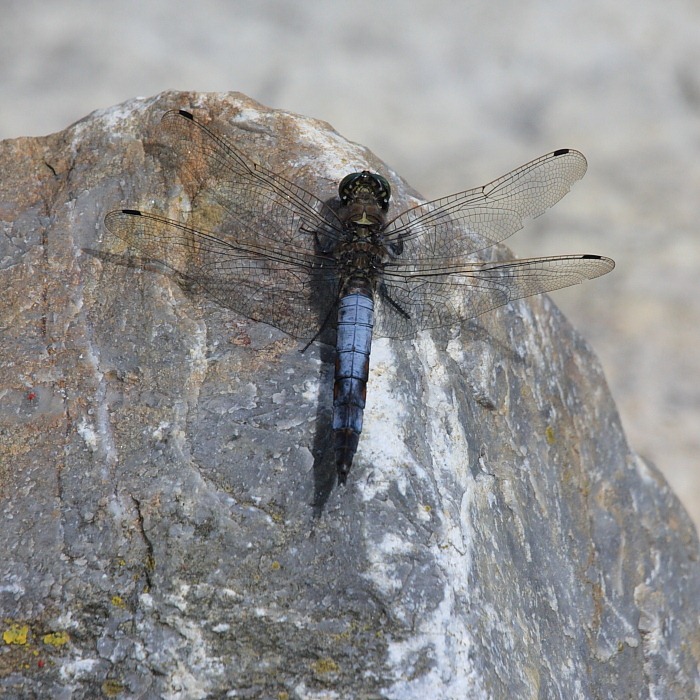
IMG_0389_White-tailed_Skimmer Mercifully fortune offered me a second chance recently. We were just about to pack in and go shopping when I spotted another suspect zooming back and forth along a lake shore. I knew what to look for now and was pretty sure it was a White-tailed Skimmer. It settled on a rock. I checked the camera  [Ed: novel idea, Franco!]. It remained settled and I clicked off a few shots. I checked the image and all looked good. Relief!

IMG_0233_Black-tailed_Skimmer_2 For those keen on puzzles and just for a bit of fun, here’s another recent picture of a very similar Black-tailed Skimmer also sitting on a rock, though at a different angle. In an exam, this could form the basis of one of those “compare and contrast” type questions, couldn’t it?

Posted in 2011 Spring Tagged with: , , , , ,

Damsels in Distress

In an attempt to avoid our local breezy, cool, overcast weather this morning, we went to investigate a new-to-us stretch of La Rigole, the cleverly constructed small canal that feeds the Canal du Midi with water from les Montagnes Noires. We’ve been Odonata hunting in its upper reaches but the valley looked like the best possibility for an improvement in conditions today. We arrived at a small man-made lake constructed in a bend in La Rigole. During the time it had taken us to make our circuitous way there, the skies had largely cleared and the sun was out. So were the damselflies and dragonflies.

IMG_0377_Copulation_wheels In more southerly latitudes, it’s always worth looking more closely at blue-coloured damselflies since there are several species that look superficially similar but which might be subtly different and add to one’s photographic collection. Francine wandered off to retrieve a different lens as I dutifully began watching a small collection of blues flitting about a couple (literally) of plant stems protruding from the water. Since the main activity of damselflies when the sun is shining is sex, occasional tandem pairs of damsels arrived and alighted on the stems to form their copulation wheel.

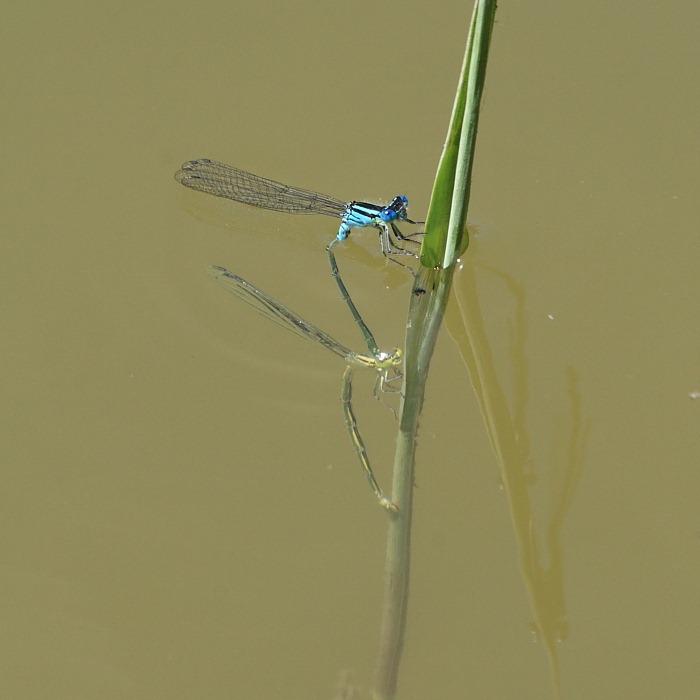
IMG_0356_Ovipositing_White-legs After the copulation wheel, it’s time for a spot of ovipositing in the water. This pair of White-tailed damselflies (Platycnemis pennipes) very kindly demonstrated the most usually seen type of damselfly ovipositing behaviour: using vegetation as support, the male guards the female as she dips her abdomen beneath the surface to lay eggs. I know that, in some species, the female becomes almost submerged as she oviposits.

IMG_0940_Drowning_damsels Almost! I watched a pair of damselflies alight on one of the plant stems and begin shuffling downwards until only the female’s head and thorax remained above the surface. So far so good. I continued watching in something approaching disbelief as the male released his hold on the female and she continued shuffling down the stem until she was completely submerged. Being completely gobsmacked took over as I watched her continue down the stem until she was out of sight in relatively clear water. By now Francine had returned and was watching with equal fascination as other pairs, all the same species, repeated this sequence, so it obviously was not an aberration. Francine had a good angle and grabbed this very clear shot including a completely submerged female.

The species involved in this submerging behaviour is the Goblet-marked Damselfly (Erythromma lindenii). These are the ones in the synchronized copulation wheels, above. We didn’t witness the resurfacing of any of the submerged females. Since my field guide makes no mention of this, I’ll have to try to do some research to see what I can find out about the life-cycle of the Goblet-marked Damselfly and see if this is a terminal act in an all-too-brief adult existence.

Posted in 2011 Spring Tagged with: , , , , ,

Express Delivery

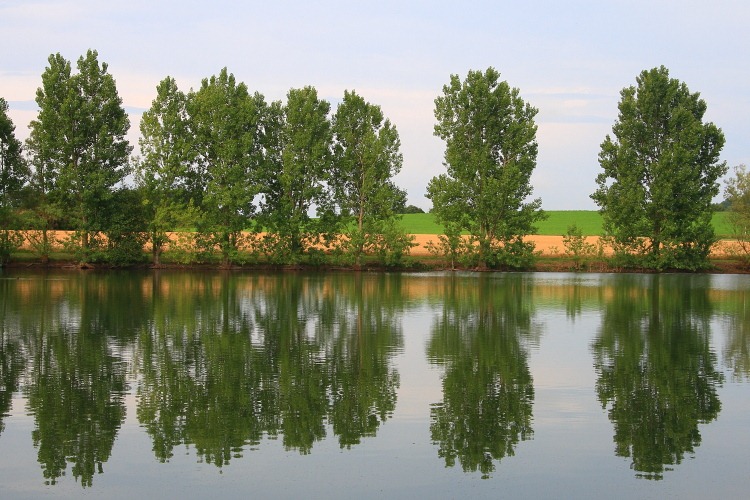
IMG_0876_Lakeside_pitch We are not normally given to reserving pitches on campsites in France. In fact, in close to 30 years, we simply hadn’t ever done so. That was largely because we never really knew where we would end up or when. Since falling in love with one particular site at Fanjeaux a few years ago, though, we’ve tended to know that we’d end up there for the last part of our trip. Since they have just four ridiculously good lakeside pitches, this year we decided to reserve one ahead of time from 12th June. A view like this from Guillaume’s windows may help to explain why.

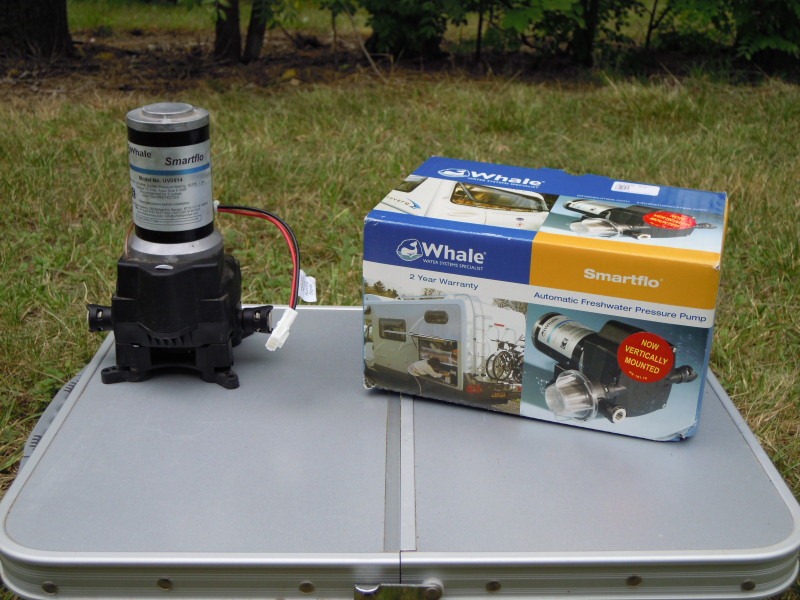
Our rare advanced knowledge came in handy when, on the first night of our trip, Guillaume’s incontinence reared its ugly head once again. After some debate, since we knew a future address to which they could ship spares, we opted to contact the Caravan Club’s Red Pennant service which located a replacement Whale Smartflo UV0814 water pump for us. The pump was dispatched on 31st May. We warned our future hosts to expect it and they offered to email us when it arrived.

So, two things were supposed to arrive at Fanjeaux on or before 12th June: us and the pump. On Friday 10th June, Nadine sent us the long-awaited email saying the pump had finally been delivered. I breathed a sigh of relief and immediately felt more relaxed about our holiday. Assuming I had correctly diagnosed Guillaume’s problem, my only remaining puzzle should be fitting the darn thing.

Having finished our stay around Albi and Castres, we completed the short (60 mls/85 kms) hop to Fanjeaux on Sunday morning to be warmly welcomed by Luc and Nadine. Our welcome included cups of coffee and a hefty package across which was stamped in large letters, “Express Delivery”. Admittedly, the 10 days said package had taken to arrive included a 4-day weekend in France (Ascension) but I didn’t regard the remaining six days as particularly express. However, it was here.

We completed Guillaume’s installation on Sunday, renewed our acquaintance with some other Fanjeaux addicts, and, on Monday morning before the temperature rose too much, I set about removing the old leaky pump and installing its replacement. No matter what one has in one’s toolkit from previous repairs, one never has everything needed for the latest little difficulty. I discovered that the existing electrical connector was not reusable. Fortunately, even though it was yet another public holiday (Pentecost), the local supermarché was open and I found what I needed to complete the installation.

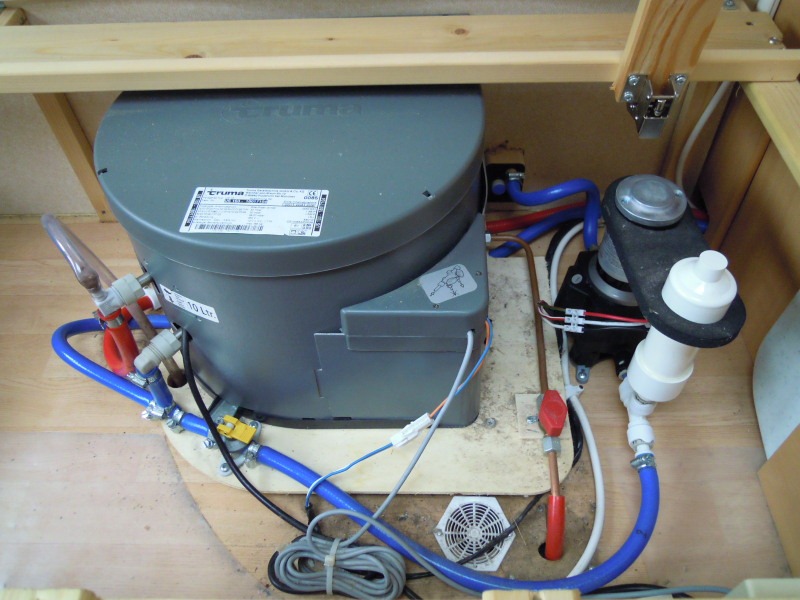
DSCN0033_Water_Pump DSCN0034_Water_Pump Just for added interest, in order to access one of the four screws that fix the pump in place, I had to remove the bed/seat support slats but eventually the plumbing joints were broken and remade, the electrical connector was cut off and replaced, and it was time for the heart-in-mouth big test. Fill the water container, switch on the pump and open a tap. The pump burst into life and Guillaume appeared to have a water system again. Furthermore, after waiting a decent length of time to spot any potential leaks, Guillaume appeared to remain dry and continent. Here’s the old ripped-out pump and the new replacement in situ to the right of that large, grey thing which is the hot water tank.

I never thought I’d say this but it’s wonderful to be able to do the washing-up again!

Technorati Tags: ,
Posted in 2011 Spring Tagged with: ,

Castres and Lautrec

Now we come to the second reason why we chose to stop for a few days at Réalmont. The first was Albi, about 20kms/12mls to the north. The second is Castres, lying a similar distance to the south. The weather has been a little unsettled since we arrived but today, Saturday, looked more promising and it’s market day in Castres.

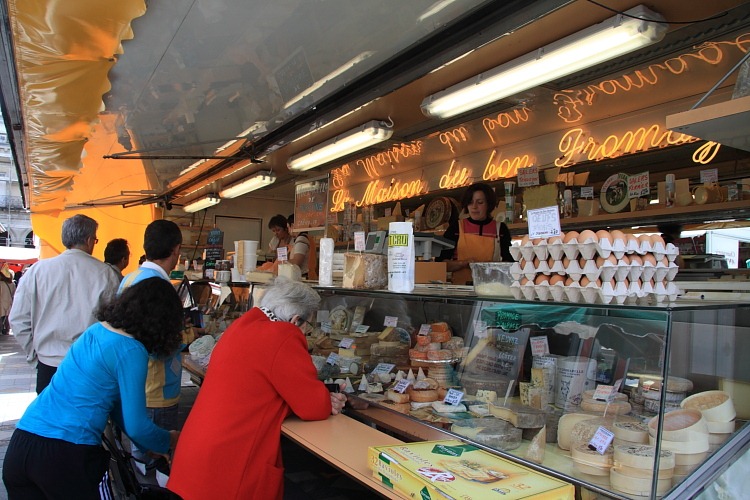
IMG_0763_Castres_market IMG_0768_Castres_marketFollowing a now familiar pattern, Castres is known for two things. Hoorah! I confess that’s a personal opinion rather than something I read somewhere. The first and the reason we were happy to visit Castres on a Saturday morning, is its market. We’ve been relatively impoverished thus far, market-wise, and it was good to get a second dose of France’s wonderful street market culture. A little sun, some colourful market stall umbrellas and some colourful locals are a good start point but markets are notoriously difficult to photograph. All too often, the picture is full of shoppers rather than of the market itself. We quite like these two, especially the lady leaning on the cheese stall counter seemingly staring longingly at the wares. As a confirmed cheese-aholic, I know exactly how she might feel.

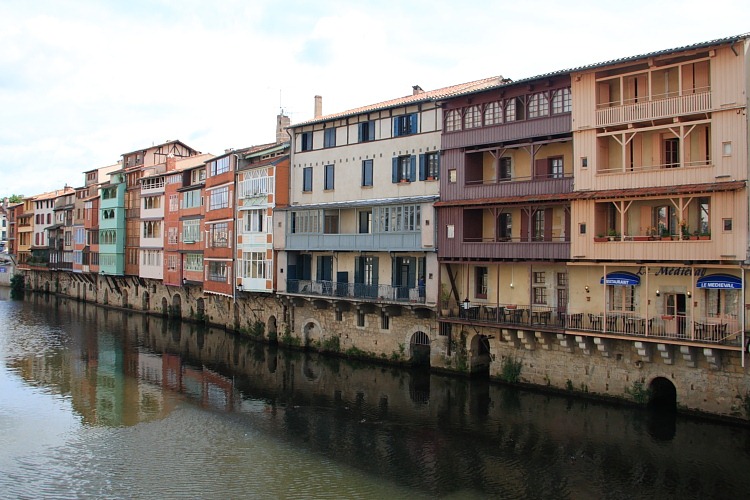
IMG_0754_Castres_waterfrontThe other notable part of Castres, as depicted on many postcards, is a rather colourful stretch of buildings fronting the river Agout which flows through the centre. Clearly the tourist office didn’t plan Castres very well since, to get the best out of it, you need to visit in the morning for the market but later in the afternoon to get the sun on the buildings, which face north-west. We didn’t. Still, albeit contre-jour, here’s a shot to give you the idea.

IMG_0791_Lautrec_millBetween Réalmont and Castres lies the old village of Lautrec, presumably the one of Henri Marie Raymond de Toulouse-Lautrec-Monfa fame. Breaking with tradition, Lautrec appears to be known largely for an intriguing windmill. The fascinating feature of this, IMHO, is the way in which the sails are adjusted according to the wind strength. Each sail has two sheets of material supported on wooden vanes. The sheets seem to be manually twisted to reduce the surface area, then tied off onto the vanes when the miller judges that he’s got it right. Simples!!

Technorati Tags: ,,,
Posted in 2011 Spring Tagged with: , , ,

Bunting Hunting

Small birds are tricky to photograph. Something the size of, say, a Golden Eagle gives a photographer a fighting chance, especially if it sits still, stares at you and says, “aren’t I pretty – why not take my portrait?” [Ed: Dream on, I think.] Even with a relatively powerful lens (mine’s a 400mm), you have to get damn close to a modestly small bird  to make the picture worthwhile.

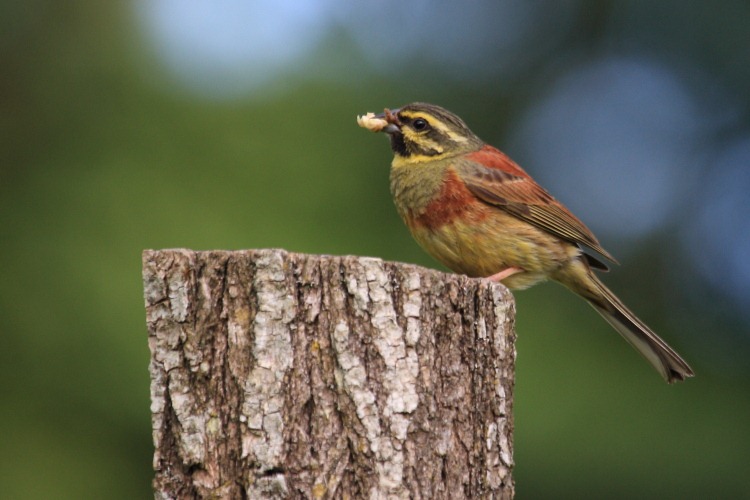
One example of a problematic small bird might be a Cirl Bunting (Emberiza cirlus). “That’s a curious example to choose”, I hear you mutter. True enough, except that a Cirl Bunting happened to be flying around our campsite at Réalmont catching insects. Every now and then it would alight on the fence behind our pitch, either on the post or the wire, with a beak full of ex-insect. It was a male and, since we didn’t see a female, we assumed the male was engaged in feeding his mate while she was incubating eggs.

Normally, not being equipped with a wildlife hide, close approach would prove impossible. However, our pitch at the campsite was surrounded by some neatly trimmed, dense hedges complete with the occasional gap through them. When my target was on the fence, the hedges hid my approach and I was able to get to within 4m/12ft or so. What a perfect hide substitute. I found that by lying prone on the ground I was less likely to scare the little chap away. Sneaking out from behind a hedge with my camera raised like a rifle made me feel a little like Mel Gibson in yet another Lethal Weapon movie [Ed: much less attractive, of course] but eventually I was able to bag a useful set of Cirl Bunting shots. Mel would have been bagging the bad guys. 😉

IMG_0205_Cirl_Bunting Quite a colourful little character, don’t you think?

Posted in 2011 Spring Tagged with: , , , , ,

Albi

One of the reasons we are where we are, if you see what I mean, is to see Albi. Albi lies 20kms/12mls north of us and, since today the skies cleared a little to leave a patchwork of dark grey, light grey and blue, now seemed to be the time for our visit. There is a cycle track, a voie verte, running most of the way but, with the weather remaining threatening and the cycle track falling short by 3kms/2mls and dumping the unfortunate cyclist onto busy Albi roads, we elected to drive.
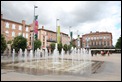
IMG_0748_Albi Driving into a sizeable French town is always a bit stressful. The main stress is the worry about parking. Finding somewhere both convenient and legal to abandon one’s car can be awkward for strangers unfamiliar with the variable local rules. Fortunately we lucked out and found a space governed by an horodateur [parking meter] almost immediately before what appeared to be the the main square. Even this cause a little head-scratching: we think it was free between 12:00 noon and 2:00 PM but charges applied before and after the lunch two hours. How wonderfully French to not spoil lunch with a parking charge.

Like Figeac, Albi is noted for two things. What is it with two on this trip?

Firstly, Albi is the birthplace of the artist – wait for it – Henri Marie Raymond de Toulouse-Lautrec-Monfa, better known just as Toulouse-Lautrec, unsurprisingly. He was an aristocrat descended from the counts of Toulouse and Lautrec, and the viscounts of Montfa. (The two different spellings, Monfa/Montfa, come from Wikipedia, not me.) Albi possesses a museum housing “the most comprehensive collection” of the artist’s works. [The Rough Guide] Moving swiftly on …

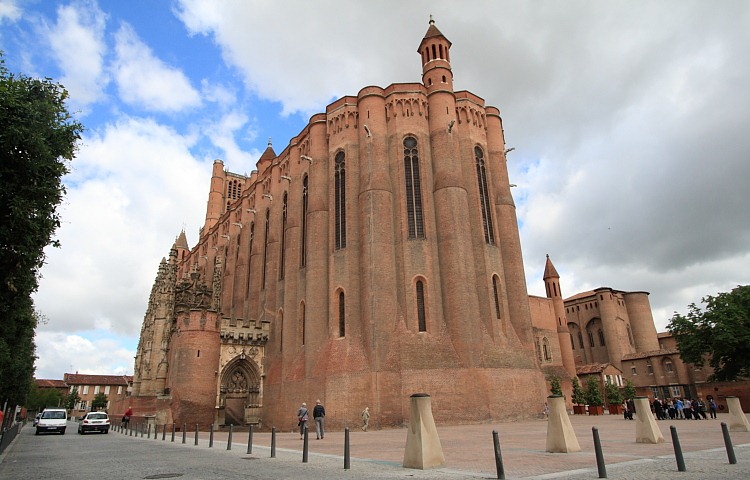
The second thing for which Albi is noted is its Gothic cathedral. I wouldn’t know it was Gothic, you understand, but apparently it is. Albi is a very pink city, most of its buildings being constructed from a pink brick. Surprisingly, the cathedral is no exception; it, too, is constructed from modestly sized pink bricks, not unlike modern house bricks. Think about that for a moment. Have you ever seen a cathedral built of anything other than large lumps of stone?
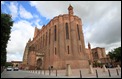
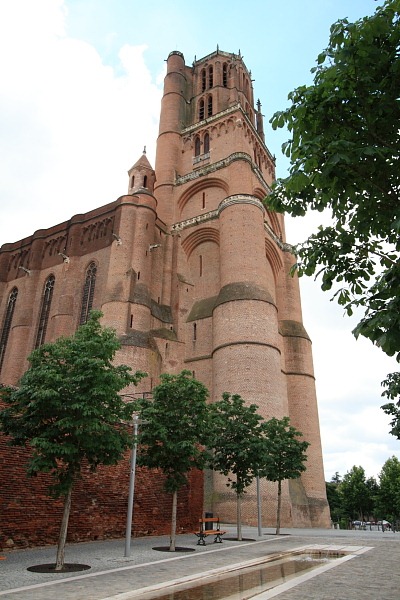
IMG_0727_Albi IMG_0731_AlbiThe cathedral was begun in 1280, is built of brick and is absolutely massive. It is huge. It’s utterly enormous. The Rough Guide uses words like impressive and imposing to describe this staggeringly large edifice. Think gigantic and pink and you begin to get the idea. I’m going to add my own, potentially controversial, adjective to the mix: ugly. There is absolutely nothing that could remotely be described as elegant about this cathedral. Some of the angles where planes meet round towers, and all made of brick, don’t forget, made me think there was no plan, as such. “I’ve got a few bricks left over, boss.” “Oh, alright, slap a 45° ramp up just there [points] between the wall and the tower.” To my mind it looks as though someone has dumped the rusting hulk of a retired super-tanker into the centre of Albi. This really is one humongous, style-free, slab of a building. It’s sheer size does make it very impressive and imposing, though.
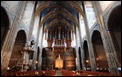
IMG_0737_AlbiAs a confirmed Darwinist, I never cease to be amazed at how mankind could invest so much money, time and effort on such an unlikely myth. At the same time, I’m rather glad that mankind did because I think the world would be all the poorer without such spectacles at which to go, “ooh, aah!” and, just occasionally, “yikes, that’s ugly!” Chartres cathedral was much more impressive and appealing, in my book.

The only way to get anything approaching an undistorted picture (distortion courtesy of my very wide-angle lens) would be from a distance but we failed to find the correct vantage point. It exists, though, ‘cos we’ve seen it depicted on postcards. Photoshop may help, later. 🙂

Despite what I consider to be an extremely ugly building, I rather like Albi. It seemed like a very pleasant, not-too-large town with a pleasing rather than suffocating amount of bustle.

Technorati Tags: ,,
Posted in 2011 Spring Tagged with: , ,