Action Stations

What a difference a day of sunshine makes, not just to we humans but to the whole of nature, it seems. The Marais Poitevin is something of a wildlife haven. With its intricate network of canals, one might reasonably assume that it would be the perfect habitat for odonata (dragonflies and damselflies) but, with the weather we’d been experiencing since our arrival, we’d seen none.

Today was wall to wall sunshine and very warm. As well as a sudden burst of human activity enjoying the serenity of this rural setting, there was a definite sudden burst of wildlife putting itself on display for those bothered to look. As usual, our activity took the form of cycling around some of the lanes and woodland tracks, criss-crossing a few canals keeping our eyes peeled for nature in all its glory.

IMG_5191_Hoopoe We were not disappointed. First, we were treated to a slightly distant but very welcomed view of one of natures weirdest creations, a Hoopoe. This is one of those onomatopoeic names suppose to invoke the bird’s call. It should be called a Hoohoohoo, if that’s the case. It was feeding on someone’s manicured lawn but eventually got fed up with the radio playing in the adjacent house and flew off. The picture, handheld and manually focussed with the extender, isn’t great but it just had to be reproduced.
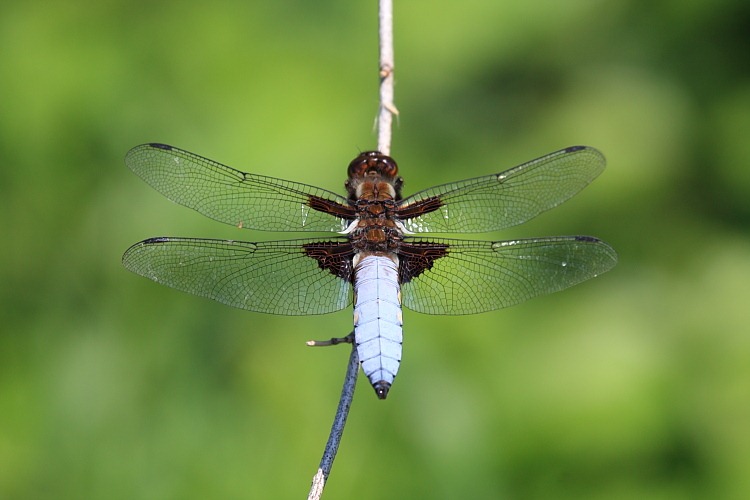
IMG_5205_Broad_Bodied_Chaser Next up hawk-eyed Francine spotted a fabulous dragonfly specimen whose hunting ground seemed to be a couple of water butts at the edge of a farmer’s field. It buzzed around while a camera could be pressed into action and patience paid off; it eventually adopted the perfect pose. ‘T was a magnificent (and new to me) Broad-bodied Chaser and was captured full-frame in all its glory.
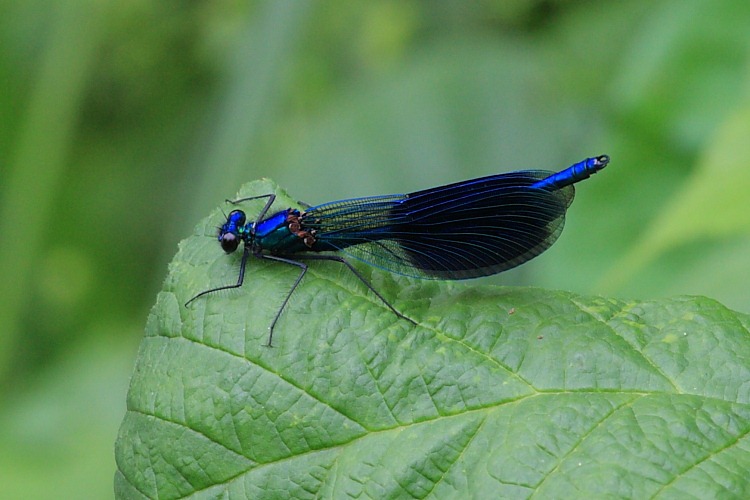
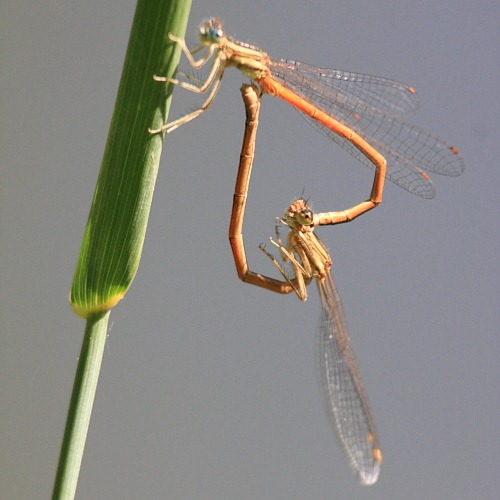
IMG_5171_Banded_Demoiselle IMG_5235_Small_Red_Damselfly An occasional Banded Demoiselle graced us with an appearance. Canals were lined with swarms of blue damselflies, identity uncertain as yet. When we returned to our campsite our local canal was similarly teeming with damselflies of various colours. Suddenly, all the dragonflies and damselflies that had been absent over the last few days were flitting about eating and mating. Those, after all, are the main purposes of zoological organisms: to eat and have sex. Sounds perfect – learn from nature!
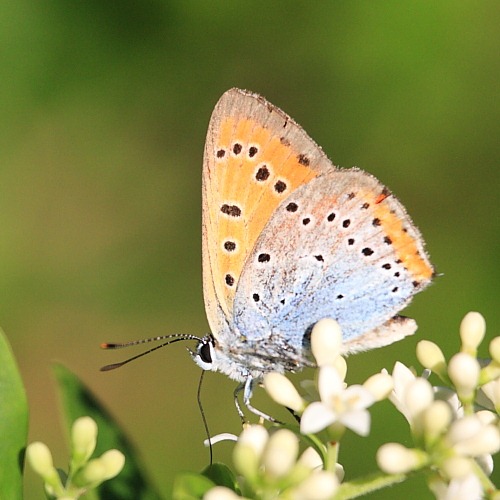
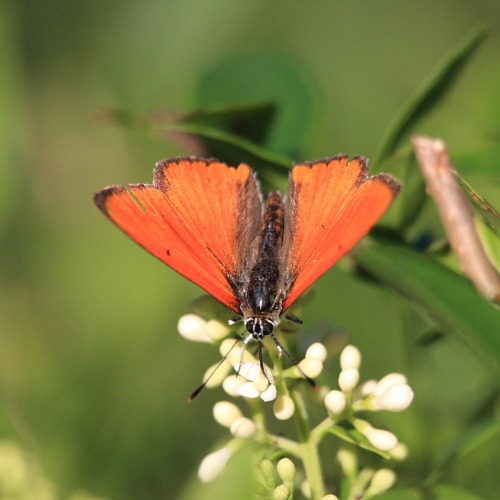
IMG_5238_Large_Copper IMG_5254_Large_Copper And nature provided us with one last, late evening piece of colourful theatre. A butterfly had alighted, unseen, on the privet hedge bordering our pitch. It sat with wings folded, showing only its relatively unremarkable underside markings which were reminiscent of a blue. It looked a little bigger than a blue, though. Eventually it took to the air and flitted along the hedge, dazzling us with the most vivid orange wings I’ve ever seen. Fabulous and, then, a complete mystery. Yet more patience paid off and a shot or two of mostly open wings at rest proved it to be a male Large Copper, extinct in Britain since about 1850 when the Cambridgeshire fens were drained effectively destroying it last English habitat. Mankind does such a bad job with ecosystems. The Large Copper lives in marshes and we are now in one of Europe’s best.

Mercifully, the magnificent Large Copper is now protected here in France. I feel privileged to have enjoyed something I can no longer enjoy at home.

Posted in 2010 Spring Tagged with: , , , , , , ,

The Chain Gang

At last, after four days of irritating rain, a settled day – not sunny but settled nonetheless. A slightly stir-crazy Franco and Francine made good their escape from camp à bicyclettes.

We were off in search of coypus or ragondins as they are known over here. At least, the polite members of marais society call them ragondins. There are apparently much less polite names used by others since these large aquatic rodents do great damage to the banks of the canals and are regarded as a serious pest. Somewhat typically, the French have turned the pest into a resource by putting down traps baited with sliced apple and, in turn, turning the hapless trapped ragos into pâté de ragondin. Yum!

We caught a brief glimpse of just one coypu as it swiftly clambered out of its canal and began hiding on the bank that it had set about destroying. Camera not required, regrettably. We did have a very pleasant bike ride, though, which included a slightly heart-in-mouth crossing of the river Sèvre Niortaise on a bateau à chaîne (chain boat). The chain boats were an traditional old method of getting about between otherwise isolated sections of land in the marais (marsh) before the advent of roads. Two chains attach either end of the boat to either bank of the river.

IMG_5166_Bateau_a_Chaine We were a little timorous but keen to give it a go. Francine gamely grabbed one chain and lugged the boat, which was, of course, on the opposite side of the river, across the water towards us. Getting both bikes and both of us aboard was a tad dodgy but we made it safely and, once aboard, the boat proved to be very stable with its wide, flat hull. Francine leapt into action once again, this time on the other chain, and dragged the boat, us and our two bikes over to our destination on the other side of the river. Disembarking was an equally delicate process. I soon learned that it was necessary to place all the retrieved chain inside the boat when mooring it to prevent the boat drifting off downstream.

Great fun!

Technorati Tags: ,,
Posted in 2010 Spring Tagged with: , ,

Drought Protection

It’s supposed to be dry tomorrow. Meanwhile, today, the rain continued in an irritatingly sporadic kind of way. What better time to be given an insight into French water engineering for allotments?

The Marais Poitevin has what appears to be quite rich soil in between its plethora of canals and drainage channels. I readiy confess to hate gardening but it looks good even to me. In addition to many of the water-surrounded fields being used to raise a few cattle, the area is also littered with what we would call allotments, though the plots here are at least twice the size of our English plots. Many of the locals can frequently be seen tending their vegetable patches in pursuit of the French national love of good food. Quite frankly, so many people here seem to be growing their own that I’m a little surprised that the local grocery stores sell anything.

Having just suffered four days of rain, it is also hard to believe that watering these vegetable gardens could be a problem but, I am assured, a problem it is. Fortunately there is a ready solution to drought in the form of the network of canals covering the countryside. Linda, having recently taken on a plot of land, was keen to prepare for the hot summer weather [Ed: bring it on!] and today, in her company, we drove around a few suppliers learning a lot about French irrigation techniques in the marais.

The done thing here is for keen growers to invest in a petrol-driven water pump. Linda’s neighbour, having many years experience of such matters, was adamant that she should invest in a 4-stroke rather than a 2-stroke pump, though we’re not entirely sure why. From one side of the pump – the suck side – a pipe with a filter is tossed into the nearest handy-dandy canal. The other side of the pump – the blow side – feeds a pipe delivering the canal water to a series of spray heads supported on stands. The spray heads are smaller version of those that can be seen automatically swinging back and forth in farmer’s fields. I may not be into gardening but I do like a bit of plumbing and I’d love to be around to help set up the watering system. Great fun! We’ll be moving on by the time Linda’s 4-stroke pump arrives, though.

The land rental is dirt cheap [Ed: sorry, couldn’t resist it] at €22 p.a. and the water is free but the irrigation kit ain’t cheap. So far it’s looking like about €600-700 so I hope Linda remains keen on market gardening for a few years.

Technorati Tags: ,,
Posted in 2010 Spring Tagged with: , ,

Rain, Rain, Rain

Need I say more?

It’s been a very wet weekend. The rain hasn’t exactly been constant over Saturday, Sunday and Monday, both day and night, but it feels like it has. The skies have certainly been solid grey and threatening. Not only have we been largely sheltering but most of the wildlife has, too. Even Franco File is tiring of it. The only area not suffering from gloom seems to be Provence and that’s a long way away so there was no point sun-chasing.

Fingers crossed for the forecast improvement coming. (It always seems to be tomorrow.)

Technorati Tags: ,
Posted in 2010 Spring Tagged with: ,

Snail Male

As luck, or otherwise, would have it, we’ve hit a spot of poor weather this weekend in the Marais Poitevin. Yesterday we spent a relaxing Sunday with our friends, Mike and Linda, putzing around in between showers. Then, after a splendid evening of food and booze chez eux, we sauntered back to our campsite in the last dry spell before an entire night of rain.

Eventually this morning the rain ceased, then started again, then ceased again. It seemed to be remaining to be ceased so finally we decided to risk an excursion on our bikes and struck out into the lanes twisting through the marais.

You have to give the French credit for being opportunists and, part way into our cycle ride we saw a prime example. Just as the rain brings to the surface earthworms which blackbirds are swift to harvest, so the rain also brings out snails which the French are keen to exploit. There, beside one lane along which we were cycling, was a man, armed with a supermarket carrier bag, picking his way along the hedgerow collecting snails. We’ve witnessed this before: down comes the rain, out come the escargots, out rush the French with buckets and bags to collect one of their favourite gastronomic bonanzas. They never seem to miss an opportunity to collect free food.

In the autumn, mushrooms are another prime example. France is geared up to help people safely exploit the fungi growing in their woodlands. Many pharmacies provide a kind of fungus identification service. Pierre Public, if a little uncertain as to the contents of his mushroom basket, can take along his booty to the local pharmacy and be reassured that he isn’t about to poison himself.  What do we do? Almost unique among European nations, for the most part we ignore such resources. Quelle domage!

I, myself, am very fond of snails swamped in garlic butter. I really should make the effort to research their preparation so I could join in this typically French post-rain ritual one day. At the moment, however, as interested as I am in cooking, I confess to ignorance about how to prepare snails. I believe one has to “purge” them before cooking but the devil is in the detail and I’d hate to get it wrong and waste such a resource by spoiling it. A research note for the future.

Technorati Tags: ,,,
Posted in 2010 Spring Tagged with: , , ,

To the Marais

The Marais Poitevin is one of favourite areas in France. Marais means marsh. This is a flat rural area of erstwhile marshland criss-crossed by canals and drainage channels. It is a very similar area to the Somerset Levels in England. It is a great place for wildlife and, being flat, was a natural for the development of many varied cycling routes; an opportunity which the French characteristically grabbed with open arms. An added attraction these days is that we have friends who now live there permanently.

We’ve stayed there many times before and started heading for our favoured campsite, Camping des Conches, at Damvix. After about 4 hours driving the 110 miles or so cross-country we arrived during lunch hours. (A single hour is not enough for lunch in France where food is deserving of time and effort.) The campsite bureau didn’t open for another 45 minutes so we wandered around the site thinking we might select a preferred pitch. Actually, we knew our favoured pitch already. Whilst wandering, however, our senses were constantly assaulted by particularly intrusive and incessant noises from development work going on in an adjacent car park. There were about four other units on the campsite but all were on the opposite side of the site. The noise was so loud, though, that it was impossible to escape. After 10 minutes our nerves were on edge. What a complete contrast to the serenity we had left 100 miles behind.

Knowing of another campsite, a municipal in Arçais just three miles up the road, we decided to try that. It’s a smaller site with fewer facilities but the simpler the better, as far as we are concerned. There were only a few other campers booked in and all appeared calm and peaceful. No contest, we went for it. I was going to miss watching the resident spotted flycatchers and hoopoes that buzz about Camping des Conches but sanity had to come first.

Sometimes one needs an incentive to try something new.

Technorati Tags: ,
Posted in 2010 Spring Tagged with: ,

Peaceful Solitude

Since our first two days of unadulterated sunshine, the weather has become considerably more seasonal. Let’s face it, 31C in May is something of an aberration. We want to be in the Marais Poitevin by the weekend to rendez-vous with friends but needed to decide when to move on. Since we seem to have landed in camping heaven, a rural farm site where we are the sole occupants, we’ve decided to stay here and make the most of our solitude until Friday, when we’ll travel the 100 miles or so into the marais.

It is such a treat to have this absolute peace and quiet. Quite frankly, it never happens in England. Well, to be completely fair there is one field in England where we have, on occasion, been completely alone but, at any time of year it’s pretty much the Holy Grail. We dare not travel anywhere at any time in England without booking. Not only has one always got company, there’s usually too much of it. In France, even in high season, in 25 years of camping, we have never booked anything but the ferry crossings. On one occasion only have we been unable to get onto a campsite that we had been aiming for.

Here we are with a beautifully rural setting all to ourselves. We’re going to enjoy it while we can.

Technorati Tags: ,,
Posted in 2010 Spring Tagged with: , ,

Asparagus and Strawberries

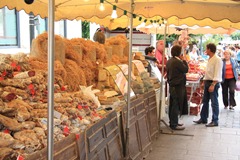
Ya gotta love French street markets. I don’t know when our English street markets went wrong but go wrong they most certainly did. For many years a lot of English market stalls have felt a little like things that “fell off the back of a lorry, guv’nor”. Our market vegetable stalls are filled in the main with trays of produce imported from the vast, tasteless growers of Holland – basically the same stuff that fills our supermarkets but cheaper by virtue of not having the supermarkets’ overheads.

Interestingly blackened backed goods - ? A splendid looking ham and cheese stall A French street market is a very different affair. French street markets remain true to what a market should be, largely populated by specialist local producers selling their own wares. Here are people selling only goat cheeses made from their own goat herd; people selling their own local speciality bakery goods or people selling simply the mushrooms that they themselves have gathered or grown. At Sarlat-la-Canéda, home of one of the largest street markets in France, we’ve witnessed an aged gentleman wheel his bicycle into town carrying just a single tray containing a few bags of green beans and a few bags of tomatoes. Once sold, his day was over. Brilliant! Of course, there are still stalls with imported factory-produced vegetables from Holland but they tend to be the exception rather than the rule. Even in the centre of France, a much larger country than ours, there is always a fresh fish stall (or more) with the emphasis firmly on fresh. There are butchers’ vans and frequently one or two large rotisserie vans doing a brisk trade in rotisseried meats, mainly chickens (which we like to call “spinning chickens”).

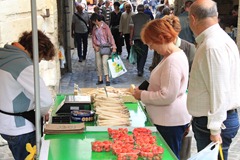
Asparagus and Strawberries We returned to Loches because Wednesday is market day. Whilst wandering around, camera in hand, I began to notice a strange theme. Well, that is, it seemed strange to me. It is asparagus season and people here go bonkers for the white asparagus that we rarely see in England. I lost count of the number of stalls selling asparagus. However, there were at least four separate local growers selling just white asparagus together with strawberries. No, I don’t mean to imply that they should be eaten together but it seemed like an unusual combination of produce to grow. I’m certainly no gardener but we began wondering if asparagus and strawberries shared a need for a similar type of soil. Clearly there was some connection that we didn’t understand.

We came away with some nicely aged goat cheese and a couple of paupiettes de veau from a butcher’s van. Some pleurotte (oyster mushrooms) and a little crème fraîche made an excellent sauce for the veal.

English farmers’ markets are a great improvement over our usual comparatively dull street markets but they still tend to be very small and staged only once a month. They are to be encouraged but have a way to go. In my experience all French markets are farmers’ markets. It’s why they’re there.

Technorati Tags: ,,,
Posted in 2010 Spring Tagged with: , , ,

Loches

I imagine that not everybody understands the scale of France. It isn’t huge by world standards but it’s certainly big by ours. It has a similarly sized population to Britain, about 60 million, but is about 2½ times the area. Britain is overcrowded; France much less so.

Having begun with a couple of blistering (for Europe) days with crystal clear blue skies, we set off à bicyclette to visit Loches. Loches was a Loire valley fortress and still boasts two 15th century gates into the old town. Clearly we are not in a high tourist area and it isn’t high tourist season. We may be a little off the beaten track but there really were a staggeringly small number of vehicles beating our particular track. It was 16 miles to Loches (we’d underestimated the distance!) via quite narrow country lanes but we saw only about a dozen other vehicles en route. I’d challenge anyone to find such a quiet road mid-morning in England. The relatively empty French countryside makes cycling a pleasure, especially without the potholes so popular back at home.

We passed through an inappropriately named village called Dolus-le-Sec where, despite its name, rain fell on us. We sheltered for 15 minutes or so under a tree waiting for the shower to pass and then continued on our largely unaccompanied way.

IMG_6202_Tassel_Hyancinth We stayed in Loches long enough to see the Logis Royal (Royal Lodgings), the old walled town and to sit out another passing shower along with a few fishermen trying their luck in the Indre river, before beginning to pedal our way back. Part way home, someone’s tired legs leapt of her bicycle, as much as tired legs could leap, that is, and snapped an intriguing plant that we had no clue about but which turned out to rejoice in the name of Tassel Hyacinth.

34 miles was a long trip for a first cycle outing and our poor old legs were feeling it just a tad by the time we returned. A shower and a reviving drink soon fixed most of that, though.

Posted in 2010 Spring Tagged with: , , , , ,

Processing Error

A small concern formed as we awoke to our first morning in France. Our plan, usually made only once we actually arrived in La Belle France, was to tear ourselves away from our usual start and head for pastures new in the Indre valley. My navigation officer reckoned our journey would be about 220 miles. The issue was the availability of fuel.

This being a Bank Holiday, as on Sundays, the vast majority of the non-motorway service stations are very firmly closed. To be more accurate, they are unmanned. Similarly, most large French supermarkets, like ours, have fuel stations. The supermarket fuel stations naturally save you a packet – €1.15 vs €1.28ish – and traditionally have a cashier, except during the typically French two hour lunch break. For this period, and for Sundays/Bank Holidays when the supermarkets are closed, these, too, tend to have automatic stick-your-bank/credit-card-in fuel pumps. No problem, then?

Wrong! Much as I love France to death, here’s a delightful piece of French nonsense. With a few notable exceptions, normally the fully automated stations such as Esso Express, few of these automatic pumps accept British cards. When the cashier is present, their bank card machines process our cards complete with chip and pin pretty much faultlessly and all is well; we can buy fuel. In the self same fuel station during lunch break or on a logical Sunday, the automatic fuel pump normally blows a resounding raspberry. This makes no sense at all; the cashier’s office is hooked into the system and accepts payment without a glitch but the fuel pump on the same forecourt steadfastly refuses.

For this reason, my usual approach when touring is not to travel on Sunday or, at least, to ensure that I have a full tank to start Sunday. A full tank goes 200 miles comfortably with 240 miles being pretty much the limit on a good day. Here we were with 220 miles in the offing, only half a tank of fuel remaining and two logical Sundays back to back.

I popped out and tried the Leclerc nearby our campsite. Sure enough it was closed but there was an automatic pump. After the previous local successfully purchased fuel and left, I introduced my credit card. Things looked promising as it switched into English and requested my PIN. I entered my PIN and it said “PIN accepted”. Great! After a few moments more it declared “Processing Error” and spat out my card together with a zero receipt. Bollocks! Why go this far and then reject it? I tried a debit card with the same result: switched to English, took the PIN, “Processing Error”, card returned with a zero receipt. Weird!

Beginning our journey on the free autoroute apparoaching Rouen, we managed to fill up with some top-dollar diesel before striking out cross-country towards Le Leroux in the Indre valley.  Approaching Tours, we dove back onto an autoroute forking out a spot of toll money to get a little more expensive fuel supplies rather than risk running dry.

Good decision, too. On another blistering day when the temperature around Tours hit 31°C, having found the correct road south out of Tours, we managed to do something of a diversionary loop entirely missing the road to our intended campsite. Maybe we really should have bought a satnav? ‘T was only a minor glitch, however, and we soon found another (and better) approach road to our intended camping à la ferme site without further problem.

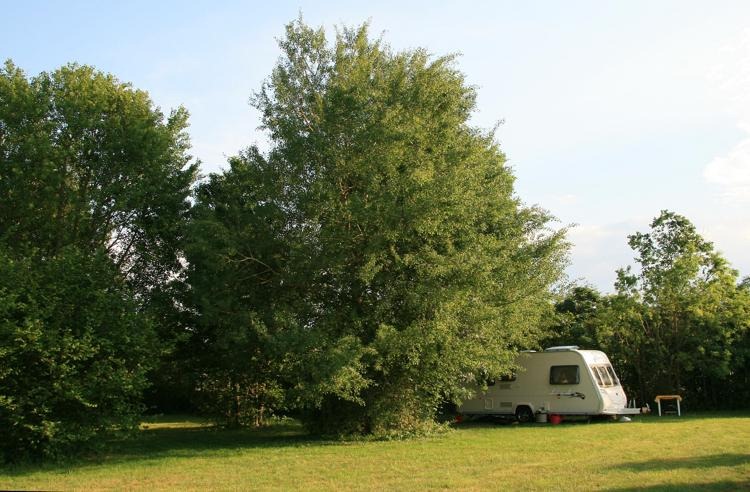
Billy alone with Blackcaps In complete contrast to the Neufchatel site last night, this site is essentially empty and what a great welcome we had. Our jovial farmer host shook hands and took us on a short guided tour of his 25-ish pitch site amongst trees opposite fields of crops. Fortunately we’ve got 50 metres of cable and sited Billy at the very edge overlooking a field full of corn. You never know, someone else may turn up. 🙂

We were hoping for some interesting wildlife buzzing about over the corn; maybe a barn owl or a raptor or two. No such luck, unfortunately. It’s probably too high now for owls and raptors to spot scurrying, furry creatures. There were some swallows flying low and scooping up insects, though.

We are being almost constantly serenaded by some blackcaps warbling away in the trees around us, though. The blackcap is rapidly becoming one of my favourite songsters and there do seem to be lots around, this year. It’s all very peaceful and very pleasant, having the place pretty much to ourselves.

Technorati Tags: ,,,
Posted in 2010 Spring Tagged with: , , ,