Gifts for Guillaume

Francine and I are Francophiles of long-standing. About 30 years ago we used to enjoy travelling around France in a cheapo 4-person ridge tent. [Ed: A nominally 4-person ridge tent has just about enough space for two civilized people to be comfortable. Always divide a tent’s capacity by two.] That is to say, we mostly enjoyed travelling with a tent. Every now and then we would try to pitch our trusty tent on a campsite which seemed to consist of about 3cms turf laid on what could only be described as concrete. “Smack, smack, smack” went my mallet, “bend, bend, bend” went normal tent pegs. We persevered.

We had very close friends who were also Francophiles. Indeed, it was they who introduced me to the delights of camping in France. Our friends camped in relative luxury; they had a caravan. I couldn’t help but notice that, when they arrived on site, a few turns of the windlass to lower the corner steadies was pretty much all it took to get them settled. Not for them the sweaty brow induced by fighting to smack malleable tent pegs through impervious layers of concrete. Not only that but, when camping in the cooler dewy, autumnal days of September, they didn’t  have to leather off a soaking wet tent before packing it up to move off.

I was sold; Francine and I invested in our first caravan and joined in the travelling luxury. Our first caravan was very basic but served us well. I particularly enjoyed not struggling with tent pegs. Eventually we upgraded to a van including a hot-water system and a shower. We began travelling further south to sunnier climes, occasionally in high summer when the Mediterranean sun was at its most powerful. A combination of my fair skin and thinning hair meant that a sunburned head was a serious danger. Reluctantly, I bit the bullet and invested in a sun-canopy. It ran the full length of our van and enabled us to sit in shade. I had returned to occasional fights with a few tent pegs but only a few – a mere four, to be precise. Besides, other than in the height of summer, we didn’t need to use it.
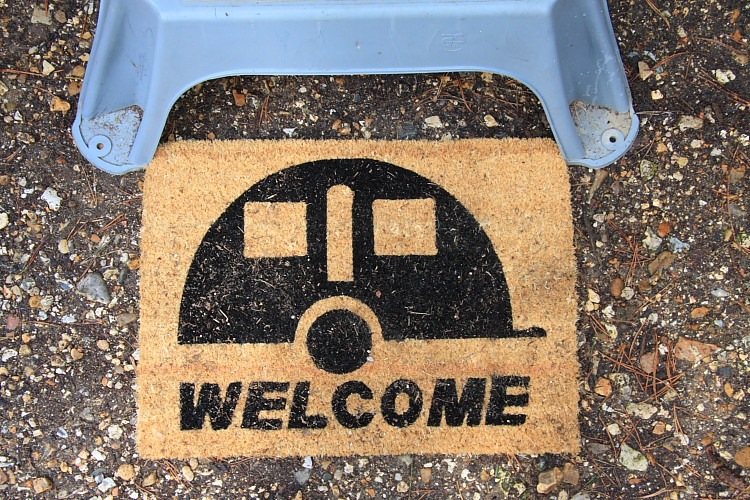
IMG_7393_Guillaumes_presents Here we are in The New Forest. It is September. The sun, when/if it actually shines, is not strong. A sun canopy for shade is regrettably unnecessary. When it rains [Ed: we are in England so there is no “if” involved in the rain], being in a forest, shoes get grubby and dirt can get tracked into Guillaume (our third caravan). For some time, Francine has been worrying away like a dog with a bone for a “porch awning”. I, as the person tasked with trying to drive bendy tent pegs through unyielding concrete, have been resisting. Dirt has been tracked in, male resistance is useless – “we” have visited Southampton and bought a porch awning. Being the eternal homemaker, Francine could not resist also buying this rather trite but, nontheless, cute(ish) doormat. Lucky Guillaume – two presents! 😯

In stark contrast to bendy tent pegs, modern bendy tent pole technology is brilliant. Three external, narrow, springy poles threaded through their correct sewn-in channels and our porch awning was basically erected. Now for the pegs to stop it blowing away. How many pegs come with a modestly sized, 2.5m/8ft x 2m/6ft porch awning? 45! 45 for Chrissakes!! Ever hopeful, I set about attacking the first peg: “smack, smack, smack”, “bend, bend, bend”. The peg had run into something harder than I’d ever encountered during my tenting years in France. Move the peg slightly – same result. Try somewhere else completely different – same result. The whole forest seems to be built on concrete. Do these bendy pegs have any thing resembling a sharp point to help them pierce the ground? No, they are perfectly blunt; totally flat; not even rounded. If only peg technology had kept pace with pole technology. Why do we do this to ourselves? I’d fixed this problem 25 years ago moving to a plain, unadorned caravan.
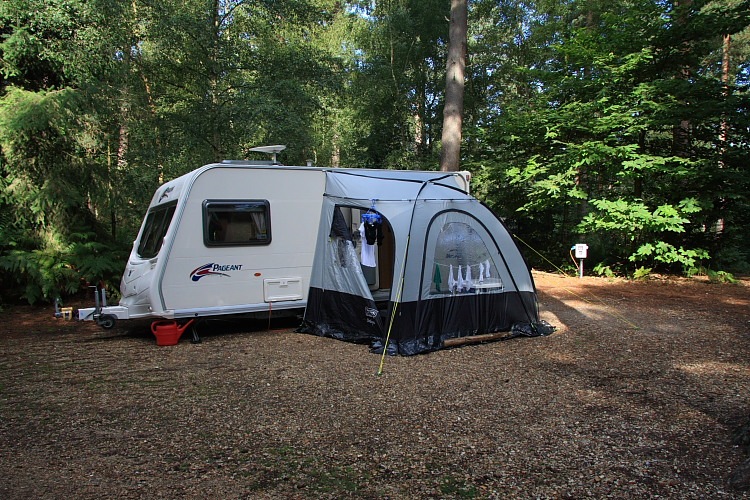
IMG_7394_Guillaumes_presents Gamely Francine leapt in the car and shot off to our most local camping supply shop. Then she went on to our second nearest camping store. Fortunately it was not a windy afternoon so I didn’t have to constantly hold down the yet-to-be-tethered canopy during her absence. Eventually she returned with pegs resembling 10ins/23cms hardened steel nails, complete with a sharp point. There are successfully pitched full canopies on site using exactly these devices so hopes rose. My trusty rubber mallet was clearly going to bounce straight off rock pegs attacking concrete so Francine also purchased a metal thumping device, to whit, a camping axe. (The only mallets available were either rubber or wood.) I managed to use the back of the axe as a hammer. Luckily I also managed to avoid burying the sharp end of the axe in my forehead whilst using the back as a hammer, and finally smacked in sufficient high-tech rock pegs to hold our super new porch awning. Phew!

Cost of porch awning complete with 45 bendy pegs: £89. (Quite astounding given the work and detail in it.)

Cost of 25 rock pegs and camping axe to pitch it on concrete: £22.

We’re (I’m) not tracking dirt into Guillaume any more. We (Francine) has somewhere to hang damp towels, washing, and to stand wet umbrellas and dirty walking shoes. The porch canopy is very good. It’ll be even better on reasonable soil.
Posted in 2010 New Forest Tagged with: , ,

Scouting Ride

For those of us who might be seasonal Odonata freaks and who just happened to be planning a trip to The New Forest, Francine stumbled across a useful little Web site descriptively entitled New Forest Dragonflies. This Web site is very elegantly designed and, unlike “The New Forest”, it does exactly what it says on the can: it presents a whole host of useful information about dragonflies and damselflies in The New Forest. There is even a Google Map showing locations where named species have been spotted.What a great idea!

The down side was that there are so many dragonfly locations shown on the map that it’s difficult knowing where to start. So, prior to travelling, I contacted Mr. New Forest Dragonflies asking for a few location suggestions for new visitors. Helpful chap that he is, he obliged with three suggested locations. Wanting a little technological help, and to give it something useful to do, I downloaded the locations as waypoints into my Garmin eTrex GPS thingy.

After serious amounts of evening and overnight rain, today’s forecast was for sunshine and showers. Nonetheless we set out à bicyclette, our excuse being to scout out a couple of the dragonfly hot-spots just in case the sun graced us with an appearance. Let’s face it, the season it well advanced; September is pretty much the last chance for Odonata enthusiasts and seeing them needs better weather than we are currently getting but … you never know.

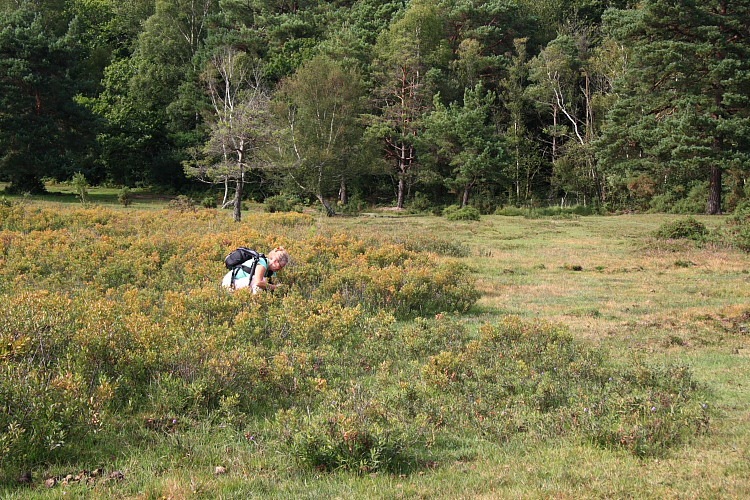
IMG_7392_Flower_hunt The land looks quite flat in The New Forest. As usual, once on a bike you realize that it isn’t actually as flat as it might look when driving a car. Nonetheless we pedalled our way around a 20 mile circuit, found the two of our new friend’s suggested locations that were on our route and, rather remarkably, stayed dry. Our remaining dry was entirely a stroke of luck. At one point, we were clearly cycling along a road freshly saturated by one of the advertised heavy showers. I could see said heavy shower, still heavily showering, receding into the distance. Although we didn’t see any friendly Odonata at either suggested location, I did spot a few late season hangers-on flitting about en route. The  flower hunters amongst us had more luck; my dragonflies may not have been venturing out but Francine’s plants remained firmly rooted in place, to her delight.

In common with Francine and I, dragonflies prefer dry, sunny, warm weather. There are supposedly Golden-ringed Dragonflies in the area and I’ve never seen one. My fingers are firmly crossed.

Technorati Tags: ,,
Posted in 2010 New Forest Tagged with: , ,

To the Woods, to the Woods

Satan’s little disciples are supposedly now safely locked up in school again so, in theory at least, it should be safe for civilized folk to enjoy a little peace and tranquillity in the big wide world. For one reason and another, Francine and I decided to try something a little different and visit a campsite north of La Manche (a.k.a. the English Channel). We chose a Forestry Commission campsite called Setthorns in the New Forest.

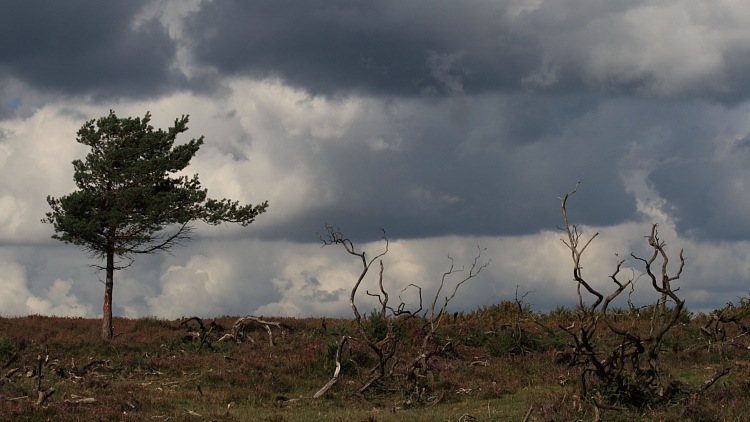
IMG_8660_One_tree_forest “The New Forest” is a slightly odd tag in some ways; it is neither new, having been declared new almost 1000 years ago by Guillaume le Conquerant, nor does most of it match the majority of peoples’ idea of a forest, large tracts being largely devoid of trees. (See Francine’s nice moody shot to help illustrate.) Many years ago, we drove a visiting Swiss friend to see our New Forest; he looked around slightly quizzically and said, “Ver are ze trees?”. I hadn’t previously thought it odd but I had to admit, he had a point. Much of it is more like heath land. I now know that the term “forest” actually referred to a hunting ground. The New Forest is where Guillaume le Conquerant would have galloped after the occasional sanglier (wild boar) for a damn fine hog roast.

August was a waste of time, weather-wise but mercifully September has started in a different vein with a week of very pleasant weather. Our very own Guillaume, Guillaume le Caravan, was quite excited about the prospect of a trip to The New Forest. We made a leisurely departure and things were progressing admirably until we hit stationary traffic on the A34 still some way north of the M4 junction – and when I say stationary I mean completely. Radio on – reports of 1½ hour delays and A34 being completely closed. We did crawl very slowly to a nearby exit but only because other traffic was clambering off the A34. Beyond the exit, traffic was at a standstill and the queue disappeared over the hills and far away. We exited when we could and Navigation Officer Francine talked me down a few pleasant (i.e. not blocked) country roads, through Newbury and back onto the A34 south of whatever disaster had befallen it. (We still don’t know.)

Having left a lot of very unhappy motorists behind, we arrived at Setthorns campsite and checked in. What a delightful site it is – pleasantly constructed pitches, well spaced out, amongst a mixture of pine and oak trees in Setthorns Inclosure. You see, there are some trees in the forest. We just about got Guillaume set up before the Anglo-Saxon rain began. Since it began sporadically and slowly, armed with an umbrella, we went for a short orientation walk. Soon, however, the real rain came down and the umbrella went up. As forecast, it is now raining quite heavily and persistently.

This camping north of La Manche lark may not catch on. 🙂

Technorati Tags: ,,
Posted in 2010 New Forest Tagged with: , ,

A Roundabout Way

CedezLePassage_small Many years ago when Francine and I started travelling to France, there were no roundabouts. All road junctions were just that, junctions – cross-roads and the like. There were, of course, a few oddities peculiar to the French, such as the magnificent Arc de Triomphe in the middle of Paris where rules seem indiscernible, but anyone attempting to drive around Paris, let alone the Arc de Triomphe, is certifiable anyway so rules would be superfluous. At least out on the French open roads, the priorité a droite rule at junctions had been replaced by Cédez le Passage giving priority to the major road. Phew! (Image courtesy of http://www.freefoto.com.)

Several years ago, though, someone obviously introduced the French to the concept of the roundabout because they began appearing throughout the country. This was a mixed blessing.

The bad thing about French roundabouts is that most drivers never learnt how to use them correctly. Lorry drivers are actually very good users of roundabouts and conscientiously signal their intentions; they indicate left to stay on a roundabout and right when they are about to exit a roundabout. Car drivers are a completely different bouilloire de poisson. Not only do car drivers never indicate to signal their intentions, they actually try to obfuscate them. Their main obfuscation mechanism consists of using a completely inappropriate lane whilst on a roundabout. Most drivers wishing to go all the way round to the last exit will do so in the outermost lane. When waiting to enter a roundabout, since no car drivers are indicating, one can’t tell whether a car in the outermost lane might be going to exit or continue round. There is a second breed of car driver. The second breed of driver will zoom onto a roundabout straight into the innermost lane, narrowly avoid the island, then swerve straight off again at the first exit cutting up any hapless instance of the first breed of driver merrily toodling all the way around in the outermost lane. The only really safe way to enter a roundabout in France is to wait until no other traffic is in sight. Fortunately, the traffic density is such that this eventually happens.

The good thing about French roundabouts is that they provide the French with a canvas to express their national creativity. French roundabouts are frequently beautifully and interestingly decorated. The decoration is not just flower planting but usually consists of something more like sculpture. The sculpture often indicates a trade associated with a nearby town or the reason for some local historic person’s fame. Other decorative devices just look as though they’ve been pinched from the Tate Modern. [Ed: most things in the Tate Modern would be better used decorating our roundabouts!]

IMG_6224_Roundabout_Car I’d love to make a photographic collection of some of the French roundabouts but we are usually attempting to negotiate them safely by guessing where the other drivers might be going. No easy task when towing a caravan. This last trip, however, we did come across one whilst on bicycles and armed with a camera. (Image courtesy of Francine.)

Great, isn’t it?

Technorati Tags: ,
Posted in 2010 Spring Tagged with: ,

Great Drivers – NOT!

Much as we may love France and many of the French we’ve met, it has to be said that they are not the world’s greatest drivers. They believe they are, of course, as is evidenced by the fact that they all think they are Alain Prost. Most French drivers will bust a gasket trying to overtake anyone who happens to be in front.  They don’t necessarily want to go much faster than the leading car but they simply have to be in front. Their overtaking manoeuvres are frequently carried out approaching a blind bend, just as if they were on a racing circuit with no opposing traffic flow. The reason they mostly seem to get away with this lunacy is that the traffic density on France’s roads is very low and there often is no opposing traffic flow. Not always, though.

During our two day journey back from the south of the country to the north we passed a couple of interesting incidents. One was a very fresh one on our final autoroute journey to Calais for the ferry. A camper van was on the hard-shoulder (la bande d’urgence) with its offside rear quarter modified to the point of disintegration. A car was sideways in the outside lane with its nearside front quarter similarly seriously modified. We surmised that the camper van had, perhaps, failed to check its mirrors sufficiently, not seen the car approaching to overtake, and had pulled out and creamed it. It’s only a guess but it made it an understandable, if not forgivable, incident. After a minor delay waiting for a lorry to pick its way through the debris scattered around on the remaining mostly-clear lane, we continued.

The previous day we had seen something entirely incomprehensible, however. We were following some sort of patrol vehicle along a perfectly straight, as built by the Romans, two lane road heading north towards Chartres. Suddenly, the patrol vehicle turned on its Cyclops lamps and the message ”en service” appeared on its rear-mounted message board – very clever. Eventually the van approached a number of stationary cars on the southbound lane and a lady, standing beside the road, began gesticulating wildly into the adjacent low-lying farm field. There, completely inverted, lay a car on its roof. The nearest bends were about two miles in either direction. How does anyone contrive to throw a car off a perfectly straight road such that it flips onto its roof? It may have been a badly-judged Alain Prost overtaking manoeuvre but it certainly wasn’t due to any blind bends or hidden dips in the road. Staggering! Though confused, we decided against stopping to ask the driver, still trapped upside down in the car, how he (I assume it was a he) had contrived to perform such a feat.

We’ve picked our way through the couple of bits of carnage and are safely back at home on the overcrowded roads of the UK.

Posted in 2010 Spring Tagged with: ,

Something Fishy

Our ferry is tomorrow (Sunday) at around midday. Once again we’ve made for our favoured and brilliantly run campsite in Neufchâtel-en-Bray, Normandy. It’s an easy 2½ hour run to Calais from here, providing we don’t run into any bouchons (traffic jams). There’s also a very good Leclerc supermarche on the doorstep where we can stock up with booty and fuel. Unlike some, we don’t load ourselves up with ludicrous amounts of booze – it simply is more trouble than it’s worth – but it’s nice to bring back a few things that are less than common in the UK, such as Calvados.

We also try to treat ourselves to a decent last supper to commiserate. In common with most French supermarkets and street markets, the Leclerc in Neufchâtel-en-Bray has a very good fish counter. The counter must be 5 metres long and well stocked both in terms of quantity and variety. The same is true in Spain: huge fish counters with large amounts of fish. If an English supermarket actually has a fish counter, it tops out at about 2 metres and has a restricted selection that tends not to glisten with freshness. This, of course, reflects the British public’s approach to fish. Many Brits are still in the battered cod or nothing category. Rick Stein has done a great job improving our attitudes but there’s still a way to go.

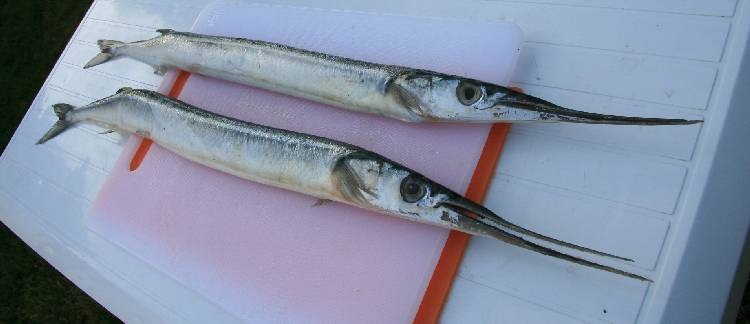
Being adventurous eaters, we occasionally have difficulty resisting the unusual. Regrettably, given the lamentable fish supply around much of the UK, “the unusual” in fish terms covers an awful lot of perfectly edible species. Naturally, in a nation given to tucking into snails and frogs’ legs, the situation is far better. Here, there were some excellent looking grondins (gurnard) but they are relatively readily available at home or, at least, in Cornwall. However, my eyes were constantly drawn to a handful of orphies (garfish). These long, thin pipe-shaped fish are one of Darwin’s more curious creations. They are cooked in England – the eminent Mr Stein has a recipe for them -but I’ve never seen them available. Their party-trick is that their bones, which start off as normal white-looking fish bones, turn bright blue when cooked. Seriously, bright blue. I couldn’t resist. Their other benefit was that they were dirt cheap, about €3.50/kg.

GarfishI managed to gut and prepare them chez Guillaume and pan-fried them with some good ol’ garlic, not wishing to unpack the BBQ on the last night. Our plates looked particularly messy after our feast and our hands were decidedly greasy so I’m afraid the blue-bones picture didn’t happen. Sorry!

We’ll have to go back and do it again.

Technorati Tags: ,,,
Posted in 2010 Spring Tagged with: , , ,

Annual Migration

Approaching the end of another trip around La Belle France. As usual, Francine and I had to decide how best to approach the unwelcome journey north: three easier days or two longer days. Also as usual, once we get onto our favourite farm near Fanjeaux with the very hospitable Luc and Nadine, we have difficulty dragging ourselves away. Predictably, we elected to go for two longer days, maximizing our time in pastoral heaven.

Today we dragged up to Neung-sur-Beuvron in La Sologne. This was a minor deviation from our originally intended stop. For the last hour or so of our trip heading north on the autoroute, we had been passing beaucoup des bouchons (many traffic jams) of eager French holidaymakers attempting to head south with what must be described as restricted success. Bouchons on the French autoroutes are relatively rare because most are toll roads and quite expensive. The French concentrate their holidays into the second half of July and first three weeks of August and, being a week later than usual in our return, we were crossing swords with the first big holiday migration weekend of the season for the French when even some of their roads get busy. The newspapers gave almost as much coverage to the French annual migration as they did to the lamentable performance of Les Bleus (the French national football team) in the World Cup. (I’m told it was bad but I don’t “do” football so wouldn’t be able to judge.)

Approaching the junction prior to our intended clamber-off point, a sign greeted us announcing an accident 7 kms/4 mls ahead. After 550 kms/350 mls we had no wish to sit in a bouchon ourselves so we exited early to a backup campsite. We’d used this site before and it had been very quiet. It had also been the site where, from the local supermarché, I experienced the most disgustingly undrinkable wine ever. I actually poured two bottles of it around an unlucky oak tree which doubtless succumbed shortly thereafter, so bad was it. I offer this ability to discard a drink as proof against my alcoholism. Anyway, this time the site was heaving, mostly with Satan’s little helpers, rugrats. There were three huge groups camping in tents. We were about as far away from them as it was possible to get and basically OK but one night was enough.

The French habit of swarming away en masse in late July and August leaves the country exceptionally civilized outside of this period. This effect doesn’t occur in England which always seems busy from April to October. In fact, we had trouble getting on a campsite at New Year, the depths of winter.

We used to travel to France in the high season and, to be fair, only once in over 25 years have we failed to get onto a campsite because it was full. However, our recent travels in quieter times have spoiled us and the disappointment of going home has been lessened a little.

Posted in 2010 Spring Tagged with: , ,

Assault on Andorra

… on foot, that is.

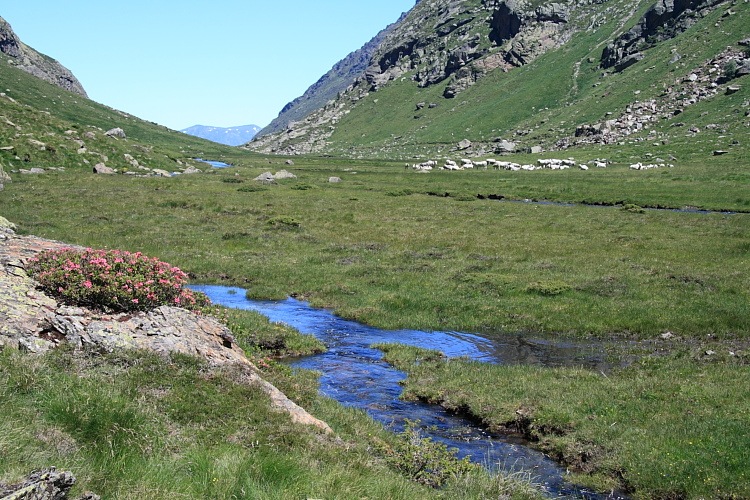
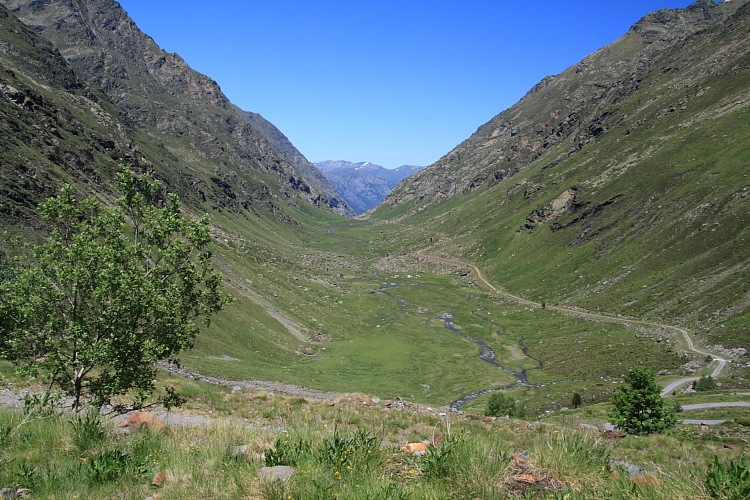
Having spent a v. hot day a few days ago discovering the relative cool (24°C/75°F) of the Soulcem barrage (dam) in the Vicdessos valley, we fell in love with the place. It’s a stunningly picturesque dead-end valley that bumps into the borders of Spain and Andorra which, typically, are on the high points, rising to around 2900m/9500ft, that surround the valley. Dead-end, that is, except for a few footpaths including a GR, a Grande Randonnée (long distance footpath), into Andorra. The col (pass) is at about 2500m/8200ft.

Another stinky-hot day was in prospect chez nous so we thought we’d return to Soulcem for some more soul-cleansing scenery and more cooling altitude to investigate the GR. I couldn’t go without a camera though because we’re getting into Apollo butterfly season and I’ve never seen one. I lightened the load by taking one wildlife lens, and Francine did likewise by taking just the scenery lens. We then promptly put our loads back up with 750ml water each. Following a leisurely start and 1½hrs driving, we didn’t arrive at Soulcem and begin walking until midday.

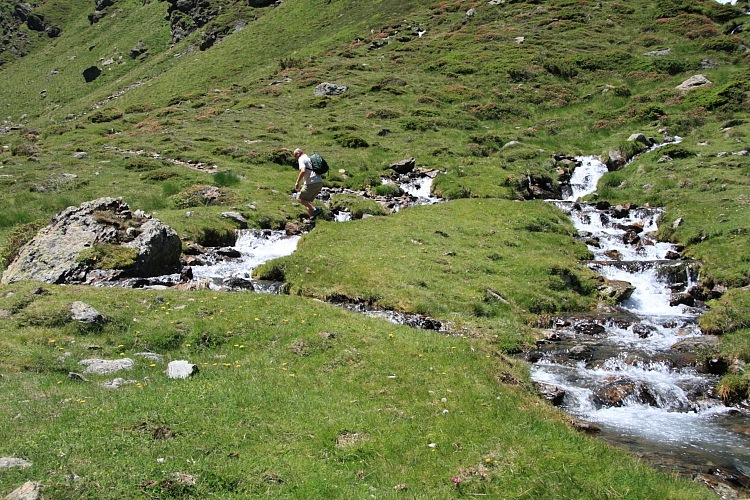
Streams criss-crossed the high valley Franco jumps a stream GRs in France are marked with red and white rectangle markers. We had no trouble following the lower sections ‘cos we’d done it before on our first visit. Thereafter, though, the GR fooled us by having us walk on the west of the valley rather than along the eastern track we had half expected. This was a beautiful walk, we even found a pool acting as home to a population of red damselflies, but I couldn’t help but wonder what the GR’s plan was for having us cross the various streams of snow melt water to get back to the east side where Andorra lay. Turns out there was no plan; the GR simply crossed streams and, not being correctly equipped for fording such things, we scratched our heads. After much searching further upstream, we eventually managed our way across using a combination of jumping and stepping on strategically placed stones.

Andorra is to the leftPart way up on the trackWe’d made it back to the track on the eastern side of the valley but, with our upstream detours of about ½km, had completely lost the GR markers. The track, however, zigzagged its way up the mountain in the correct general direction. We couldn’t see anything resembling a footpath behind us so we so we set off along the track. After about 1½kms/1ml of reasonably gentle hairpin bends we spied a red and white GR marker cutting off the track and going, effectively, straight up. On the opposite side of the track we spotted a couple clambering up the path we had been unable to see – the way we should have come. “Bother (or words to that effect), that’s where the GR is!” It came very steeply up the side of the valley where we had failed to see a footpath.

GR way markers Time was marching on considerably faster than we were. The GR continued to insist that we ford streams. Just to rub it in, one marker was painted atop a rock right in the centre of a stream. Nice! By 3:30PM, the gradient was steep, the going heavy and the end, Andorra,  was still not in sight. Though the temperature was only about 25°C/77°F, we were getting uncomfortably low on precious water. The mountain streams were probably safe to drink but there were horses even up here so who knows. Discretion being the better part of valour, we decided to call it a day and just enjoy our remaining water on the downhill walk back. This time we stuck to the GR and it certainly was steep.

I’d go back for another shot but:

  1. with an earlier start;
  2. with 2 litres of water each;
  3. with walking poles;
  4. without the extra 2 kms detour;
  5. without the camera.

I still haven’t seen an Apollo. 🙁

Posted in 2010 Spring Tagged with: , , , , ,

In for a Good Cause

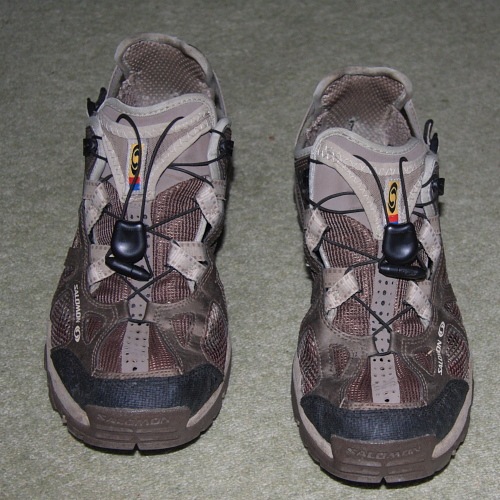
IMG_6540Salomon_TAs_ Last year while travelling in France I was developing my usual cracked heels problem from sun and sandals (without socks!). Francine, having somehow managed to drag me into a sports shop, spotted some helpful looking shoes called Techamphibians by Salomon. They looked useful because they were a complete shoe, offering heel protection, but were made of a fine mesh which should be quite cool. Actually they were relatively high tech shoes supposedly designed for river guides, or some such: they contained no material that would absorb water; they had a Kevlar cable instead of laces; they allowed water to drain out of them. They were on sale. I bought a pair. My heals improved.

Another hot day was in the offing today – that is, after all, why we are here. Having sheltered once already in the Pyrenees, this time we decided to shelter in Les Montagnes Noires (the Black Mountains) a little north of Carcassonne. Les Montagnes Noires are the source of the water used to top up the Canal du Midi. The water is fed down via La Rigole, a purpose built small canal, which offers a shaded and very pleasant walking/cycling environment. We set off intending to visit La Prise d’Alzeau north of Saissac. This is where La Rigole begins its journey to the Canal du Midi.

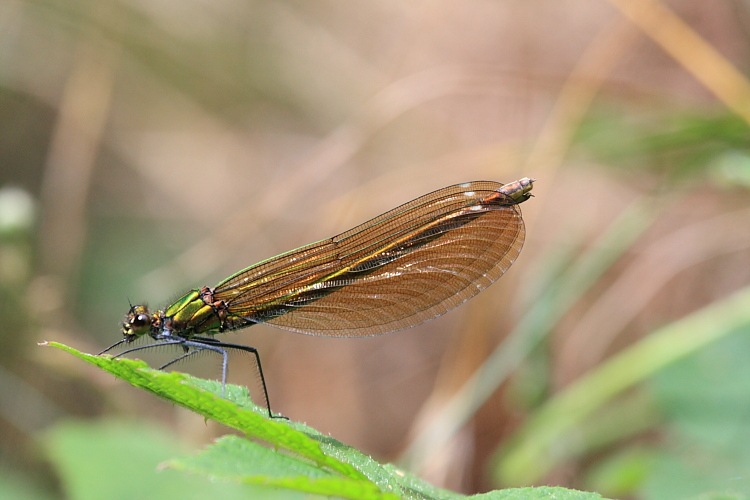
We found a shaded picnic spot near a cute stone bridge about 3kms from La Prise and started a picnic before our wander. Pretty soon my baguette was interrupted when Francine spotted several splendidly colourful Beautiful Demoiselles flitting about near the bridge; sandwich instantly dropped in favour of camera.

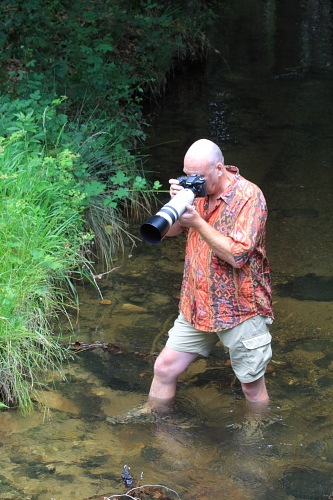
IMG_7308Franco_paddles_ I soon noticed that these delightful damselflies always sat directly facing the sun. That meant they were facing the opposite bank and showing me their backs. Despite a chunky lens, the opposite bank was too far away to afford a good shot. But wait, I was wearing these weird Salomon Techamphibians. They may not yet have been used by me for their intended purpose but these guys’ natural habitat is supposedly wading about in water and La Rigole isn’t very deep. I’ll go to reasonable extremes for nature and soon hitched up my shorts to take the plunge in search of better pictures. (Please excuse the rather ancient and garish shirt, it’s very fine silk and the coolest thing I own – temperature-wise, that is.)

IMG_6401_Beautiful_demoiselle_female IMG_6399_Beautiful_Demoiselle_male I may have received a few strange looks from passing locals wondering what I was up to paddling around in their beloved La Rigole but it was great fun, cooling and very worthwhile. Their name undoubtedly sounds a little trite but what stunning insects Beautiful Demoiselles are.

I never dreamt I’d put Salomon’s Techamphibians to such good use. 🙂

Posted in 2010 Spring Tagged with: , , , , ,

Frog Alert!

Decision time: we are on a pitch that has been booked by others beginning on Sunday so we have to move. The question was whether to move pitches and stay here or to try somewhere new. To cut a long and very indecisive story short, we decided to move to a new pitch here.

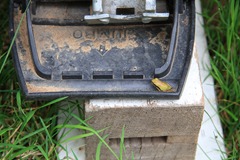
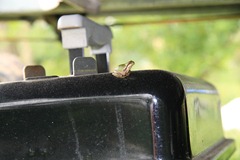
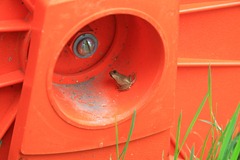
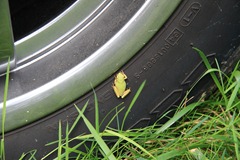
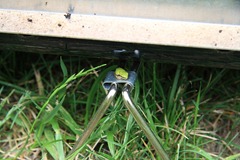
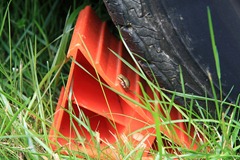
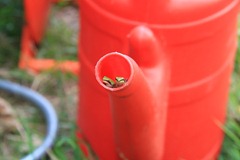
Enter, once again, our old friends the tree frogs. We are basically surrounded by hundreds of tiny, perfectly formed bundles of cuteness. As we began preparing to move – disconnecting cables, water supplies, etc. – it became quite startling where the little fellows chose to sit. In the following collection of pictures, which should mainly speak for themselves, the orange thing is our electricity cable reel. Also featured are the caravan corner steadies, wheels (dangerous) and wheel chocks, a portable Weber barbecue (particularly dangerous) and, the pièce de résistance and my personal favourite, a watering can spout.

IMG_7037_where's_that_frog IMG_7043_where's_that_frog IMG_7049_where's_that_frog IMG_7053_where's_that_frog IMG_7069_where's_that_frog IMG_7070_where's_that_frog IMG_7081_where's_that_frog IMG_7078_where's_that_frog IMG_7079_where's_that_frog

No frogs were hurt in the making of this blog entry (we think).

Technorati Tags: ,,
Posted in 2010 Spring Tagged with: , ,