Peau de Meau Revisited

On to my main interest for wanting to be in this area at this time of year: the Peau de Meau.

As an amateur odonatologist, the Peau de Meau is irresistible. It is a part of the larger area known as Le Plain de la Crau. It is pan flat and, at first sight at least, looks like a baked, desolate landscape with little in the way of life. When it comes to dragonflies, however, nothing could be further from the truth. It is one of the premier dragonfly sites in Europe. A fellow enthusiast claims to have seen close to 50 species there. To put that in context, there are 40-odd species in the whole of the UK. We have visited once in September (and not got anywhere near 50) but I was keen to see what a spring visit would add. Today looked like good conditions, sunny and with little wind, so we packed lunch and called in to St-Martin-de-Crau to buy our €3 permits to visit.

P1030379Here’s the view that greets you as you drive in through the entrance of the Peau de Meau, the car park being on the immediate right. Dragonflies, here? Nah, surely not!

J14_1139 Booted Eagle maybeActually, the first thing we saw was a large raptor, yet to be identified [who forgot to pack the bird book, then?] so something else thought there was life here to be hunted, too. It may be a Booted Eagle; they tend to eat snakes and lizards which would probably be in this sort of environment.

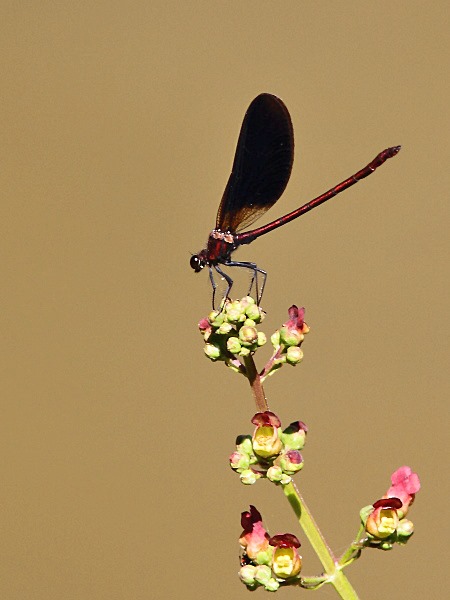
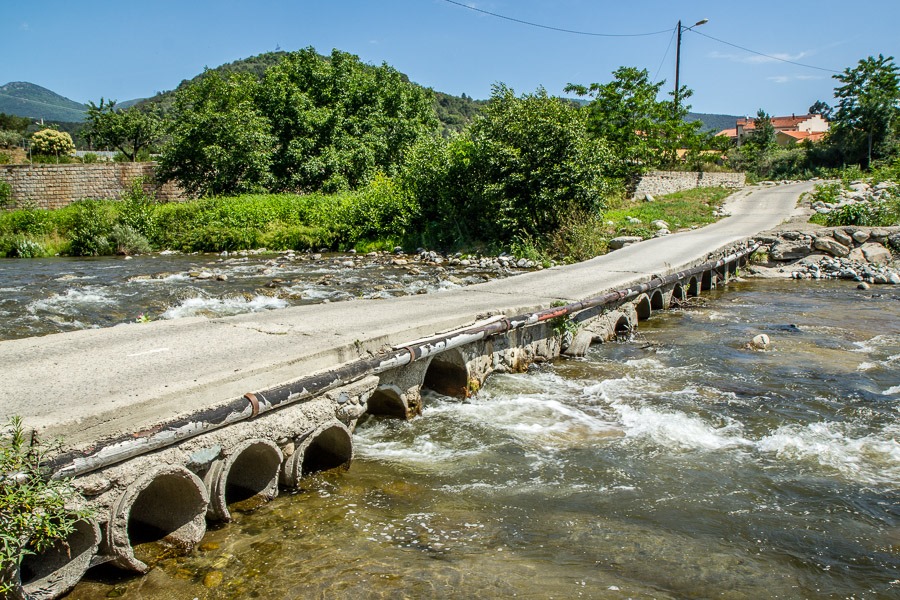
P1030380 blogThe dragonfly habitat is a small stream that runs along the northern border of the area and that you cross as you drive in. One might easily miss it. Assuming that you don’t, here you quickly see fluttering Demoiselles, both the more mundane Banded demoiselles but also the captivating Copper Demoiselles that you have to come this far south to see.

J14_1175 Blue-eyed HooktailOn this visit, one good addition was this Blue-eyed Hooktail (Onychogomphus uncatus) with the fearsome looking anal appendages. Just imagine a sexual encounter involving those.

_MG_4674Our most interesting addition to the location’s list, though, was our completely inappropriately named Norfolk Hawker (Aeshna isosceles). Here were several Norfolk Hawkers patrolling up and down a small stream in Provence. The Dijkstra suggested European name of Green-eyed hawker seems so much more appropriate. The critter isn’t even limited in range to Norfolk in the UK, now. More curious is the fact that in the UK, this creature is tightly bound to one specific aquatic plant on which it oviposits, Water Soldier. Here in mainland Europe, no such association exists; there wasn’t a single Water Soldier plant in sight.

An interesting day, for those of us that care about such things, anyway. 😉

Posted in 2014 France

International Cabaret

Campsites can be entertaining places sometimes. Today we were treated to a couple of international entertainment acts.

Act #1 was from Deutschland.

Popular though they most certainly are with many punters, I am personally very disparaging about motor vans. There is something vaguely insolent about motor vans. We arrive on site in the early afternoon, pick a pitch as far from any other instances of homo sapiens [the word sapiens is applied loosely] as is possible then, generally much later, in swarms a collection of roughly 2-ton, £60K motor vans with accursed roof-mounted, auto-seeking satellite dishes that ruins everything. They just seem to be saying, “up yours”!

P1030382One particular German big mo’-fo’ motor van had clearly not understood the motor vanners’ manual ‘cos it turned up early in the afternoon. It paid dividends, though. It was of the brand Roller Team. How naff is that name, for a start? Specifically, it was a Roller Team Granduca Magnifico. Yikes! No wonder it was big – it needed to be big to get all the signwriting on. It was driven into a pitch adjacent to us and stopped by its kommander, momentarily, anyway. Herr Panzer Kommander dismounted to join seine Frau and began looking at surrounding pitches wondering where precisely to site his tank. Leider, Herr Panzer Kommander hat vergessen to apply the hand brake. Ever so gradually, two tons of Roller Team Granduca Magnifico began roller-teaming majestically down the slight gradient of the pitch. Frau Panzer Kommander, realizing the situation, began shouting excitedly at Herr Panzer Kommander. Had Herr Panzer Kommander been Japanese, he would undoubtedly now have done the honourable thing and committed hara kiri by flinging himself onto the ground in front of his tank to arrest its progress. Fortunately, he was saved from this course of action by the hedge surrounding the pitch, which crunched a little as it finally brought the Roller Team Granduca Magnifico to a stop in much the same fashion as did the Normandy bocage 70 years ago this coming Friday, June 6th.

A narrow escape for the assembled resistance personnel in the opposing pitches on the other side of the track.

Act #2 came from Holland.

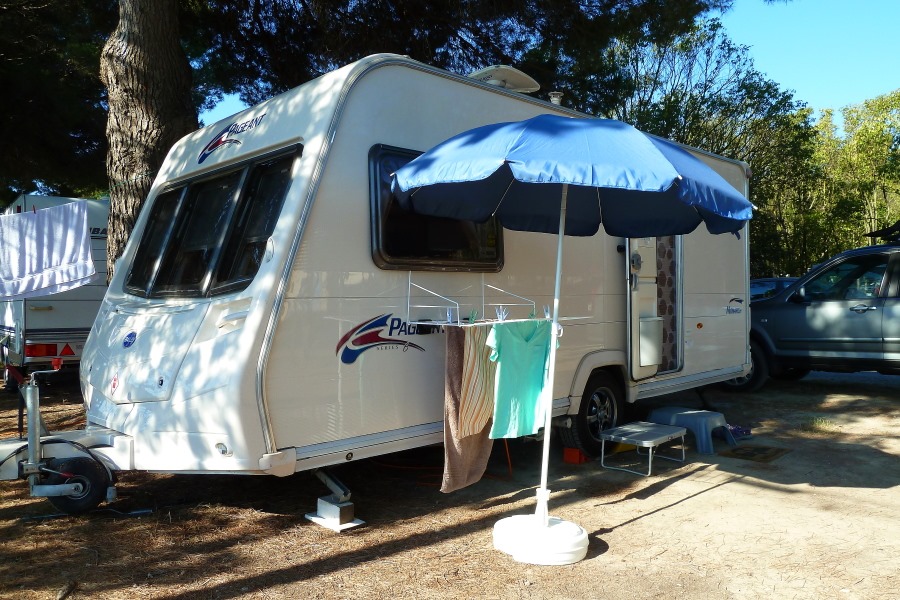
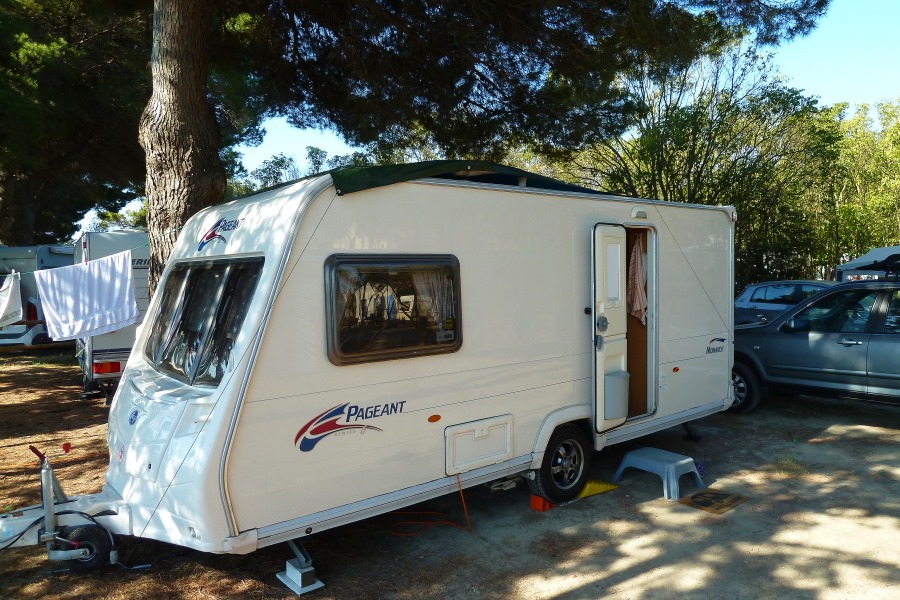
The Dutch have a reputation as being magnificent travellers but I sometimes wonder whether they really deserve it. A KIP Grey Line 470 Special caravan turned up, being towed behind a Volvo estate that sounded more like a Massey-Fergusson than a car. This combination regrettably chose to become our neighbours. Bother!

The Dutch, of course, are fond of their bicycles. Our laudable Caravan Club strenuously discourages any attempt at mounting bicycle carriers on any part of a caravan. This is a perfectly sensible stance. Carriers are available to sling bicycles across the draw bar of a caravan but doing so vastly increases nose weight. Other carriers are also available to sling bicycles across the rear of a caravan, as if it were a motor van, but doing so on a caravan seriously decreases nose weight. To tow safely, one needs to have a positive nose weight within a specified range. Indeed, the police force representing Act #1 [see above] may well check your nose weight when travelling through Deutschland and give you a ticket if it is found to be out of bounds. As travelling savvy as they are supposed to be, the darn Dutch sling their goddamn bikes in both unsafe places, sometimes across the draw bar and sometimes across the back of their vans. Our new prospective neighbour, the KIP Grey Line 470 Special, had two weighty, style-free Dutch bicycles slung across its rear.

P1030383The caravan was unhitched from its Massey-Fergusson and Mr Cloggy began using his caravan mover to position the beast on the pitch. When going in reverse, each time the caravan stopped, its jockey [nose] wheel lifted off the ground a little. With the bikes slung across the back, this combination clearly had next to zero positive nose weight. The final scream came on the final rear braking manoeuvre. The back end heavy caravan reared up and sat on its rear with its nose in the air. “Hi-ho Silver, away!”, shouted the Lone Ranger. The KIP Grey Line 470 Special needed a tail skid. The Lone Ranger and Tonto both rushed to add their weight to the caravan’s draw bar and drag the nose wheel back into contact with terra firma.

Most entertaining, how we did applaud. 😀

_MG_4607To calm ourselves down after all our exciting international cabaret, we drove off into Les Alpilles. This is the first time we’ve had a chance to walk in them as they are closed between July and September to guard against fire risk. Things looked a little quiet at first but then  perked up when we started seeing a particular butterfly in large numbers. It was a species we’d encountered just two years ago in France, the False Ilex Hairstreak (Satyrium esculi). There were, though, a few other lighter but similar looking butterflies mixed into the darker swarms. These, we later discovered, were the Blue-spot Hairstreak (Satyrium spini), a new species for us. New identified species are always a thrill and, for once, the underside view is critical.

Posted in 2014 France

Fair Wind to Provence

One instinctively knows when it’s time to move on. We’d had a good time at Millau, helped by an interesting riverside pitch and reasonable weather for orchid hunting but now it felt like time to move. We bad farewell to our compatriot friends across our intervening pitch, hitched up and headed for Maussane-les-Alpilles in … yes, Les Alpilles, a few kilometres south of St-Rémy-de-Provence. I don’t know if the name Les Alpilles is some form of diminutive of Les Alps but they are a series of modest rolling hills – I’ve seen them described as waves – on what is an otherwise quite flat landscape.

The prevailing wind for our stay at Millau has been largely from the north. Its continuation now put the wind up Guillaume’s skirts and helped him south down the remaining stretch of the A75 before he hung a left towards Montpellier and on past Nîmes to our destination. Descending off les causses to the Mediterranean plain took us down a 7.5kms/5mls 7.5%/1-in-12 hill with a tedious 50kmh speed limit for towing vehicles. Quite sensible really – the sight of a jack-knifed Guillaume can be very upsetting, especially if one is in the car attached to hte front of him. At least you can enjoy the views. 😉

The temperature rose steadily as we descended southwards. Clouds were thinning and the skies were clearing as we neared Provence. 18°C/60°F became 28°C/77°F. That’s more like it, that’s why we’re here!

Our campsite at Maussane-les-Alpilles can best be described as “not us”. It is a municipal with excellent security, hedged pitches and inclusive wi-fi. It sounds fine but it’s a bit too urban and feels quite crowded. Still, it’s the most convenient we’ve found in the area and we are here for a reason, namely the Peau de Meau, but more of that later.

J14_1107 Copper DemoiselleAfter pitching Guillaume in the most secluded corner we could find, we set off to investigate what I fondly refer to as the Maussane Ditch, what appears to be a drainage channel running into a small stream. Our late summer trip here produced about 11 species of Odos here. I was intrigued to see what spring species might be around to add to the list. We added a couple I think, from memory, but the most enchanting inhabitant is still the stunning Copper Demoiselle, which I’ would never tiring of watching. I offer this as proof that there is no God, since any god could never be this artistic. [Prepares to dodge the thunderbolt!]

Posted in 2014 France

Another Celebrity

Today dawned brightly enough but soon turned largely grey. Anyone would think we were in the UK.

The first task on our agenda was to take my limping steed to a French bicycle repair man. I loaded my bike on the car and we set off into Millau to a shop whose door claimed it opened at 9:00 AM every week day. At 9:30 AM he shop was firmly shuttered. We went shopping. At 10:30 AM the bike shop remained firmly shuttered. We drove past another two bike shops that were also firmly shuttered. In fact, many of the shops in downtown Millau were shuttered. Monday seems to be an off day. Lame steed with have to remain lame when we leave for Les Alpilles tomorrow.

J14_1039 Uid orchidWhereas grey days are not good days for Odonata, orchids tend to stay where they were rather than hunker down and hide. We had a suspect orchid, one that was just a flower spike but with no actual flowers, to revisit to see if it had advanced enough for Francine to identify it following our first trip up onto the causse. We set a course back up the Causse Noir with but one stop in mind.

_MG_4560_MG_4565Fortunately, our memory of where this particular uncertain orchid was located proved to be accurate. We parked in a handy lay-by and sauntered back down the road to where it was. Excellent, the beast had flowered in the intervening four days. Snaps of the more advanced plant were taken. Still no leaves were showing, just scales on a strikingly red stem with pinkish-red flowers.

Francines’s suspects for this plant included Red Helleborine, which is advertised as being in this area, but the stem seemed to be the wrong colour (i.e. red), or some form of Serapia but, again, the colouring of this plant’s stem didn’t seem right. This whole plant appeared to be red. Neither did it seem to have any leaves, as such. Curious. A rummage in the book was needed.

We headed off up the Gorge de la Jonte thinking that we’d visit the Belvédère des Vautours (a viewpoint for the Griffon Vultures) but that proved to be just as open on a Monday as Millau’s bike shops had been. Why have I never noticed that France seems to be closed on Mondays before?

Conditions were cooler and greyer up on the causse, where we felt decidedly underdressed. After a generally grey and windy day, we returned by way of the Gorge du Tarn for Francine to hit the orchid books. She soon figured out that her intriguing orchid was actually something rejoicing in the name of Violet Limodore (Limodorum abortivum), also called Violet Bird’s-nest, apparently. It is a saprophyte, a plant with no chlorophyl of its own, deriving sustenance from rotting vegetation with the aid of a fungus partner. How bizarre nature can be.

We move on with Francine having scored an impressive 18 orchid species around Millau. What a happy camper!

Posted in 2014 France

Another Causse Way

The back wheel of my bike is buckled, probably caused by my falling on it when I used my left knee as a brake, in the absence of any actual brakes, a few days ago. Since none of the plasters in our first aid kit came any where near the dimensions of my wound, a cut up T-shirt served as a temporary bandage while Francine scoured the local pharmacists for a pack of wound dressings equal to the task.

Today, I found a spoke key in the Millau Leclerc supermarket for a meagre €2.80 – I thought I might have a go at straightening the buckle myself. The key is a disc with a series of spanner-like slots of varying dimensions, none of which was small enough for the spokes on my lame steed. Foiled again! Yet again, I need a French bicycle repair man.

_MG_4465The afternoon was much more successful. We drove up the valley of La Dourbie and took another route up onto the causse in search of orchids. From our second stopping point, Francine went off piste into a meadow where she’d spotted a goodly crop of somewhat underdeveloped Pyramidal orchids (Anacamptis pyramidalis).

J14_1075 AscalaphidI was rummaging around on the other side of the road but Francine soon called me over ‘cos she’d also discovered another goodly crop of an utterly fascinating flying insect which was being unusually cooperative by settling on grass stems quite frequently. When they settled, the insects kept their colourfully marked wings spread for a while before folding them, tent-style, over their body. With distinctively long, clubbed antennae, they were unlike anything we’d encountered before. A swift scan through Chinery back chez Guillaume showed that we’d found something called an Ascalaphid, Libelloides coccajus. According to Chinery:

Ascalaphids are fast-flying relatives of Ant-lions.

“Oh, well, that explains everything”, I hear you say. We have come across an Ant-lion only once; that was up near Die in 2009. There are Ant-lions in the UK but no Ascalaphids. Both insects have predatory grubs. Now you know.

_MG_4525 Aymonins OphrysSeveral more stops produced nothing extraordinary until, on our penultimate pause, Francine found another new orchid. Her discovery turned out to be more special than she originally imagined; it was a local celebrity rejoicing in the name of Aymonin’s Ophrys (Ophrys aymoninii), known from the causses only, though “it may be more widely distributed in the central mountains of France” (it says here).

Two happy campers, despite the knackered knee and bike.

Posted in 2014 France

All in a Good Causse

The scenery around Millau is quite spectacular with various rivers, most notably the Tarn, having cut precipitous gorges deep into the surrounding Jurassic limestone plateau. The resulting individual plateaux between the series of gorges are at an altitude of about 1000m and are referred to as causses [pronounced koss, we think]. The limestone causses, with harsh winters but a near Mediterranean spring and summer climate, support a rich diversity of wild flowers and are particularly known for their orchids. One of our main reasons for coming here at this time of year is for Francine to search for those orchids.

J14_1029 PeyreleauToday was forecast to be un peu plus mauvais [a bit worse] than yesterday but, though the morning dawned grey, it didn’t look too bad. We made lunch of left over sausages and a baguette, and set off up the Causse-Noir, just behind our campsite. Our advised route took us to the attractive village of Peylereau and up the D29.

With Francine spotting orchids as we drove, the trick is to find somewhere to stop on mountainous roads with hairpin bends. Nonetheless we managed to find several areas in appropriate places and Francine was soon crouching down, snapping away and building up a list of orchids. She even had me looking for orchids. Whatever next?

_MG_4256 Military OrchidAs Odo-nutters are well aware, old favourites are always nice to see but it’s new species that cause excitement. Our first stop produced Francine’s first new find of the trip, the Military Orchid (Orchis militaris). It’s nice to see a grin spread across a face. 🙂

_MG_4329 Monkey orchid_MG_4335 Burnt Tip OrchidMilitary Orchids (it says here) can be confused with both Lady and Monkey Orchids, both of which I deduced were on Francine’s hit list. Our third stop produced another gleeful gesticulation at the driver as Francine found one of the potential confusions, a Monkey Orchid (Orchis simia), beside the road. Excitement went through the roof wandering back to the car as she spotted two diminutive Burnt Tip Orchids (Orchis ustulata). I was now driving a very happy camper, though she really did want to see the other potential confusion, a Lady orchid.

_MG_4346 Birds-nest OrchidStop #4 started slowly but produce more broad grins as Francine stumbled upon a small group of Bird’s-nest Orchids (Neottia nidus-avis) lurking beneath a conifer, apparently the wrong kind of tree entirely. Exciting her discovery may have been but colourful it wasn’t. Bird’s-nest Orchids contain no chlorophyll whatsoever and are consequently a rather dull honey-brown colour. Another new one for the list, though. Over the road were a few Lesser Butterfly Orchids (Platanthera bifolia), not new but enjoyable to see anyway. Just as we were about to leave, sneaking behind a bush – using your skill and judgement, guess the reason – Francine discovered a small colony of Common Twayblades (Listera ovata).

_MG_4398 Lady OrchidOur penultimate stop, stop #5, was producing more specimens of those already on the now lengthy list until, again returning to the car, we spotted a single Lady Orchid (Orchis purpurea) lurking near some bushes. Delight turned to ecstasy. How lovely to see such a satisfied customer.

_MG_4357 Narrow-leaved HelleborineBack at Guillaume, a sixth new species was added. All around our route we had been seeing large numbers of what Francine at first thought were White Helleborines (Cephalanthera damasonium). With a book to hand, she realized her mistake: these were Narrow-leaved Helleborines (Cephalanthera longifolia).

So, a very successful day, all in the Causse-Noir hunting orchids, which, at least, neither run nor fly away. Six new species for Francine in a day’s total of 15 (+1 to be identified when it flowers – we need to go back again).

Look at that grin. 😀

Posted in 2014 France

Beavering Away

We’ve stayed at Millau a couple of times before and always at the same campsite, Camping St. Lambert amongst trees beside a gentle bend in the river Dourbie. The Dourbie’s attraction for us is that it’s a good wildlife river, being non-navigable (other than by canoe) with wooded banks and the odd area of more rapid water. It flows into the better known river Tarn at Millau about a mile downstream of the campsite.

On our drive down through central France this time, we flirted with the idea of staying at one of another couple of campsites overlooking the Tarn itself. Francine was reading the write-ups and one mentioned “50 species of birds, and beavers in the river”. Beavers? Oh, how we chuckled. Some poor tourist had clearly seen a coypu, which we are very familiar with in France, and thought they were looking at a beaver. Similar, I suppose, if you look back at our coypu picture from day #1. Mirthful interlude over, we just headed for our same old campsite.

We’re early in the camping season and managed to snag one of the prized riverside pitches set in the river’s curve. Guillaume was soon installed and being entertained by his view across the river. A pair of Dippers is flying tirelessly up and down the river, one going downstream and one going upstream, both to different areas of tumbling water, gathering food from beneath the water for chicks in their nest on the opposite bank. Dippers are delightful, dumpy little birds that fly fast with frenetic wing beats just a few inches above the water. By the time any camera electronics have thought about focusing, they’re gone. We can see where their nest is but can’t see the nest itself.

One of the stars opposite Guillaume has to be the gaudily coloured Kingfisher. Occasionally we get treated to a flash of iridescent blue underscored with orange.

On the more mundane side, though still endearing, we have a Starling’s nest in the tree beside Guillaume. The youngster(s) have fledged but still sit chattering and whistling waiting to be fed.

J14_0977 Chewed treeSo, when relaxing, here we sit watching for interest in and around the river. We were doing just that when Francine noticed the base of the trunk of one of the larger trees across the river. Here’s a shot of it – that is one seriously thick trunk. The only thing I know that does that kind of thing to a tree is a beaver. Strewth, the tourist had definitely not been confusing beavers with coypus! In front of the tree you can see what looks like the beavers’ access point into and out of the water.

We chatted to Thiery, our campsite proprietor, who confirmed the presence of castors [beavers] in the river. A little Internet research by Francine told us that the National Parks had made a few species reintroductions around the Gorge du Tarn, one of the most charismatic of which has to be the mighty Griffon Vulture, examples of which can be seen drifting serenely overhead on most days. Much less popular, with Thiery at least, has been the reintroduction of beavers. It seems the little rascals have been pinching logs out of Thiery’s winter fuel supply and worse, chewing their way through some of his rentable, wooden chalets on the site. Castor oil is one thing but at this rate, given the French approach to most animal nuisances, there could soon be a new line in castor pâté on sale.

_MG_4265About 20m to the right/downstream of that chewed tree, is a fallen tree over an untidy pile of sticks that we suspect constitutes the beavers’ lodge. That half-chewed tree must be 30m or more tall. When that tree comes down it’ll make one almighty mess, in all likelihood spanning the river.

Maybe we shouldn’t stay here too long. 😯

Posted in 2014 France

Me, Ow!

[You should get the joke in a minute.]

We spent s splendidly peaceful night at our blissfully rural site Bruere-Allichamps. The morning dawned with as many clouds as we’d had the day before but, nonetheless, I decided to wander along the edge of the river just to see if I could find any Odos roosting.

For camping, I love Crocs – they’re so handy for slipping on and off as you exit/enter Guillaume, thus leaving all the wet grass clippings outside. Where Crocs fall down deplorably is in the wet when they become disastrously slippery. The grass beside the river was decidedly wet. At one point, my uphill right foot decided to lose grip and pass my downhill left foot in seeking a point of lower potential energy. In short, I fell over with only my camera and macros lens breaking my fall. I wrenched my right knee. Fortunately, the camera and lens were merely dirty and needed cleaning. I found no roosting Odos.

With most of France being blanketed in thick cloud, our plan, such as it was, was to head south with all speed. Our first main area of attraction were plateaus around Millau [pronounced Mee-oh – now you should get the joke], hopefully far enough south to get a chance of some decent weather. Wrenched knee and all, we hit the road and made our way to the autoroute where Sally Satnav instructed us to “continue for 354kms”. Great – easy!

We followed Sally’s instructions (for once) and, after a fuel stop and a lunch stop, found our way to our favoured campsite beside the river Dourbie in Millau at about 3:00 PM.

I fancied a beer but we’d drunk them all. So precipitous had been our journey south that we hadn’t yet been anywhere near a French shop. No beer. A swift cycle ride into Millau was called for, in search of a bar.

Shortly before our departure for France, Francine became the proud owner a of a new bicycle. Never mind the details but this meant that I swapped a set of tyres from Francine’s old bike onto mine. I took the bikes off our car and off we set.

Along campsite tracks, then up a ramp to the road, turn left to head for Millau and, after 500m or so, Francine turned left onto a cycle track. I began turning to follow and touched the brakes. Nothing! The brake levers flopped in my hand. I continued at the same speed. Having no brakes on a bike is a little like ones first attempt at ice skating where there is absolutely no way to halt forward progress. Friction is utterly lacking. The only way for a novice ice skater to slow down is to fall over. I continued forward and clipped Francine’s new back wheel and slowed down, in the time honoured manner, by falling over. My left knee became my brake and the concrete surface of the cycle track became my brake drum. The concrete, naturally, remained largely undamaged but little remained of my left knee. Blood trickled down my leg.

I had clearly absentmindedly forgotten to reconnect the brake cables after changing the tyres on my wheels. I must’ve distracted myself somehow. Utterly stupid!! I had now buggered both knees in one day. Welcome to Me-ow!

At least the sun is shining. There is a Dipper flying back and forth along the river gathering food for young, a Kingfisher is flying along the opposite bank and majestic Griffon Vultures are soaring overhead. There aren’t many better places to sit nursing buggered knees.

Now, where’s that bandage?

Technorati Tags: ,,
Posted in 2013 Spain

The Road to Hell

A long time ago, the eminent Chris Rea wrote a song called The Road Hell. Today, we drove along it. I should back up a little.

Our favoured route into France is this: down to Dover, ferry to Calais, 2-hour drive down the A16 past Boulogne-sur-Mer, then the A28 to Neufchâtel-en-Bray in Normandy. On day 2 we generally head south through Rouen to Evreux, Dreux and Chartres. This route drops down what is pretty much the centre line of France so we can deviate almost anywhere without too much hassle. The route, though, has one serious problem: between Evreux and Dreux lies St-Remy-sur-Avre which is one of the worst bottlenecks known to French homme. It’s a favourite truck route and traffic backs up horrendously to crawl through the traffic lights at St Remy’s centre. The most frustrating aspect is that two lanes neck down to one and cars in the outside lane constantly queue jump, cutting in and holding up inside lane traffic even more. So bad is it that we’ve actually seen trucks sit in the middle of the road to block both lanes and stop the queue jumpers in their tracks. Bravo Euro-truckers! Weekdays are dreadful – the only way to deal with it is to hit it on Sunday morning when it’s quiet. We were travelling on Monday so decided to try a deviation to avoid it. Big mistake!

In attempting to bypass St-Remy-sur-Avre to the east, we hit one of the slowest, bumpiest roads, rich in towns and villages deploying 30 kph speed limits and violent ralentisseurs [infernal speed bumps] to enforce them. It may be hard to believe but the French seem to be even more in love with speed bumps than we are. Poor Francine was, at the same time, staring left and right as we passed orchids in the verges, and getting bounced up and down by said ralentisseurs. This combined movement completely wrecked Francine’s neck. It also lost us 45 minutes, as well as our sanity. The traffic jam would’ve been far preferable although, of course, had we been sitting in it, we wouldn’t have known that. We’ll know next time. Such is life.

We eventually hit some decent roads sans bumps, then the A71 autoroute past Orléans and down to a delightfully rural, 1-star campsite at Bruère-Allichamps, just a spit north of St-Amand-Montrand. Bruère-A has a Roman column noting that it is Centre de la France. I said we were dropping down the centre line and we’ve ended up plumb centre – for a night, anyway.

I’ve often stated that our favourite kind of site is a field with an electric hook-up and no facilities. Well, here it is and at a stonking €9.04 a night including electricity – and madame let me off the 4 centimes. I tried to insist but she was having non of it. We are on the banks of the river Cher and the only noise is a cricket chirping away. Some sun would be nice but, hey, it’s blissfully peaceful. There seemed to be only one other unit on site when we arrived. Since then a couple of touring motor vans have turned up, too. Being Dutch, the very first thing motor van A did when it arrived was set the roof-mounted satellite dish spinning on its mission to auto-locate a TV signal. Its still very peaceful, though.

J14_0963 Erythromma lindeniiWe very recently been paying £21.00 a night for a site with less facilities in England’s New Forest. This French field beside the river does actually have a rudimentary sanitaire block but we’ll be using Guillaume just for convenience. I know which I think is preferable. To add to the pleasure, we found Banded Demoiselles (Calopteryx splendens), Blue-tailed Damsels (Ischnura elegans) and Goblet-marked Damsels (Erythromma lindenii) flitting about just metres from Guillaume as he overlooked the river. I dislike that BDS name, Goblet-marked Damselfly; I much prefer the Euro name, Blue-eye which I think is more descriptive.

Interestingly, on the path beside the river, close to where many Banded Demoiselles were flitting about, I spotted a few dark blue “stains” on the ground. The dark blue stains were, in fact, discarded male Banded Demoiselle wings. There were about four pairs. Something had been dining on Banded Demoiselle.

Chris Rea’s Road to Hell was the M25. Our road to hell was the D16 to Dreux. After our seriously misguided choice of alternative route, we deserved a little luck.

Posted in 2014 France

Guillaume Reviens

Guillaume is at his happiest when he’s in France but he was a bit of a grumpy guts having missed out last year due to yours truly deciding to forego foreign travel in order to get his cataract ripped out. Today, Guillaume breathed an enormous sigh of relief when he boarded a P&O ferry at Dover’s east docks bound for Calais and his long awaited return to France. He was doubly delighted because we checked in and instantly boarded the boat departing almost an hour before the one we’d booked. Excellent!

The only potential cloud on Guillaume’s sunny horizon, this coming week being half term, was that the ferry turned out to be something of a Euro-Disney Express. Every other warm body was one of Satan’s Little Disciples. We even had an announcement by M. Mouse himself. Mercifully, the Disciples were little problem and the journey passed quite pleasantly. We disembarked and were on the road by 1:00 PM local time.

Since our favourite entry and exit campsite has joined the ACSI organization and has become filled with travelling Dutch, I made reservations – not something I’m given to doing in France, especially out of the main season. In this case though, there’s little in teh way of alternatives and we didn’t want any disappointment. We disembarked our earlier ferry and were on the delightful French roads – smoother and quieter – by 1:00 PM. Ignoring the atrocious fuel consumption (22.4 mpg) caused by towing into a ferocious headwind, we hit Neufchatel-en-Bray at 3:00 PM and pitched up. Well, we pitched up after waiting for one poor couples tow car to be towed away for repair. It was en panne. Our hearts went out to them – been there, done that.

J14_0959 RagondinAfter an early-ish start (on the road at 7:00 AM), we popped out to a local plan d’eau in search of relaxation and entertainment. Odonata life was decidedly slow, though we did eventually find some. Our best entertainment, though, came from a ragondin [coypu] which was brazenly swimming about the modest lake apparently unconcerned about human neighbours. We’ve searched them out before in the Marais Poitevin where they tend to scarper at the slightest disturbance.

Posted in 2014 France