Solo Across Spain

This journey is something of a novel experience for me. Having driven many thousands of miles in France over the last 30+years, I am very used to driving our right hand drive cars in a drive-on-right country. Going “the wrong way” around a roundabout has not presented a problem for many years. The only slight difficulty with this road/car combination is an overtaking manoeuver on a single carriageway road, the driver not being able to see past the slow-moving vehicle in front. This is particularly critical  when one feels like overtaking at a lower differential speed with Guillaume, our caravan, in tow. However, I’ve developed a fool proof technique for such occasions: I edge out sideways until Francine, in the passenger seat, can see past the obstructing vehicle and, if she screams, I take this as a signal that something is probably coming and pull back in again. 😀

The novelty with this trip is that, for the very first time, I don’t have Francine in the passenger seat. The potential overtaking difficulty does not arise since the vast majority of my 480-mile journey is on autopistas [motorways]. Where I will miss Francine desperately is at the toll booths. Ticket dispensers and pay stations being on the left of the car, it is trusty Francine who always has to deal with these. Now I’m travelling on my own, I’m having to deal with it myself from the “wrong” side of the car. I have to get out of the car at each toll plaza and walk around the car either to take a ticket or to insert the previously taken ticket and pay. It’s not particularly difficult but it certainly feels a little odd.

Navigation is the other issue that’s a bit of a novelty. Prior to the days of satellite navigation systems, I’d have remembered towns to head for on the motorways [in this case: Valencia, Teruel, Zaragoza Logrono, Bilbao] and possibly a road number or two before resorting to reading road signs when on final approach. Now, of course, I have Sally Satnav to help but I’m also used to relying on Francine to “keep Sally honest” and save us from some of her occasionally strange route choices. Honestly, it’s technology that’s almost clever. I must say, though, I was thankful to have Sally approaching 480mls/770kms solo in a foreign land, one with which I’m not yet particularly familiar.

I dealt with the tolls to Valencia (yesterday) before hitting today’s blissful toll-free stretch on to Zaragoza. Then tolls took over again to my stopping point slightly before Bilbao at a place called Arakaldo. As luck (or not) would have it, the toll booth for payment seemed to coincide precisely with my required exit road. As I approached the toll, Sally muttered “exit right”. I stopped at the toll plaza, clambered out, inserted my ticket followed by my credit card, then returned to drive off. Damned if I ever saw an exit road but in the blink of an eye I was past it and heading further towards Bilbao. Bother!

Sally kept her cool and told me to get off at the next exit 8kms away. I did. She told me take third exit off the roundabout at which I’d arrived. I ended up at another toll booth paying a little more. This was wrong, I was still heading towards Bilbao, getting yet further away from my destination.

My nest exit was in a complicated area of Bilbao with tunnels and roads resembling Spaghetti Junction. As I clambered of yet again, as instructed, there were two slip roads on top o each other. Wrong one! Still going the wrong way. Eventually I took a slip road off within a tunnel, arrived at a toll booth, paid – a real warm body for once – arrived at a roundabout, took the third exit and arrived at the other side of the very same toll booth paying yet again to backtrack. Are we having fun yet?

Heading south again, Sally told me to take a slip road right. It felt wrong but my brain was now fried and I did it. Ah, been here before, this was the roundabout I’d first arrived at where I mistakenly got back on going north. Now I think Sally was confused; she said nothing. Sally’s map didn’t help ‘cos here there are roads on top of roads and the intended/highlighted road is unclear. I circumnavigated the roundabout fully twice, hoping that Sally would say something. She remained quiet. Arakaldo did not appear on any road sign, as far as I could see.. In an act of faith, I headed off down a non-motorway road that appeared to be going in the right direction and was on the correct side of the river on the valley floor. (Precipitous valleys are the very reason there are roads on top of roads in this part of Spain.)

I rebooted Sally. Mercifully I was going the right way and was a mere 10kms away. I arrived with much relief, albeit 40 minutes later than expected. I checked in a bought a much needed drink.

This is some supposition based upon my experiences of satnavs in combination with Bilbao:

  1. There are several roads very close together and/or above and below each other, leaving the satnav less than sure which road you might be on;
  2. The roads are a tangled nightmare with multiple exits on top of each other. Spoken instructions of the satnav simply are not fast enough to distinguish between the exits; speaking it takes too long. It gets very confusing. I’ve noticed a very similar difficulty with multiple mini-roundabouts on top of each other in the UK.

I hate the roads around Bilbao, especially without Francine. 😀

Technorati Tags: ,,
Posted in 2015 Autumn

Marjal dels Moros

I’ve locked up Casa Libélule and begun my journey home to re-join Francine. I’m breaking the journey just a little by calling in to a reserve, the Marjal dels Moros, near Puçol, just above Valencia. It took me two hours to get here using Sally Satnav and I found ample parking at 12:30 PM. So, tomorrow’s journey to near Bilbao should be more like 6 hours than 8 hours.

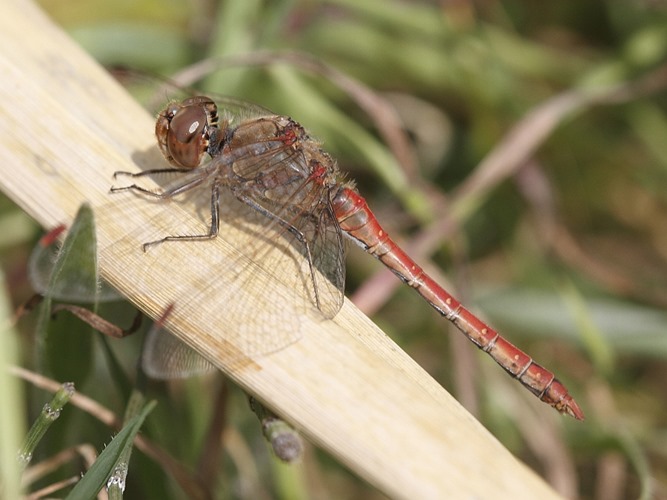
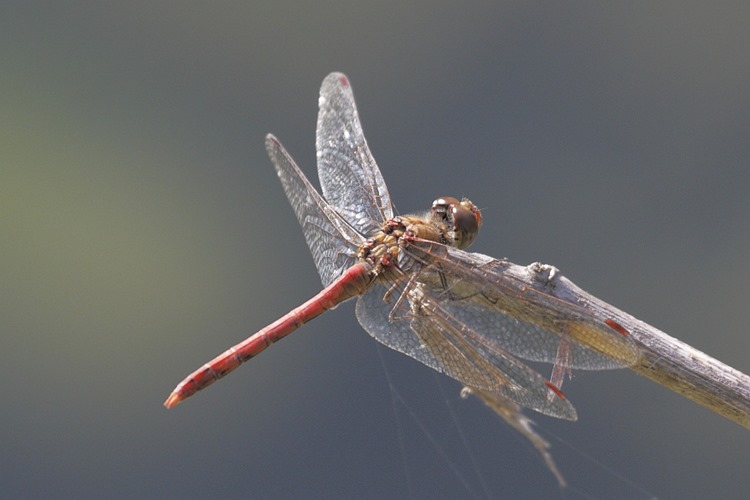
J15B0451 Sympetrum meridionale maleI had inside information that the way into the marjal was “along the beach”, the beach being large pebbles, or along a track between two canals behind houses. I had a look at the latter first and decided to try the beach, largely ‘cos I spotted a small gaggle of birders armed with spotting scopes coming out that way. Tromping north along the beach, from my slightly elevated position, sort of a rough sea wall, I could see water bodies and above one I spotted a distant hawker hawking about. What I didn’t see was any ready access to said water bodies. Indeed, it took me some time to find any way in to the reserve at all. At one hopeful looking track beside a bird observation platform, I was blocked by a fence. There were a few Red-veined Darters (Sympetrum fonscolombii) flitting about in the nearby vegetation and also what turned out to be Southern Darters (Sympetrum meridionale), but I was beginning to feel a little underwhelmed.

J15B0469 Anax parthenopeJ15B0473 Anax parthenope maleEventually I found a board advertising an Itinerari beginning with a boardwalk heading into the marjal. Hopes raised, I set off into the interior. Additional life seemed scant, though. I did spot one Broad Scarlet (Crocothemis erythraea) but that was all until I finally came to an access point beside a water body. At last, a place to watch Odos over water. Here, I amused myself for a time watching and trying to snap a male Lesser Emperor (Anax parthenope) on patrol. Pictures were only partially successful, at least in part because the lighting conditions were not great – glaring water, despite the cloud. Actually, I’d driven for 90 minutes in sun to get here only to find cloudy conditions at the marjal. Typical! Still, it was warm, about 27°C, and there was activity.

J15B0486 Trithemis kirbyi maleI’d been targeting this particular reserve before setting off from the UK, my main reason being to search for Orange-winged Dropwings (Trithemis kirbyi). As it turns out, I found them on my doorstep in Jalón. So, the apparently lack of them here, thus far, was not too much of a concern. I wasn’t actually spotting what I now thought of as their normal type of habitat, rocks beside streams. However, on the southern leg of my route, beside what I’d describe as a drainage ditch rather than a stream, I did actually find a couple. So, they do exist here.

What would be most handy, certainly on a first visit to the Marjal dels Moros, is a guide. Occasional “usted esta aqui” [you are here] maps would be a decent substitute. Unfortunately, both were in short supply. I began looking for a way out. I actually didn’t even know if I was still on the itinerari, so scarce were the maps. A man dressed in almost nothing, the only chap I’d seen other than me, tried to direct me in his English, which was less scant than my Spanish. I flipped a mental coin between back-tracking and trying to follow his instructions round the rest of the park. Perhaps foolishly, his instructions won. Eventually, after returning from yet another track blocked by yet another fence, I did find a second of the itinerari signs. Heartened, I continued, eventually finding myself on what I suspected was the southern edge track between the two canals. I was right and was fairly shortly reunited with my car with an unusual amount of relief.

I’m glad I visited en route to Bilbao. Had I done my originally planned 4-hour round trip from Jalón, I’d have been quite disappointed. This marjal really looks a bit like an RSPB reserve, great for birds (with observation platforms) but where the habitat is also enjoyed by dragonflies. Observing the dragonflies, though, is a bit more of a challenge. You need to get close to them and places where that could be done seemed a bit limited. I suppose, had this given me my first ever Orange-winged Dropwing, I’d have been feeling considerably more positive about it. As Jalón had proved better, I felt a bit so-so.

Fretting about an exit when I had no idea where I was didn’t help at all.

Posted in 2015 Autumn

Early Exit

As has been expected for a while, events back at home have conspired to make me leave Spain earlier than originally planned. We’ve been in a somewhat complicated situation with Francine having flown back home last Saturday, leaving me here with #1 car in which we travelled over together. Our original return date was to be 22nd October from Bilbao.

It would have been possible for me to leave the car at the airport and fly back home for a few days, subsequently returning to retrieve the thus completely abandoned car. Francine may have been able to come back with me after her home duties, too, but it would have been for a week only, at most. Since any such bookings would be at short notice, the flights were looking expensive.

I actually considered driving up through Spain and France to take a more civilized cross Channel ferry. I could do that journey solo in two days. It would involve quite a bit of fuel and toll costs plus an overnight hotel, amounting to about £300 I’d guess, but, to be honest, since it avoided my encountering the Bay of Biscay again, it was in all honesty my personally favourite choice.

However, Francine contacted the booking agents (Caravan Club) for our original Bilbao crossing and managed to change my return date to 6th October. That still cost a whopping £115 to amend, mind you. Strewth!

So, that’s what I’ll be doing, dicing with the Bay of Biscay again. 😯

I’m taking the opportunity to break the journey to Bilbao by calling in to a nature reserve just above Valencia. on Sunday, one that I had wanted to visit on a day trip  Since the route to Bilbao takes me more or less past it anyway, calling in en route makes sense. Then I make my way to Bilbao from there on Monday for a relatively early ferry on Tuesday.

Wish me luck. 😉

Technorati Tags: ,,,
Posted in 2015 Autumn

RVDs Restored

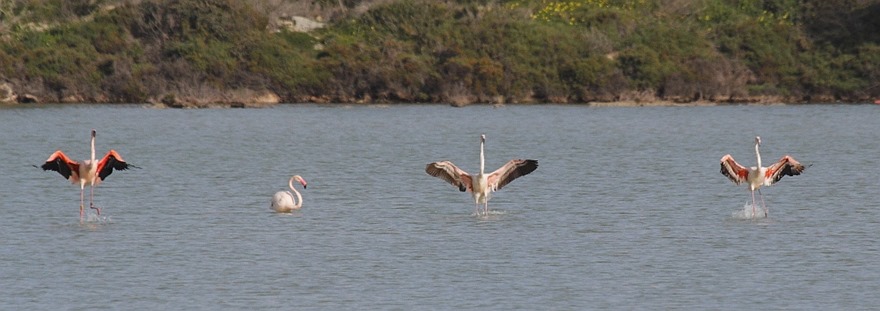
The most famous inhabitants at the Calpe lagoon, Las Salinas, are Greater Flamingos. It has also been a reliable home for one somewhat salt tolerant species of dragonfly, Red-veined Darters (Sympetrum fonscolombii), affectionately known as RVDs, often being found in coastal situations. Las Salinas is at least brackish – there’s a clue in the name. I don’t know how salty the water normally is and the water does look appealing enough to taste. :D.

On my last visit to Calpe in June this year, there had been a problem with the water at the lagoon, which was then very low indeed. I was disturbed to find no sign of any Red-veined Darters. Had the water become too salty for them now? The Flamingos were still in residence but then they survive on Africa’s toxic soda lakes so they are hardly a good gauge.

Today I took an opportunity to visit Las Salinas again to see how things were. The water level looked much better so perhaps the problem had been sorted out. I couldn’t see Flamingos at first but, sure enough, there they were on the very far side of the lagoon. As I wandered along the southern edge of the lagoon, I still wasn’t seeing any dragonflies, though. Worrying.

J15B0427 Sympetrum fonscolombiiJ15B0433 Sympetrum fonscolombiiEventually, at a small promontory that sticks out a little further into the water, in some low vegetation a movement caught my eye. There were at least three Red-veined Darters flying and settling here. Relief. I snapped what I could. The all looked initially like females but you have to be careful, immature males have the same colouration and one of these was just that, an immature male [left].

J15B0437 Sympetrum fonscolombiiI had to wander someway further before I found a more mature, red-coloured male and even this one doesn’t look fully mature, with yellow still showing on his sides.

The lagoon at Calpe is, I think, the best place I know for photographing these beauties. The sun is behind you and there is usually a nice clear background, either the lagoon water of distant vegetation, in front of you. I was much relieved eventually to find RVDs in residence again.

Posted in 2015 Autumn

Almost DeScamped

I thought it was time I took el perrito, Scamp, for a bit of exercise. A wander into the village is about the right length and, if I played my cards right, I might also be able to check on the local Odo inhabitants around the pools of the river. I’d take my camera rucksack along, just in case.

El perrito used to use a regular collar to attach his lead to and walk in. There’s something about collars that seems to make dogs pull canstantly, the classic straining at the leash I imagine. The constant pulling also seems to half choke them so not only is the leash constantly taught but there is constant accompanying coughing, wheezing sound. Unpleasant.

More recently, el perrito uses one of those harness-type contraptions. There is a crosswise strap in front of the little blighters front legs, another crosswise strap just behind the front legs and a strap running fore and aft between his legs that joins the other two straps and keeps them in place. The whole harness comes together on top of el perrito’s shoulder blades, where the lead attaches. The harness is quite snug – you get different sizes tailored to different sized dogs.

El perrito’s reaction to the harness provides a good deal of amusement. As usual with a brainless canine critter, muttering the word walk causes ears to prick up in interest. However, removing the harness from its cupboard instantly makes el perrito disappear and hide. Undaunted, you track down el perrito who sits subdued and unmoving while you finagle his front legs into it and fasten it over his shoulder blades. You are now free to do anything – he won’t move. The contraption acts like a canine wheel clamp. Excellent. Freedom! Now clip the lead onto the harness above el perrito’s shoulder blades and suddenly all is normal again; the dog becomes re-animated and wants to go for a walk again. Very curious. Along with my camera rucksack, this is how we made our way down to the rock pools of the river.

Dog and I crossed a lot of boulders to approach the place where I’d seen my first Orange-winged Dropwing (Trithemis kirbyi) a couple of days ago. Today wasn’t very sunny so I wasn’t that hopeful but when I arrived at the spot there were not one but two males flying about and occasionally settling. With one hand hanging on the el perrito, I slipped off the rucksack and extracted my camera one-handed. Still one-handed, I grabbed a couple of snaps of my quarry in the quarry. One-handed photography isn’t the easiest, especially with a hefty 300mm lens plus 1.4X extender weighing down on the front of the camera. I needed to park el perrito.

3 metres away was a stand of bamboo. I lashed el perrito to the bamboo to free up my other hand and returned to my subject. At first el perrrito tried to follow me but was pulled up short by his anchored lead. I spent about five minutes trying to get better line-ups and shots using both hands. Finally I was crouching down in amongst the rocks taking what I thought was my best picture of this visit when, to my astonishment, el perrito wandered up and sniffed around my ear. What! Somehow he had slipped out of the harness.

I perhaps should just have left him to sniff around but tried to grab him, whereupon he decided to make off across the rocks, heading back in the direction from which we’d come. Giving chase to a scampering Scamp across boulders with an unwieldy camera rig in one hand is not easy. I wasn’t gaining on my quadruped charge who was fast approaching the road on the far side of the river gulley. Mild panic set in. I put on my sternest voice and bellowed “SCAMP!”. Fortunately it worked and the little blighter stopped, looking round at me. Relieved, I got to him. Next problem: picking up a struggling dog one-handed whilst not dropping my newly repaired camera onto the ground again. [It was recently repaired from dropping it during my previous Spanish visit.]

Somehow I managed to get him into my arm, I honestly can’t quite remember how. Now I had to make my way back across the boulders clutching a camera in one hand and a dog in the other to retrieve the harness and lead which was still lashed to the bamboo. I expected to find the harness opened up somehow rather than clipped together but no, it was still fastened as it is when across el perrito’s shoulder blades. The only thing was that el perrito was no longer in it, he was under my right arm. I have absolutely no idea how he managed to wriggle out of what appears to be a very secure straight jacket device. He should be renamed Houdini. I put my camera gently on the ground and fought Houdini back into his harness.

J15B0412 Trithemks kirbyi maleHere’s the picture that nearly made me lose someone else’s dog. The soft light as opposed to strong sunlight is an improvement with this species, I think.

I’m now wondering if he’d have sat immobilized if I’d simply unclipped the lead from the harness and left him with his canine wheel clamp on. Interesting thought. Maybe I’ll put it to the test somewhere safer, one day.

Posted in 2015 Autumn

Gandia Marsh

The amount of water in the Jalón-Gorgos river looks quite healthy at the moment. There’s certainly more than there was when we were here back in June. There’s apparently been some unseasonal rain during August which I’m sure has refreshed the river. I was a little surprised to find that the water in the Pego-Oliva marsh looked a bit low, though, when I visited yesterday. However, that has sluices and may be actively managed so I shouldn’t draw conclusions from that. Back in June the water in the Gandia marsh was very low. I was keen to see how that was doing now.

I have difficulty remembering how to find the place but Sally Satnav got me there. The bottom line is that there wasn’t any more water there than Francine and I had seen in June. I was disappointed. On our very first visit, as well as a couple of small lakes, there was a water channel running beside the approach track and all the way through the “marsh” itself. It was large enough for us to have seen workmen dredging it. In June that water course was utterly dry. It remained utterly dry today.

Distressingly close by the marsh, somebody seems now to be running outdoor exercise classes. They sounded as it they were being run outdoors. The booming accompanying music was loud enough to be heard in Valencia, I should think. I certainly couldn’t get out of earshot of it at the marsh as I made my way around the two lakes, which did still contain water. It reminded me of the managed green spaces in Milton Keynes which do support wildlife but where you can’t escape the constant drone of traffic. I think I preferred the drone to the Booming disco music, though.

J15B0384 Trithemis annulata maleIt took me a long time to spot any dragonflies. Activity wasn’t high but it was there, eventually. The most interesting thing that the first lake produced was this not completely mature male Violet Dropwing (Trithemis annulata). The usual gaudy pink colour of the abdomen was not fully formed, just enough to be recognisable.

J15B0393 Anax parthenope maleThe second lake looked even quieter at first but then I spotted a Lesser Emperor (Anax parthenope) cruising about above a reed bed at the edge of the lake. I spent some time amusing myself by trying to get a decent flight shot. Given the line ups I was only ever going to get the back end of the beast, looking as if it was flying away from me but get it I did.

J15B0397 Anax parthenope maleEventually, my subject settled for long enough for me to work my way through some of the vegetation and get a decent settled shot, albeit cropped. At least I didn’t scare it off. 🙂

J15B0401 Trithemis kirbyi femaleJ15B0404 Trithemks kirbyi femaleI thought I’d had as much fun as Gandia marsh could supply so I started wandering back out beside the desiccated water channel, Half way along, my eye was caught by a dragonfly movement. Given the way it was perching (on top of a stem) and its general colouration, I assumed it to be a female Red-veined Darter (Sympetrum fonscolombi). I am not short of RVD pictures but it had been a somewhat slow, slightly disappointing visit so I thought I’d have a little photographic play with this one, anyway. I am extremely glad that I did. It turned out to be my first ever female Orange-winged Dropwing (Trithemis kirbyi). Great stuff, a female to go with my first ever male from the Jalón river a few days ago. I was particularly pleased with a head-on shot that I decided to take –  just a little bit different.

Posted in 2015 Autumn

Decamped

While Francine remains in the UK attending to family business, Franco has been left in Spain holding the baby. The baby in question is el perrito, our friends’ pooch, Scamp. Since Casa Libélule is not particularly dog-friendly, I’ve moved into their house for the duration [a week].

Francine and I have looked after el perrito on many previous occasions but I’m discovering that it is not an easy task single- handed. Getting the car out of the property is a challenge requiring unlocking and opening the gates, driving out, stopping and closing an locking the gates. While I’m doing this, el perrito is constantly dropping a ball at my feet accompanied by an ear-splitting terrier-like yap/bark if I don’t stop what I’m doing to throw his ball quickly enough. Guess who thinks he’s in charge.

At least I’ve cracked the reverse operation of getting back in, which would normally involve the same demanding canine ball retrieving activity. Mercifully, el perrito has taken to getting into the back seat of my car and riding with me as I reverse in through the gates – much easier. Maybe I should start trying to drive him out and cut out the crap with the ball. My eardrums would appreciate that. Barking dogs are bad enough but piercing yaps are horrendous.

J15B0353 Sympetrum fonscolombii maleHaving ball-thrown my way out of the gates today, I took myself off to a marsh at Pego-Oliva to see what entertainment I could find. Not a huge amount in all honesty – a bit disappointing, really. The place is always lousy with Red-veined Darters (Sympetrum fonscolombii) and I soon managed to snag a decent shot of a handsome male.

J15B0359Orthetrum trinacria maleI was most fascinated with a very fast, dark looking dragonfly that was chasing about low down over the water in quite good numbers. I suppose its dark appearance should have given me a clue to its identity but I remained bemused until, part way around my regular circuit of this place, one finally settled in a reasonable location quite close to me. All was revealed: a Long Skimmer (Orthetrum trinacia). It’s still one of those species with which I’m slightly less than familiar. They really are fast little beggars. Maybe I’ll know next time.

J15B0362 Crocothemis erythraea femaleThere were Lesser Emperors (Anax parthenope) cruising above the channels (I think this marsh is a former rice paddy) but they weren’t posing. I spotted a couple of late-ish Common Bluetails (Ischnura elegans), too, and there were Broad Scarlets (Crocothemis erythraea) in reasonable numbers but the only other half-way reasonable photo opportunity was a female Red-veined Darter.

I might try my luck at Gandia tomorrow.

Posted in 2015 Autumn

A Look Upstream

Yesterday I confined my Odo hunting activities to the rock pools in the river as it flows through Jalón itself. With another day of wall to wall sunshine and temperatures topping out at 33°C, I thought I’d try my more usual haunt upstream towards Alcalalí.

My first port of call showed yet more Lesser Emperors (Anax parthenope) and Epaulet Skimmers (Orthetrum chrysostigma) doing what Odos do in the sunshine: hunt for food and couple to reproduce. Those two things are all that’s important biologically, food and sex. Neither species was being particularly cooperative but I did manage a distant shot of a perched Lesser Emperor.

Further upstream I saw more of the same with a scattering of the ubiquitous Red-veined Darters (Sympetrum fonscolombii) thrown in. This spot isn’t a great position for photographs, though, being high and looking down on the subjects.

Still further up was a pool close to my heart because it’s where I first saw a Violet Darter (Trithemis annulata) in Spain. I fought my way through a thicket of bamboo to get there again. Water, water everywhere. Yikes! There was precious little dry land for me to stand on but stand on it I did. Yet more Lesser Emperors and Epaulet Skimmers.

J15B0332 Anax parthenope maleI was keen on the Lesser Emperors, though, because they did seem to be perching every now and then. We have only two photos of them in our collection and good ol’ Francine snagged those. These seemed to perch only briefly, though, and my first attempts to bring the camera to bear were too pedestrian and failed. Eventually, I did see one land but it was behind intervening vegetation. I managed to focus on it and use the vegetation as a sort of old-fashioned centre-spot filter. I liked the effect. So, it seems, do many others ‘cos I got several complimentary web comments. 😉

J15B0337 Anax parthenope ovipositingI stood for some time watching and waiting. I saw what I thought was a couple of paired Lesser Emperors fly past but flight shots proved too difficult. Finally, a pair settled in the water close by and I did manage to capture them ovipositing, albeit with poor lighting conditions. These later turned out to be not Lesser Emperors but Vagrant Emperors (Anax ephippiger). Far from being concerned about my error, I’m delighted not only to have a third new species but also to have captured it on pixels. 🙂

J15B0345 Desert Darter maleI kept watching and eventually called it a day, here. I wanted to go and check on the two new species I’d found yesterday so I returned to the rock pools in town. I soon found my Desert Darter (Sympetrum sinaiticum) and today he was posing much more advantageously. By twisting myself all shapes and getting down low on the rocks, I managed to snag several better shots with a good, clear background.

Of my other new friend, the Orange-winged Dropwing (Trithemis kirbyi), there was today no sign. In fact, there was no activity where I’d found him, yet yesterday there were at least four species at that location. It’s curious how things can be so different on two adjacent and similar days.

Posted in Uncategorised

All New

Poor Francine has had to return to the UK for the classic family emergency. I dropped her at Alicante airport last night for a dreadful 11:50 PM flight back to Luton getting in at 1:20 AM. Strewth!. Dropping Francine off went fine but then I managed to miss my north-bound slip road onto the autopista and ended up going south for two more exits before I could turn around. (The first exit muttered things like “A31” and “Madrid” so I thought I should avoid that. Everything looks different in the dark. I flipped a U-turn and got home eventually and Francine was on her way shortly thereafter.

I’m left here with the car and, next week, a dog to look after. It’s a lousy job but someone has to do it. Today I am being descended upon for dinner. Before that, I decided to use the sunshine to investigate the Jalón river for potential Odos.

Since the river was all but dry on our last visit, I was surprised to see a very healthy amount of water. There has been quite a bit of rain in Spain during August, unusually. It’s still more of a series of pools than a flow but it looked quite healthy. So did the Odo populations.

J15B0289 Epaulet Skimmer maleThe first things I spotted were several Epaulet Skimmers (Orthetrum chrysostigma) and a lesser Emperor (Anax parthenope), though the latter was definitely not in the mood for a photograph. Eventually I got a decent shot of the skimmer, though, when one decided to pose with a sense of theatre.

J15B0251 Desert Darter maleA darter caught my eye. There are lots of Red-veined Darters (Sympetrum fonscolombii) around but this looked more like a Common Darter (Sympetrum striolatum) but a little different. I snagged it on pixels and dared to dream what it might be. Sure enough, I’d had my first ever brush with a Desert Darter (Sympetrum sinaiticum). I know it’s sad but I was beside myself.

J15B0300 Orange-winged Dropwing maleI came to Spain this time with a target in mind, intent on making up for what has been a lousy summer in northern Europe. I wanted to see an Orange-winged Dropwing (Trithemis kirbyi). I had even researched a place just north of Valencia, about two hours away, where I might find them. As it turned out, there, just down the Jalón river a little way and perching, as advertised, on a rock beside the water, was a delightfully bright orange-winged creation. I had my second new species of the day, the one I was after, right on my doorstep. Ecstatic!  Ground shots aren’t the best but this seems to be what this species likes to do.

I returned to push my luck even further by preparing dinner for 6 using a recipe I’d never done before on a bit of cooking kit I’d never used before. It all seemed to go swimmingly well, I’m relieved to say.

Posted in 2015 Autumn

New Cooking Kit

Casa Libelule is an electricity-only property so cooking is a bit of a frustration, electric hobs being what they are. So, as well as a BBQ, which really needs to be gas to avert any fire risk in the tinder-box-dry Spanish hillsides, I was interested in a flexible cooking solution [arghhhh!]. Space is another issue in that we don’t have much. There are plenty of gas BBQs around but most are rather large on trolley devices and they don’t do much else. I settled upon a Cadac Carri Chef which is very popular amongst the camping community, these days.

Though I’m not sure I’d want to cart this much kit around with Guillaume, it is compact and performs a variety of cooking tasks, coming with a pot stand, a ridge BBQ surface and a so-called chef’s pan (flat surface). As an option, I’ve also bought the paella pan so this should now do both BBQs and paellas.

We carried it out in the car and it is now assembled. My next task was to equip it with a gas supply. I’d already bought a 12.75Kg butane cylinder for our room heater but I didn’t want to keep disconnecting and moving that, so I went to the local garage for a second cylinder. 12.75Kgs is a lot of gas for a BBQ but the only smaller option would apparently be the exhorbitantly expensive small Camping Gaz cylinder of about 2Kgs (it’s about the same price, I was told).

I went to the local garage to fill out the required paperwork. When I bought my first cylinder, I thought that was cheap at a shade under 18€. I nearly fainted buying this second cylinder – the price has dropped to about 13€. 13€ for 12.75 kgs! In the UK, the Calor gas maffia charge £20 for just 6kgs of propane. That’s about four times the price.

CadacAnyway, here it is neatly tucked into the corner of our balcony, all set up and ready for its first trial with friends tomorrow evening.

Technorati Tags: ,,,,,
Posted in 2015 Autumn