Meat Market

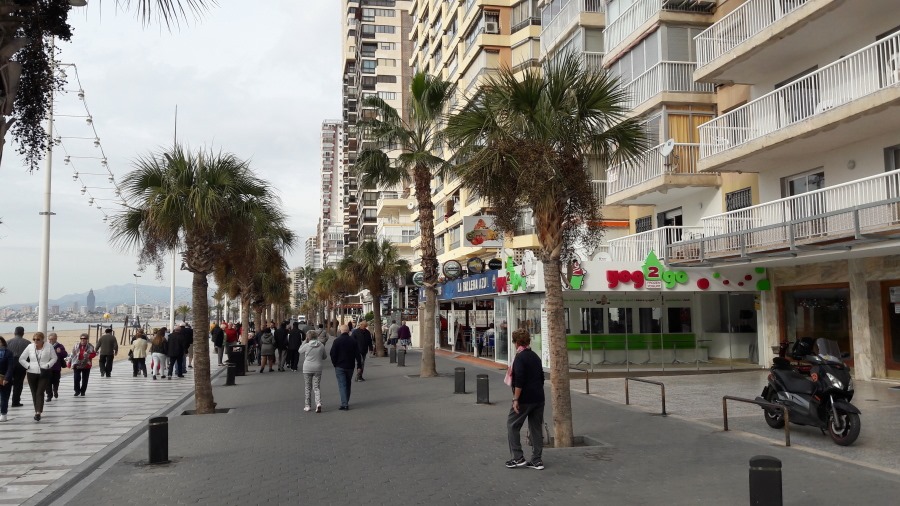
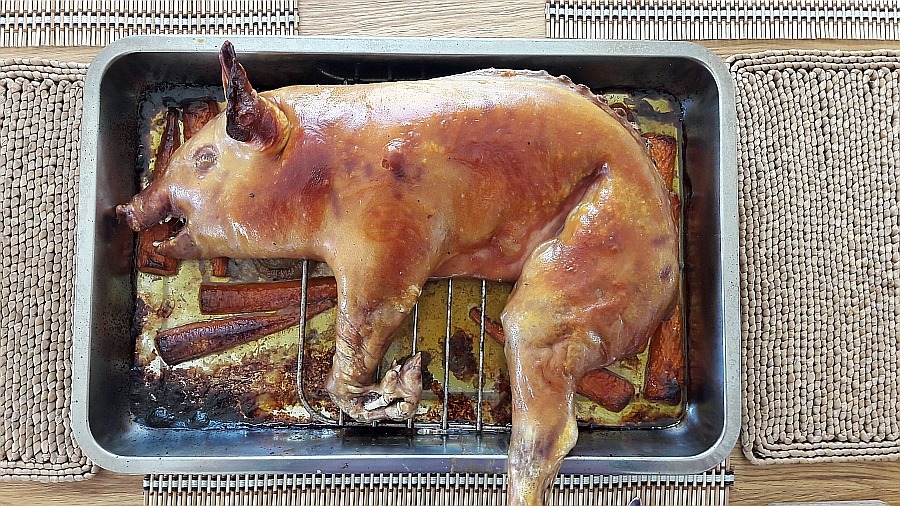
Braving Benidorm for our very first time just to call in to the humongous Carrefour hipermarché there yesterday, we had lashed out on a shoulder of cabrito [kid goat] and a supposedly Wagyu steak.

We tried the cabrito yesterday and it was very good.;I’d draw the line short of delicious but it was at least good. For the purposes of comparison, it’s reasonable to think of goat as being most similar to lamb, both in flavour and size/style of animal. For what it’s worth, here’s my thinking about Spanish goat and lamb, which, shall we say, I’ve also found a little lacking. The shoulder blade in our cabrito measured about 4 ins/10 cms. The shoulder blade in an English lamb shoulder joint would be at least twice that length. Our lamb is much larger; it has been allowed to grow for up to a year and is almost adult sized. Spanish lamb/goat is barely a month old, the whole animal weighing 12-14 kgs [~30-35lbs]. It may very well be extremely tender at that point but it hasn’t had a chance to develop any flavour. We have exactly the same problem, albeit to a lesser extent, with our so-called spring lamb, which is also lacking in flavour, IMHO. Let it grow – give it some flavour. Here endeth the first lesson. [Why does my stupid spellwrecker not like “endeth”? Ah, yes, it’ll be American.]

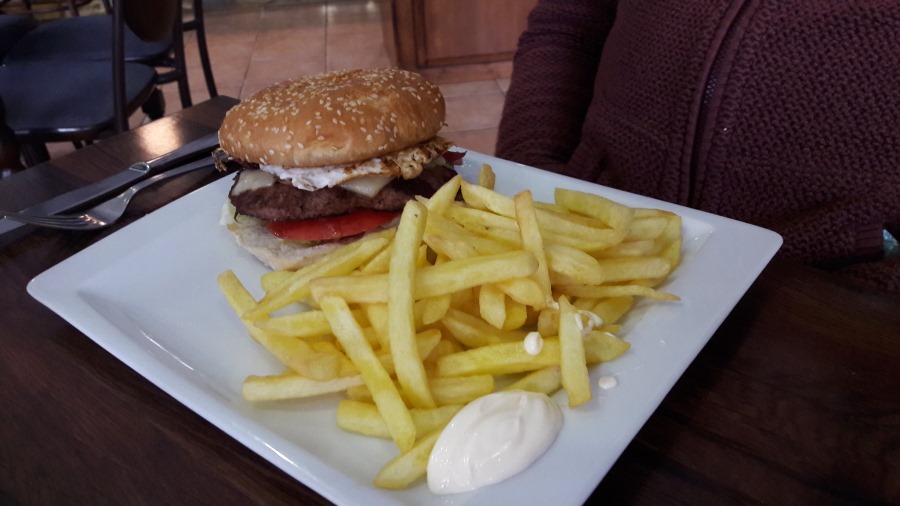
Now we were looking forward to trying our Wagyu steak. It was billed, BTW, as a picanha steak [called tri tip in the U S of A, apparently] and also called the rump cover. It’s a triangular section cut of meat. Ours matched that description. Supposedly, because it is a muscle that moves very little in life, it should be very tender.

Much is made these days of Wagyu beef. It is called the marbled breed because the flesh is so marbled with fine veins of fat that the real thing actually looks very pale pink, quite the opposite to how a well aged piece of beef should traditionally look. Wait a moment, real thing? Yes, there are many cross breeds lurking about, especially in Europe. The same happens with the highly vaunted Aberdeen Angus. ALDI, the cur price German supermarket, for example, sells “Aberdeen Angus” beef burgers, which I’m told are excellent but the small print, carefully worded, says:

… made from beef sired by Aberdeen Angus bulls.

With our piece of Wagyu picanha steak costing a mere 11€, I was quietly confident that this would be from a cross-breed. The real thing would be at least double that and probably more, even at Spanish prices. Whilst being quite well marbled, it was also relatively well coloured. Still, out with the griddle plate and on with our 2nd gastronomic experiment in two days.

Long story short: it was seriously disappointing, verging on the chewy. Verging? No, let’s be honest, it was chewy – not overcooked (for our medium taste, anyway), pink and juicy in the centre but chewy. I will not be bothering again – unless, that is, I can find both the supply and the bank balance to try the pure-bred real thing. Clearly, this picanha steak hadn’t read its job description about not moving much in life. The accompanying salad was very good, though. I confess to being somewhat saddened.

Back to goats. We learned from our Dutch friend, whom we are largely here to see, that The Netherlands breeds quite a few goats. They are bred in the Netherlands to produce goats milk for cheese. In common with all animal husbandry, pinching the milk from lactating female animals means that you have generations of starving, unwanted offspring. There’s no milk to feed them ‘cos you’ve taken it for another purpose. Some of the female young are kept to refresh the dairy herds but all the males and some of the females are surplus to requirements – they go into the meat trade after, as we have heard [see the first lesson] a very short life..

The good people of the Netherlands are not great fans of eating goat, our friend told us. Ah, problem; what are we to do with all these surplus baby goats? Well, the Dutch surplus to requirements kid goats, complete with their Dutch ear tags, are loaded into trucks and transported live to Spain, to Barcelona to be precise, where the Spanish love eating goat. To be more precise once again, they love eating Spanish goat. What they are not terribly keen on is eating Dutch goat. This must be a similar syndrome to the French not liking to eat English lamb. So, once in Barcelona, the Dutch goats’ Dutch ear tags are removed and replaced by Spanish ear tags. The goats are now legally Spanish goats. About half an hour after being magically transformed into Spanish goats, the hapless kid goats are slaughtered and sold as Spanish. Had they been slaughtered in the Netherlands, they would have been Dutch goats but now the Spaniards can rest easy in the knowledge that they are eating Spanish goats.

Marvellous!

Technorati Tags: ,,,
Posted in 2016-09 Spain

A Kind of Madness

Our next visit to Spain after the May 2016 trip was originally intended to be October 2016, for the accursed residents committee AGM. Unbounded joy! Recently, however, we discovered that some long lost Dutch friends had rented a villa not so far from Casa Libélule and wondered if we’d be in Spain. Sadly not but, not wanting to disappoint, we shoe-horned in another trip beginning at the August Bank holiday weekend. Well, we like to be sociable and the fares were reasonable.

What was a little less than reasonable was easyJet’s departure time of 6:10 AM in combination with:

  1. our usual taxi firm being unable to accommodate our journey to the airport;
  2. tales of stationary traffic jams taking 90 minutes to get from the final roundabout, into Luton airport and back out again to said roundabout – a distance of less than a mile;
  3. dire warnings from easyJet about very heavy bank holiday traffic.

I elected to go for the long term car park solution [been reading management manuals again]. I was even prepared, should the traffic be such that it merited it, to walk the two miles from the car park to the terminal. If you look at Google Earth, the car park is probably less than half a mile from the terminal building but there’re lots of security fences and a runway in between, so it’s two miles around the edge. We set the alarm for 2:15 AM. Francine told me that, were I still to be awake at 2;00 AM, I should just wake her. I was certainly still awake at 11:30 PM. The next thing I knew was the clock reading 2:00 AM. I took my life in my hands and woke Francine – and survived!

We hit the road at 2:35 AM. Three minutes down the road we flipped a quick U-turn and headed back for the piece of Scottish cheddar that we’d bought for a Scottish friend in Spain, which was still in our fridge – the cheddar, that is, not our Scottish friend. We hit the road again at 2:42 AM, this time complete with the Scottish cheddar.

Luton airport’s bête noir roundabout was clear at 3:10 AM and we were parking at 3:15 AM. A transfer bus had followed us into the car park. We skipped across to its final pick up point and caught it.

EZY2223 is the 4th plane out of Luton in the morning. We “picked up a 40 minute air traffic control delay”, our captain informed us. How? Nothing’s happened, yet; the weather looks perfect and the day is new. Bizarre. Captain EasyJet made up a bit of time en route and landed at Alicante just a tad behind schedule. Not only that but the infernal passport reading machines were not backed up with a sea of humanity. We were through in a relative trice and collecting our rental car, a FIAT [Fix It Again Tomorrow – YUK!] Tipo that is at least a decent size, even if a little gutless up hills, and began heading for our first stop, a food shop.

We don’t normally arrive on Sunday, when many Spanish shops are closed. However, we’d discovered that a Carrefour hypermarket would be open all day in Benidorm. Yikes, our first brush with Benidorm! The shop is about the size of our home town – just the fish counter was nearly as big as our Waitrose – and its range of food had me salivating. We chose a paletilla de cabrito [shoulder of kid goat] and a Wagyu steak, about which I’ve heard much so it has to be worth a try. (At ~12€, the latter will be a cross bread, not the pure bread article.) What a great checkout arrangement this Carrefour had, too; a single line of customers with a display telling the next customer which till to proceed to as the tills cleared. No fretting about getting into the slowest of several lines. With 10 or so checkouts in operation, the single line , which was naturally quite long, moved briskly. Marvelous!

We survived Benidorm and arrived in Jalón in time to unload before lunch. The local supermarket was, in fact, still open but we wouldn’t have found either goat or Wagyu steak, there.

Lunch was easy – calamari, salad and bread with alioli. More difficult was the drink. We’re having a dry August and thus far not a drop of alcohol has passed our lips. We girded our loins, forwent the rosado, and opted for zero alcohol beer. Well, at least it’s not sweet. Well done us!

In the evening, the cabrito was quite good too, with more near-beer and fruit juice diluted with agua con gas. Never mind, it’ll soon be September.

Technorati Tags: ,,,
Posted in 2016-09 Spain

Pag Island

The last day of our trip, before the lengthy drag back to Ljubljana airport for our flight home tomorrow, was to be spent on Pag Island, a long, narrow spit of land off the Croatian coast. We piled into the minibus and off over a bridge.

_16C7999 Pag Island_ there must be something hereOur first stop revealed little of interest other than hordes of hoppity things [oh, all right, I admit it, I can’t remember the technical name for ground hoppers] that were disturbed with every footstep, their briefly fluttering wings making me wonder if I weren’t missing something more interesting – to me, that is. Everyone kept looking but it seems I wasn’t missing something. Stones seem to be a feature of the Croatian coast; there certainly wasn’t much in the way of trees, mostly baking hot stones. It’s definitely a holiday destination for sun bathers.

J16_1839 Spotted FritillaryJ16_1792 Ant-lion - applauseOur second stop was more promising with grass, meadows and water. Mr. Butterfly went gleefully stalking the grassy meadows while Francine and I worked at grabbing a few record shots of some damselflies over the water. Back to the butterflies, I was glad to add a Spotted Fritillary (Melitaea didyma) to my personal collection, along with a distant record shot of a Southern Comma (Polygonia egea) for the first time; still it was at least a shot. The most fun I had here, though, was stalking a magnificent and very large Ant-lion (Palpares libelluloides), my third and another new species, while the others waited patiently aboard the minibus. I eventually got a good picture of it, together with a relieved round of applause from the waiting gang.

_16C8021 Pag marshOn we went for a longer stop at a marsh area armed with a bird hide. There were more grassy meadows at the margins and we could see critters cruising, though access here was through inventively fastened gates (barring lengths of wood tied to string – certainly not enough to deter a naturalist). A few stalking attempts revealed more of those large Ant-lions.

Francine and I headed down for the wetland area around the bird hide. Wandering down the track, an unfamiliar-looking large dragonfly headed up the track but I managed to lose track of it in the confusion of grass stems and dry stone wall joints. Things looked up, however, as we entered the reserve area and spotted a board claiming the presence of the Black Pennant (Selysiothemis nigra). These supposedly exist at Gandia, near Casa Libélule in Spain, but I’d thus far failed to find them. So, potentially adding those to my catalogue was an enticing prospect.

We began wandering to see what we could scare up. My excitement heightened when I spotted a dark-looking dragon settling in a cooperative manner. I sneaked up and snagged it, concentrating more on the photography than on the way the dragon actually looked. In my mind I might’ve been photographing a Black Pennant. As I reviewed my shots, though, realization of my mistake set in. This was the shape of a Scarlet Darter/Broad Scarlet (Crocothemis erythraea), a female, but it was not the usual colouration; this was a dark olive coloured, elderly female, which the books say exist but which I’d never witnessed. It was something new for me so, though not a Black Pennant, I was still happy.

J16_1829 Bladetail - rare_ spectacularPulses climbed again – well, mine did – as Francine spotted a movement which settled on rocks just a short distance ahead. I didn’t recognize it but it was clearly one of the  Gomphidae – eyes separated at the top of its head. It was a rather dull colouration, too. This, I suspected, was what I’d lost track of as we approached the reserve down the track. Minding my shadow, I moved gently into position with palpitations making life difficult – just the colour meant it was new to me. As I gained focus through the viewfinder, the distinctive shape of the abdomen told me that this just had to be a rather scarce Bladetail (Lindenia tetraphylla). It was a magnificent male. This one catch alone made my trip entirely worthwhile.

J16_1842 Black Pennant femaleWe weren’t quite finished yet, though. As Francine was crouching down, another dragon landed on the ground beside her. She remained crouching, still, as I snagged it before it disappeared. I was pretty sure this was a female Black Pennant, and so it proved to be. I liked this location a lot. 🙂

J16_1851 Conehead Mantis with preyAs we were leaving the marsh area and making our way to the minibus, someone spotted a mantis which, having recently seen one the same in Spain, I recognized as a Conehead Mantis (Empusa pennata). Rather than just hanging in a plant upside down, this one obligingly caught a butterfly while we were watching. It did then drop it but I suspect the damage had been done; O think a wing was missing. Whereas dragonflies can cope with a wing missing, butterflies are less able.

We moved on to a further area where I found more Black Pennants atop stems, their gossamer-like wings fluttering in the stiff breeze. It’s this fluttering of wings which gives them the name pennant. I was slightly disappointed that all my individuals proved to be females and I never did find a male but a couple of “lifers” in one day is no crying matter. 😉

J16_1957 Dark Spreadwing - scarce_16C8086 Odo lakeOur lunch was at a modestly sized lake that also threw up a few interesting characters, in addition to being a pleasant spot for a picnic. Once again, there were quite a few Scarlet Darters/Broad Scarlets and I watched as what appeared to be two males – they were both bright red – flew in tandem, ovipositing. Sharper readerrs will  notice a bilogical contradiction. 😀 No, I was looking for the first time at an andromorph female Crocothemis erythraea which, again, I’d heard about but not observed until now. On Malta, this is apparently the most common female colour form. This unassuming little lake also gave us only our second encounter with the scarce Dark Spreadwing (Lestes macrostigma), which we had made a pilgrimage to the Île d’Oléron to find a couple of years ago. Dark Spreadwings like a very particular habitat. I was a little bemused that we managed to find only one individual here, though. Fortunately it was cooperative.

The day proved to be a great end to an interesting trip, from my point of view, with two new countries, two new Odonata species and a couple of new colour forms of a familiar old favourite.

_16C8046 PagRegarding the countries, we certainly were impressed with Slovenia  and could envisage visiting it again as tourists. As a touristic holiday destination, though, we had been less impressed with Croatia, which seemed to be visually less appealing – mostly a rock pile for sun worshippers, – but it had been Croatia which delivered much more interesting finds for an Odo-nutter.

Sod the scenery, give me the wildlife. 😀

Posted in 2016 Slovenia-Croatia

Paklenica National Park

There’s that warning phrase again, National Park.

Paklenica National Park covers the area of torrent flows of Velika Paklenica and Mala Paklenica, and their distinctive canyons carved vertically into the south slopes of Velebit Mountains and the broader surrounding area.

J16_1669 Glass LizardAs we were gathering by our minibus prior to heading for the warning phrase, Milan had been up to his usual tricks capturing creatures. He arrived with a species of Glass Lizard which he’d found basking to warm up in the morning sun over the road. Looking more like a snake, this is actually a legless lizard, like a large cousin of our native Slow Worm. Legless it may be but penis-less it ain’t; it’s got two. This is called a hemipenis  and is normal in snakes and lizards, a.k.a. squamata. There, now don’t say I don’t try to educate you. 😉 Here’s Francine admiring both which have become erectile with excitement – well, OK, with nervous reaction to being handled.

The distinctive canyons for which we headed today were a magnet for a very particular type of public, the rock climbing public, which I suppose might be referred to as the Joe Brown Public. The lower part of the canyon was strewn with them, along with their ropes and carabiners. Whilst I’ve never really seen the enjoyment of crawling around in potholes underground, I can entirely understand the desire to climb. There is, after all, a decent vista on offer after the adrenaline rush. Apart from anything else, seeing someone clinging to an apparently impossible surface is decidedly impressive. We even saw 2/3-year-old children, roped and helmeted, fearlessly getting in on the act with (presumably) their parents. Great!

National Park; another entrance fee; Milan paid; we parked to begin our walk up the canyon. I wasn’t expecting to see any Odonata going up a canyon but the bird life began well with Alpine Swifts (Apus melba) peeping way above our heads. The Alpine swift is noticeably larger than our summer visitor and has some white on it. Francine and I had first seen mixed groups of swifts wheeling around together in Corfu.

J16_1673 Essex SkipperJ16_1677 Small SkipperButterfly action was good. too, with well-posed specimens of both Small Skipper () and Essex Skipper () – well-posed, that is, to demonstrate the difference between the two, the Essex Skipper having a dark underside to its antennae, as though they’ve been pressed onto an ink pad. With butterflies on what was a very pleasant walk, I was quite content. Cicadas were chirping constantly, too, and I never tire of hearing those.

J16_1680 Horn-nosed ViperThere were several reptiles and amphibians which slowed our upward progress, too – after all, that’ was why we were there – for those with a herpetological interest. The most impressive of these, which also delayed several passers by, most of whom displayed the expected scared reaction to a snake, especially a poisonous one, was a Horn-nosed Viper (Vipera ammodytes). I think this picture will demonstrate where it gets its name from. 😉

On the way up we paused at a cafe and Francine did spot a dragonfly cruising above the inevitable stream in the floor of the canyon, but it wasn’t hanging around and we could only guess at some species of Goldenring (there would be two possibilities, here).

J16_1713 Woodland GraylingOnce at our top – you can go further given more time – there was another cafe where we paused for lunch. Lunch entertainment included spotting a Glis glis [Edible Doormouse] in the cafe’s barn but it soon hid. Waiting in futile hope of its reappearance, I was swiftly and briefly flown around by a large, distinctively marked butterfly – I’d seen the topside markings quite clearly – which turned out to be a Two-tailed Pasha (Charaxes jasius) but sadly that, too, pulled off a very swift disappearing act. As a very decent consolation prize, a Woodland Grayling (Hipparchia fagi), only my second encounter with one, did pose on a bright white piece of climbing rope, making exposure something of a challenge. Bless post-processing!

J16_1720 Cicada - more naturalThe way down was naturally swifter but we did spot one of those many Cicadas that was nicely posed for photography on a low, accessible stem.

Being a canny chap, Milan wanted to pause by the lower reaches of the river flowing from the canyon so his Odo-nutter could check for dragonflies, not that I was unhappy with my butterfly haul. Find a stream we did and there was at least one species of Odo in residence; we spotted a couple of Southern Skimmers (Orthetrum brunneum). The only down side was that I had to remove my walking boots and socks and hobble across the stony-bottomed river to get a decent shot. Worth it, though. Our river stop was especially worthwhile ‘cos we found another couple of excellent butterflies including Southern Comma (Polygonia egea), which eluded my camera, Meleager’s Blue (Meleageria daphnis), with its distinctively scalloped hind-wing, and the diminutive and utterly enchanting Little Tiger Blue (Tarucus balkanicus), which, given its very limited distribution, must’ve been our star find, here.

J16_1737 Southern SkimmerJ16_1742 Meleager's Blue_16C7994 Little Tiger Blue

Some of these national parks aren’t so bad, after all.

Posted in 2016 Slovenia-Croatia

Plitvice Lakes

Today we headed out of Slovenia and into Croatia for the first time.Our first stop was to be Plitvice Lakes, “declared a National Park in 1949” [the blurb said].

A new Country is always quite exciting. This really did feel like a new country because we actually drove through a border control with barriers and armed guards to whom Milan, our guide, had to show our passports. We didn’t get a stamp, though. We were also swapping our familiar Euros (used in Slovenia) for the Kuna of Croatia. The exchange rate on my beer money is pretty easy to deal with being about 10:1 [Kuna:Pounds]. Also, I don’t have to learn a new word for beer, which remains pivo, even though Croatian differs somewhat from Slovene, according to our guide, Milan, who, of course, speaks both.

I’m forming the opinion that it’s not only the language that differs somewhat. The other thing that differs somewhat is my mental expectations of destinations on a “Wildlife Tour” compared to the reality of some of those planned by Ecotours, in this instance. The reality of Plitvice Lakes began to dawn in our minibus when, nattering to Milan in the front passenger seat, he expressed the opinion that this destination would not have featured on his hit list. Hmmm? Milan, I should explain, is an independent ecologist contracted by Ecotours as our guide. Reality rose higher in the sky as our minibus turned into a large barrier controlled car park for the second day. Again, we went through ticket controlled entry with further hordes of humanity. I’m used to Yosemite being crowded in the States, though, so perhaps it’s my expectations of a National Park that need adjusting. Here’s the alarm bell small print about these lakes.

… is situated between high forested mountains in which lies, one below another, a string of sixteen beautiful lakes and tarns of crystal blue-green colour. They are fed by many small streams and brooks and spill into each other in foaming cascades and thundering waterfalls.

_16C7754 Plitvice_16C7784BoardwalkThere’s your Joe Public magnet. The development for Joe Public was extensive and a verging on the Disney-esque, featuring miles of well-constructed boardwalks to get us out along our route, complete with queues to get onto electric boat rides followed by Mercedes-powered road trains to bring us most of the way back. The remainder of the return journey was left to Shanks’s Pony. Every metre of the boardwalk seemed to be taken up by the constantly streaming hordes of Joe Public whose idea of wildlife stopped at Mallard. Nonetheless, it was quite pretty in the fine weather. 🙂 We set out along the boardwalk.

J16_1599 Balkan EmeraldWith all this “crystal blue-green” water, there were dragonflies, so all was not lost. However, with the tens of thousands of tramping feet marching past on the boardwalk while one tried to snag a picture with a long lens atop a monopod, photographing them was rarely easy. Borrowing a popular term from the wider wildlife-spotting community, though, I was utterly thrilled to get my first “lifer” for some time. There, perched on a reed in a relatively accessible, albeit slightly more distant than I’d have liked (~3m away) position, was what I initially took to be a Brilliant Emerald (Somatochlora metallica). I excitedly snagged a couple of shots with the naked 400mm lens, then tried to add the 1.4X extender to bring it closer. Alas, it took flight before I was again ready but at least I had something. Brilliant Emerald was what I suspected we’d seen on day #1, constantly flying at Lake Bohinj. Subsequent later inspection of this individual, though, convinced me that this was an even greater prize (greater because Brilliant Emeralds occur at home), a Balkan Emerald (Somatochlora meridionalis).

J16_1604 Green-eyed HooktailDespite Joe Public, I got up to about 10 species of Odonata, including the always impressive Green-eyed Hooktail/Small Pincertail (Onychogomphus forcipatus), one of which posed fortuitously, so, a reasonable haul really.

_16C7807I was not the only one less than overjoyed with our overly touristic venue; our butterfly enthusiast was also feeling like a fish out of “crystal blue-green” water. He did find some quarry at our lunch break with tables, bench seats, loos, cafeterias, gift shops, grass and trees, though. Our birder was also getting excited about a Lesser Spotted Woodpecker (Dendrocopos minor) flitting between the trees. So, not all bad, then. 😉

Escaping Joe Public and the national park, we continued our journey to our new Croatian accommodation. Somewhat frustratingly, since entering Croatia we’d been driving straight past numerous very inviting, extensively flower-strewn meadows that were clearly an absolute haven for wildlife. We’d also been driving through numerous war-torn Croatian villages, their buildings scarred by bullet marks and roofs missing sections from bombs or artillery shells. Frequently, the villages had field cemeteries nearby. It served as a stark reminder of recent European history, a reminder that reinforced our group’s collective disappointment at the UK’s (United?) EU referendum result that had been announced on the morning of our departure. If only we could escape from that Joe Public. Dream on!

J16_1633 Mating Black-veined WhitesJ16_1657 A bird in the hand - or notAnyway, on a brighter note, Milan and Janos did find us another flower-strewn meadow to go hunting real wildlife. I joined forces with Mr. Butterfly and was extremely happy to find an artistically posed mating pair of Black-veined Whites (Aporia crataegi). A shot of a collection of hands, all holding different 6-legged critters, might serve do demonstrate the fun we were now all now having.

Our accommodation and pivo supplies for the remainder of our Croatian visit would be at Starigrad Paklenica.

Posted in 2016 Slovenia-Croatia

Bearing Up

I was seriously disappointed with our morning. We were heading for the Postojna cave, which is one of very few homes to Olms (Proteus anguinus), fully aquatic, blind, pink, cave salamanders existing only on the Dalmatian coast. Their colour leads to these bizarre little animals also being referred to as the ‘human fish’. On the surface on it, that sounded quite exciting and I had been looking forward. Slowly, however, the horrible truth began to sink in. What I had not realized or been prepared for was:

The Postojna cave is a UNESCO World Heritage site and is the best known cave in the World. A fantastic web of tunnels, passages, galleries and halls, the astonishing diversity of Karst features as well as easy access are certainly the main reasons for such popularity of the cave and a large number of visitors, which has already reached 35 million in 200 years.

Perhaps naïvely, I’d been expecting a small, insignificant cave in the countryside with just our group in it.The distressing truth became abundantly apparent as we drove into a huge car park equipped with special spaces for large coaches, one of which was borrowed by our small minibus. It was seething with people of all races, who, after purchasing their 25€ tickets for their timed entrance slot – shades of the Alhambra Palace, here – assembled under flags representing their nation to be guided in their tongue. Milan bought our tickets – grateful for small mercies – and we eventually joined our time slot. Naturally, English was by far the largest group.

OK, the clattering electric train ride was moderately enjoyable but, honestly, once you’ve seen one stalactite/stalagmite, you’ve seen ‘em all. The guide did a reasonable job as we were led around seemingly endless parades of chambers featuring yet more stalac/g-thingies but the plain truth is that I find matters geological stultifyingly boring. All I really wanted to see was the Olms. Finally we got to the end of our underground tour and, just to add insult to injury, a few Olms were on display in a modestly sized, very dark aquarium, for Darwin’s sake. Each side of the square aquarium could accommodate about 6 people at a time and there were about 100 of us. This is not what I call wildlife.

We clattered back out before lunch time, much to my relief.

The morning thus wasted, our main event of the day would begin at about 4:00 PM. That gave us time to revisit yesterday’s karst lake in today’s sunshine. Better, there are reportedly 30 species of Odo there, after all. I began to recover.

_16C7691 Lake CerkniskoJ16_1335 Orthetrum albistylumWe arrived in what was, indeed, much better weather conditions. This is what it really should look like. The dragonflies and butterflies thought so, too, and activity was brisk. At last I saw a few species that I couldn’t see back at home, the most cooperative of which was a White-tailed Skimmer (Orthetrum albistylum). Less cooperative were Lesser Emperors (Anax parthenope), which did not pose for the paparazzi, and a Green-eyed Hawker, a.k.a. Norfolk Hawker (Aeshna isoceles) which did but only for an id shot.

And so to the potentially main event of the day, possibly the trip: Brown Bears (Ursos arctos). Our group had booked an optional extra evening visit to a forest where these magnificent creatures live in the wild. These are not in a reserve, they live in the woods. The guy who ran our guest house has several hides erected in various parts of the forest and puts food out to attract the bears. All fine and dandy except that, I was told that I would have to sit still and silently in a hide for five hours. Yikes, that’s 300 minutes! I can’t sit still for five minutes, far less 300. I was concerned. I was so concerned that I very nearly dipped out, not just for my own comfort but I didn’t want to be responsible for spoiling it for any companions. I was, in this respect, not looking forward to it. Sense prevailed, though; I couldn’t pass up this opportunity of a lifetime; I girded my loins and clambered into the car. The car was a Nissan pickup with its back filled with boxes of tripe and corn. Tripe is, I was told, cheap and irresistible to bears.

J16_1520 WoodpeckerJ16_1518 JayFrancine and I had volunteered to go to a hide that required climbing into up a 5m ladder. Our companions were taken to various other areas. After climbing up the ladder to our hide with gusto and pole-axing myself on the top of the door frame at the top, we took our seats and settled down. Camera ports, complete with bean bags were provided. Blankets were also provided, as was a pillow. Our host scattered corn for the bears. After about 30 minutes of watching a family of Jays (Garrulus glandarius), five strong, scavenging the bear food. A young Greater-spotted Woodpecker (Dendrocopos major) joined in. After about 30 minutes of no further activity, Mr. Fidgety assumed the foetal position and put the pillow to good use.

A hand shook my drowsy shoulder while an accompanying voice whispered the unbelievable phrase, “there’s two cubs”.Don’t panic Mr Mainwaring! I arose as gently as I could and we stared out of the window of the hide. Sure enough, a mother bear had arrived at our feeding station with her two cubs in tow and they were an absolute delight. We scrambled as quietly as we could to focal length, now we could gauge the size of the target, and adjust bean bags so we could bring cameras to bear on them [pun intended – chortle]. As a swift précis, the mother and cubs moved around three scatterings of food and entertained us for 90 minutes. We couldn’t believe our luck. Eventually she led her cubs away but seemed to stare at our hide as she passed; we’re sure she knew we were there.

J16_1405 Mother and cubsJ16_1460 Mother and cubsJ16_1468 Cub chewing woodJ16_1478 Mother and cubsJ16_1483 Cubs_16C7748 Mum saying goodbye

Well, surely that was that. No, it wasn’t. I was about to assume the position once again for the remaining couple of hours or so, when a larger, presumably male bear arrived  He began chomping and we resumed clicking. A fifth approached from another direction but seemed to be further down the pecking order and beat a relatively swift retreat. Finally a sixth bear turned up and began to confront the fourth, which was still in front of our hide. Growls ensued and we thought we were in for some fireworks but they seemed to work it out and settle down sharing the space together. This last bear looked effectively bald on his lower half – curious.

J16_1526 Male bear I thinkJ16_1540 Male bear I think_16C7752 Mr Baldy

Bears #4 and #6 were still there when, at 9:00 PM, we heard a knock on our hide door. Yikes, another bear has climbed the ladder! Nah, we were just being rescued. Francine, who had been taking notes, opened the door to greet our host and explain all that had happened as his face lit up. The two remaining, very large bears scarpered.

What an evening! That was about the shortest five hours I’ve ever spent, I think. Our host was almost as excited as we were when we reported our luck; the previous time this hide had been used, nothing turned up. One set of our companions had seen two bears but the others regrettably had seen nothing; we put this down to the constant buzzing of a chainsaw nearby. Duh! We, however, had very unusually it the jackpot. At our late dinner – we were starving – our host was anxious to see our pictures, occasionally muttering, “wow”.

Posted in 2016 Slovenia-Croatia

A Change of Plan

Today we were supposed to be heading into some high ground again but our guide, MIlan, had been keeping his weather-eye on the forecast – well, that’s a good place for it – and suggested a change of plan. The high ground was once again supposed to be attracting weather so we all agreed to switch a couple of days and head for some more settled, lower ground. The lower ground in question was described as a karst lake called Cerkniško jezero. Jezero = lake, in Slovene, so we were heading for Lake Cerkniško, though in English it seems to be more often called Lake Cerknica.

While we’re at it, since Cerkniško contains one of those little š characters [referred to as s-roof], a word or three on Slovene pronunciation. The roof is roughly like putting an h after the letter in English. Thus š is like sh. the roof can feature on c, s, and z. Extrapolating from š makes č quite easy; it’s pronounced ch. Ž is a little more problematic ‘cos we don’t do zh. The town of Žužemberk is a classic example used to trap foreigners, though apparently I passed with flying colours: ž is pronounced like the s in vision. One final wrinkle: a c (with no roof) is like a ts (Germans should have no trouble with that), so Cerkniško is pronounced ts-air-nish-ko. I’m glad we got that cleared up. 😉

What an educational day. Lake Cerkniško is apparently a karst lake. Oh help, here we go again. Never having done geography I had no idea what the hell karst meant; in fact, i thought it might be related to cast as in open cast mining. Not so, Mr. Dumbo. Borrowing from good ol’ Wikipedia, a karst landscape …

… is a landscape formed from the dissolution of soluble rocks such as limestone, dolomite, and gypsum. It is characterized by underground drainage systems with sinkholes and caves.

_16C7590 CerkniskoJ16_1375 Emerald DamselflyLake Cerkniško is a seasonal lake and there was plenty of water left. This shot obviously isn’t the lake itself, it’s one of the rivers connected to it, but it’ll give you an idea of the landscape … and the weather. Whilst it wasn’t actually raining when we arrived, the day was noticeably overcast so not great for hunting Odos. We did find a handful, though in the form of Azure Damselfly (Coenagrion puella), White-legged Damselfly (Platycnemis pennipes) and a few more photographically aware examples of Emerald Damelfly (Lestes sponsa). Milan also used his trapping skills to grab a single Ruddy Darter (Sympetrum sanguineum) in his hand. They were all a tad drowsy. So, nothing I couldn’t readily see in the UK, then.

J16_1278 White StorkJ16_1308 Stork nestBirds are, perhaps, a little less susceptible to the vagaries of weather – we regularly have a Blackcap at home that sings in the rain keeping his territory safe – and our birding folks were very happy to hear, though not actually see, a Corncrake at the site. We had also driven past the nest of a family of White Storks en route – we were told it was the only such nest actually on a chimney, as opposed to a platform, in Slovenia [apologies for crap picture] – so perhaps the White Stork (Ciconia ciconia) visiting one of the fields beside our river was associated with that nest.

J16_1273 snake playing deadIf we can cope with another learning point, here it is. Actually, there’re two things to point out here. Good ol’ Milan was off doing what he does best, catching reptiles. He has some specially constructed hardware to help with the task. He came back with a Grass Sake (Natrix natrix) in a bag. One lesson is that the way the snake’s eyes looked indicated that this individual was “pre-slough”, i.e. getting ready to shed its skin. The other lesson is that if messed around with too much, the snake lies motionless with its jaw agape (and maybe dislocated?) feigning death, in the hope that its attacker will loose interest and leave it alone. Fear not, this character was perfectly healthy and jumped back to life again (if a snake can be said to jump). Milan replaced it where he found it.

J16_1320 LinnetEventually it was time to move on to our guest house accommodation for a bear watching extravaganza tomorrow. Whilst enjoying a pivo on our balcony, though, I was quite excited to see and snag a photograph of my first Linnet (Carduelis cannabina). Easily pleased, some folks. Linnets are not rare as such but, though we enjoy lots of bird species in our garden at home, Linnets aren’t amongst them and I’ve personally not had a chance to see and snag one before. A decent end to a rather unsettled day, weather-wise.

Posted in 2016 Slovenia-Croatia

Mount Mangart

Day 3 on the itinerary [day 2 of doing anything wildlife oriented] and we were off to the mountains. To be precise, we were off to Mount Mangart in the Julian Alps. Our route was an interesting one since it involved crossing from Slovenia into Italy and then back into Slovenia again. We’d already become quite fond of Slovenia. Entering Italy, things seemed to appear a little more run down – perhaps this is a slightly depressed corner of Italy. Mind you, Italy doesn’t really do it for me. The driving became noticeably more Italian, too. 😉

_16C7338 Frog OrchidMountains have a bit of a problem wrapped up in their majesty – they frequently attract weather and, when they aren’t attracting weather, they tend to be making weather of their own. Somewhat predictably, we arrived at the Mangart pass, 2070m above sea level, in the rain. Tea/coffee break was declared while we donned over-trousers and waterproofs. Actually it wasn’t too bad, just a bit irritating, and it did ease off after not too long. By this time someone had found a Frog Orchid (Coeloglossum viride) so Francine’s day was off to a good start.

_16C7472 vanilla Orchid_16C7475 Snapping a Vanilla OrchidI began to see something of what Milan had referred to yesterday with botanists making very slow progress. It felt as though our plant fans were going over the alpine pasture with a fine-toothed comb. Why not, though? Their painstaking search threw up another celebrity in the form of a Red Vanilla Orchid (Nigritella rubra) resulting in further excitement and this ever more familiar bums-in-the-air posture. Well, it beats lying on a beach getting bored.

J16_1184 Snow FinchThis was always going to be a day for the birders and their most exciting moment was a magnificent Golden Eagle drifting across between two of the mountain peaks. It was a great demonstration of an old wildlife photography adage, too: “you can’t have too much lens when it comes to birds”. There’s another good old wildlife photography adage, too: “whatever lens you have mounted, it’ll be the wrong one for the next opportunity”. With these unbreakable rules in mind, here’s a picture of a Snowfinch (Montifringilla nivalis) instead. 😀 It was about the only bird species that came anything like close, though there were Alpine Choughs occasionally looking for food from the tourists.

J16_1190 Artogeia bryoniae maleJ16_1197 Artogeia bryoniae femaleThe irritation rain eased off and, indeed, bright spells appeared. Now, for the most part, I was content to enjoy the alpine scenery and be guided by our butterfly specialist in search of a Mountain Green-veined White (Artogeia bryoniae). Find ‘em, we did – here’s a male and female.

J16_1223 MarmotInsect fans can spend about as much time searching for critters in an alpine meadow as botanists can plants. We did. Eventually, though, we began making our way back down to the ever patient driver, Janos, though not without a serious pause at a pile of boulders where we spotted a family of wild Alpine Marmots (Marmota marmot). The birders were equally distracted by a couple of Ring Ouzels (Turdus toquatus), once again too distant for anything resembling a worthwhile shot. A little bit of stealth and patience got a picture or two of a Marmot, though.

J16_1235 Horvath's Rock LizardEventually we re-joined Janos to make our way back through Italy before re-entering Slovenia. There was one more important pause, though. A coiuple of our number were reptile and amphibian specialists and there was one wall that was home to a particularly rare lizard, Horvath’s Rock Lizard (Iberolacerta horvathi), which they were, of course, keen to see and which Milan was keen to use to demonstrate his trapping skills. I could understand their excitement. Here is the little celebrity.

Pivo, pivo!

Posted in 2016 Slovenia-Croatia

Lake Bohinj

Yesterday we had an excellently timed flight (12:55 PM take off) from Stansted lasting about two hours to Ljubljana. A couple of firsts: first flight for me from Stansted and certainly my first time in Slovenia. The timing made our departure from home and the journey to Stansted very civilized. Ljubljana airport is a delight – very quiet – the way things used to be before the planet got too many people with too much money. Whilst this was a mixed wildlife tour organized by Ecotours, I was looking forward to seeing two new countries. We were met by our guide, Milan [Slovenian], and driver, Janos [Hungarian, pronounced Janosh], who took us to our first 3-night stop in a charming hotel close to Lake Bohinj [pronounced Bo-heen – the “j” is silent]. With different native languages, Milan and Janos spoke English to each other. My most important learning point on arrival at our hotel was that pivo is Slovene for beer. A couple were necessary and, bless them, large beers cost 2.60€ whereas a small beers are 2.30€ – a curious pricing policy.

_16C7148 Lake Bohinj_16C7153 Bohinj BridgeFrancine and I had wandered down to get a glimpse of Lake Bohinj yesterday evening but this morning our itinerary took us for a wander along its northern shore in daylight. As you can see from a couple of Francine landscape efforts (notice the fish in the crystal clear water – right), its a delightful location. I was a little surprised to note that Slovenia bore more than a passing resemblance to Austria, until I realized that it borders Austria and was once part of the Austro-Hungarian empire. Duh! Educational, these wildlife tours. 😉

_16C7159 Walking round Lake BohinjOur group has a good mix of interests, one concentrating on birds, another on butterflies, myself on Odos and Francine had botanical buddies. Milan delighted in telling us that he’d been with a bunch of botanists and managed to cover only about 100m in three hours ‘cos they stopped at every plant for a minute examination. Fortunately we made considerably better progress.

J16_1062 Sympetrum fonscolombiiAs you can see, Lake Bohinj is big water with little in the way of emergent vegetation so I wasn’t expecting much in the way of Odonata. Excitement was briefly heightened when we spotted a darter in a patch of vegetation a few metres from the lake and Milan suggested it might be a Vagrant Darter/Moustached Darter (Sympetrum vulgatum). That would’ve been a new species for me but it turned out to be a female Red-veined Darter (Sympetrum fonscolonmbii). We also spotted several White-legged Damselflies (Platycnemis pennipes) and, somewhat frustratingly, we were overflown by several bright green dragonflies that were most likely either Brilliant Emeralds (Somatochlora metallica) or Balkan Emeralds (Somatochlora meridionalis), either of which would’ve been a new catch for me but we’ll never know ‘cost they flew tirelessly and never settled.

J16_1116 Clouded ApolloJ16_1102 Flower meadowAfter lunch organized by Janos around our minibus, the afternoon took us to Pokljuka plateau, a forested karst plateau around between 1100 and 1400 metres altitude. It wasn’t an area for Odos but there were some flower meadows as well as mossy bogs, and these produced a butterfly highlight when one of our group spotted a freshly emerged Clouded Apollo (Parnassius mnemosyne). Being a new species for me, I spent some time with that. 🙂 Notice that the tips of the forewings are translucent.

As well as the meadows containing quite a bit of the relatively rare Golden Hawkesbeard (Crepis aurea), Francine had considerable fun with the flora up here with Bearded Bellflower (Campanula barbata), Small White Orchid (Pseudorchis albida) and White False Helleborine (Veratrum album) being added to her collection.

_16C7219 Golden Hawksbeard_16C7211 Bearded Bellflower_16C7238 Small White Orchid_16C7202 White False Helleborine

_16C7297 Hay racks_16C7304During our driving around, we’d been intrigued by structures that turned out to be traditional Slovenian hay drying racks. So, despite a number of our throats screaming out for some more Slovenian pivo, on the way down from Pokljuka plateau, we encouraged our tireless driver, Janos, to stop beside some examples containing hay for some photo opportunities. A couple of designs were on offer, from a simple single thickness rack to two racks joined by a roof to double up as a barn. The barn style photo shows the contrasting less romantic modern plastic-wrapped rolls, as well.

All in all, an enjoyable start in an enjoyable country. Now, that pivo …

Posted in 2016 Slovenia-Croatia

Andalucia: the Alhambra

According to the Rough Guide to Spain, the Alhambra Palace at Granada is:

… one of Spain’s architectural wonders and most visited monuments …

The Alhambra was on Francine’s bucket list so, being only about 90 minutes away by car from Canillas de Albaida, made for an irresistible draw on our day of rest from walking. [Ed: that’s if spending hours on your feet wandering around a large palace can be said to be a rest from walking.]

Planning is necessary. The guide books and visitor advice make it sound a bit like a trial: large crowds, long walk from car parks to entrance, long waits, etc. etc. Entries into the palace building itself are limited and timed with an ability to purchase them online before you go so this, Francine did. Given all the dire warnings and our 90-minute drive, and there still being a choice available (we booked before leaving for Spain), Francine opted to join the 1:00PM swarm. A-day had arrived, we hit the road at around 7:00 AM.

Those familiar with my personal likes and dislikes will have realised that crowds together with a pile of old stones did not make the Alhambra one of my main interests. I was not looking forward to it, except, given those dire warnings, with some trepidation. The journey was fine. As we approached Granada the road climbed into cloud and the temperature dropped to a decidedly chilly 15°C. We were not dressed for 15°C, we were dressed for 25°C. Bother! Fortunately, it did warm up as the day progressed.

Mercifully, since The Alhambra is on the south side of Granada, the direction from which we approached, we didn’t have to mess with too much traffic. The first dire warning came to nought as we easily entered the officially parking areas and made our way to the parking bays nearest to the entrance itself. Given our parking location, the second dire warning was dispatched with a simple 5-minute saunter to the entrance complex where there was a special short line (about 6 people) especially for those with pre-booked tickets – third dire warning dispatched, An armed security guard (normal for Spain – even the caretaker at a little visited monastery had a night stick) soon bad us through where Francine collected our tickets and a map of the site. We were in with nothing approaching hassle. Of course, we were early.

We began with the gardens and the Generalife [I’ve no idea how to pronounce that but it’s apparently the summer pleasure gardens – steady! – of the Emir]. The gardens were OK but even I’ve seen much better. Naturally, though we were early, people were already quite numerous and Francine patiently waited for a few shots without the usual array of dorks armed with tablets, mobile phones and those accursed narcissistic selfie sticks. [Incidentally, tripods are not allowed so why those bloody selfie sticks?] A person or two seemed to help with atmosphere in one or two places.

_MG_7791_MG_7801_MG_7806_MG_7793

_MG_7797The best part of the gardens, IMHO, was that they offered the best view of parts of the Alhambra itself. It is so often the case with notable sites that the best view is not from close quarters but from a distance, where you see better any majesty and in some context. One such view of the Alhambra is from Granada itself, the other is from the gardens. Francine went into another, higher garden while I chose to stay outside looking at the palace and watching the gardeners at work. Incidentally, “Al Hamra” [no, I haven’t misspelt that] is apparently Arabic for “The Red One” so, in addition to “The Alhambra” literally meaning “The The Red One”, I must assume the Moors were red/yellow colour blind. But I digress.

_MG_7845_MG_7827Nothing for it, fairly soon we ran out of garden entertainment and had to wander into the walled fortress itself. I tried to find the outside of the piles of old stones interesting with limited success. There were a few pools/ponds but they were sterile, so no entertainment there. Most interesting to me was a series of large metal rings on the walls outside the Palacio de Carlos V, One of which is shown here. Given the ledge beneath them, I assume these were hitching rings for horses complete with a mounting step. The round courtyard in the centre of this palace was undoubtedly impressive and was drawing several cameras.

_MG_7846_MG_7855We could see one of the earlier swarms queuing ready for their timed entrance to the Palace buildings themselves as we approached the military complex, the Alcazaba [Magicians, this way please], which is where we went next. I must confess that these large slabs were quite impressive. Not only that but they were playing host to swarms of swifts screaming and making the summer sound like summer. I could’ve watched them all day.

I did watch them for a substantial part of the day. We’d finished going “ooh, ahh” at the external stuff way before midday and still had to wait until 1:00 PM for our timed swarm. In fairness, the numbers in any particular swarm are sensibly limited and each 30-minute time slot really isn’t daunting. So, we sat near the entrance, in front of the Alcazaba, and magicked up our picnic lunch – there are restricted areas where you are allowed to eat a picnic – whilst watching all those swifts and Joe Public. Time to join the queue for the main event.

In we went for me once again to feign interest. Being Moorish, the decorative carvings on the walls are very extensive and very intricate, scribblings indecipherable to a non-Arabic speaker/reader. Ceilings and archways were ornate. There was another long pool complete with fish and, surprisingly given the lack of vegetation, an Emperor Dragonfly cruising back and forth. Most of the opposing groups were very polite and considerate, even the oriental ones, which surprised me a little. The only exception was a large-ish Spanish group who seemed to feel as if they owned the place – well, I suppose they did – and who barged their way through with no concern for obstructing others less prepared to barge. Eventually we barged back. Here’s a flavour.

_MG_7889_MG_7892_MG_7897_MG_7913_MG_7916_MG_7925

_MG_7905_MG_7908The most intriguing aspect for me inside was that it sported many gently running water channels in the marble floors. Whether these were to help with cooling or just to sound soothing, I know not. They are best shown emanating from a well known central fountain supported by lion effigies. As with many things, this is difficult to photograph attractively because it’s surrounded by ropes, even though you can’t actually approach it. So, here is the fountain, first to see some of the water channelling and secondly to look more appealing.

Although entrance to the palace itself is timed, you appear to be able to spend as long as you like in there. Fortunately, there are limits and we eventually exited to make our way back.

_MG_7822OK, I admit it, it was nothing like as daunting as I had been led to expect and I’m glad I’ve seen it. I do think it’s a little over-played, though but, hey, what monument isn’t? Well, the Taj Mahal, perhaps?

Technorati Tags: ,,,
Posted in 2016-05, Spain