Brisbane Arrival

My Qantas flight from Hong Kong down to Brisbane showed how a business class seat should be done: 1-2-1 seating arrangement, admittedly in a smaller plane, with oceans of space, a dead flat bed and no clambering over legs by anyone. No funny rearward facing seats either. Much more conventional and much better. Oh, yes, and the food was some of the best I’ve had and I don’t mean just on aeroplanes. Qantas nosh is designed by an Ozzie chef, Neal Perry [Sp?], and was very fine.

Being on the left side of the plane, first of all I got to see turnip rise over the Pacific. Well, OK, it was the moon, really, but near the equator the not-quite-full moon had a flattish top that made it resemble a turnip. At our latitude we’re accustomed to seeing the sides of the moon missing, rather than the top or bottom. It looked quite strange.

After nine hours aloft, we landed at 04:20 and immigration went smoothly with the infernal machine even reading my e-passport. Well, second time, it read it. I now had four hours to kill waiting for friend #1, Roy, to arrive at the domestic terminal having done immigration at Sydney. I killed two of my hours people watching in International then transferred on the shuttle bus to Domestic to kill the remaining (now) 90 minutes. I was able to wait at the baggage carousel and he duly arrived, as did his luggage.

Formalities for a rental car were next and then we were off, at about 11:00. Heaven knows where we were off but we were off. Fortunately Roy has mobile data so Mr. Google helped us deal with the maze of arterial roads that appear to constitute Brisbane’s traffic system.

We saw no atmospheric evidence of the fires that are ravaging parts of southern Queensland. First stop was somewhere called the Koala Bushlands – Roy was keen to see a wild Koala. Unfortunately, Koalas were there none. Actually, there wasn’t much of anything but a couple of other Homo sapiens also looking for Koalas. Everywhere was very dry.
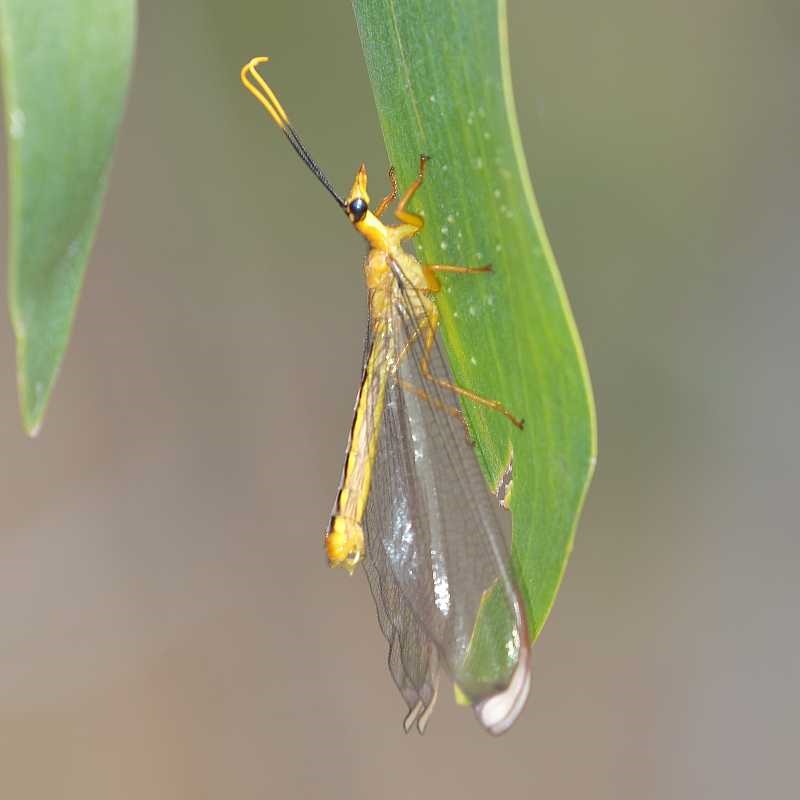
J19_1305 Ant-lionWe change tack and headed for some water showing on the map. Several corrected wrong turns eventually had us entering someone’s Memorial Park. The park didn’t work ‘cos I can’t remember his name. As we clambered out of the car a 600mm lens approached the car park held by its owner, a birder, along with friend. They guided us down a track through some paper-bark trees where we did, eventually, find some rather unexciting water which was clearly much reduced judging by the drying, cracking  mud at its margins. There was a handful of dragonflies, including one species new to me, but I had been more interested in what we thought were two different species of Ant-lion en-route through the nearby vegetation. Heaven knows what species this fellow is; for now Antipodean Ant-lion sounds good enough.
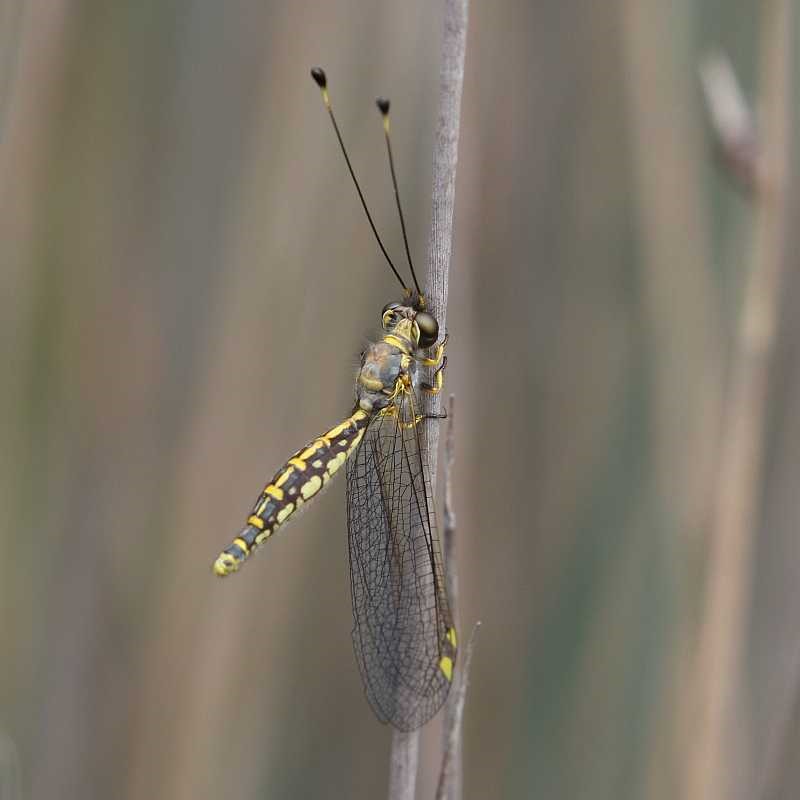
J19_1307 Owl-flyOnce I looked at the pictures properly, I realized that my 2nd suspect was not a second Ant-lion but an Ascalaphid, a so-called Owl-fly – it has clubbed rather than hockey-stick shaped antennae. Once in our hotel with Internet, I found this character on good ol’ Brisbane Insects pages. It’s a Yellow Owl-fly (Suhpalacsa flavipes). I do like a nice Ascalaphid and this is my first Antipodean Ascalaphid.

Birdman had suggested another wetland which we tried later. It was certainly wet with multiple lakes (he called ‘em ponds but they do things bigger here, rather like Americans). What there wasn’t was much in the way of dragonflies. Neither of us could understand quite why, given all the vegetated water. We’re thinking that, being closer to the coast, as it was, the water may have bene brackish. Certainly it did not appeal to our main quarry. There were plenty of birds for Roy to aim his binoculars at, though.

Beginning to flag, we called it a day and retired for a shower, following which we fought Brisbane’s road system to find a beer and some salt and pepper calamari. Sally Satnav sent us several miles around a complex circuit to get one mile further south from our hotel, all because you can’t cross the arterial road and head in the right direction. Apparently. We were confused.
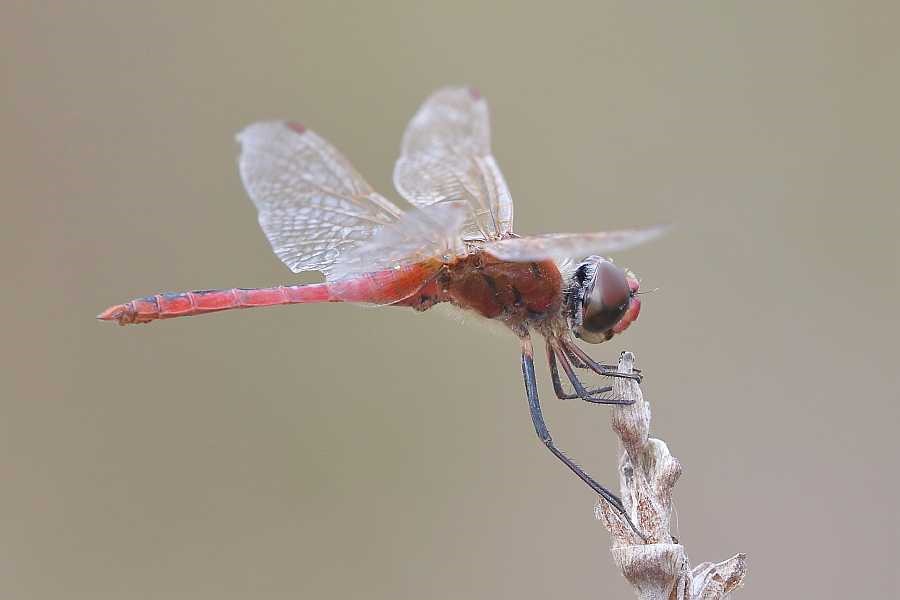
J19_1346 Macrodiplax coraJust for the record, here’s the new friend that I did come to see, the so-called Coastal Glider or Wandering Pennant (Microdiplax cora).

It felt like a long and quite difficult first day but, then, given the travel, early arrival and jetlag, it was.

Posted in 2019 Australia

Hong Kong Transit

It’s Saturday so it must be Hong Kong.

I miscalculated: the flight was only 11 hours and not 13 as I thought. Hong Kong being 8 hrs ahead, I flew into Saturday and missed the morning. Such are the joys of long haul travel and time zones. We landed at 14:20.

This was my first experience of British Airways Club Class (i.e. Business Class) and I have to say it was in some respects, weird. Half the seats are backward facing. Well, if it’s good enough for the queen, it’s good enough for me. It is supposedly safer … in the event of an emergency, that is. Personally, I don’t think any seat would help if you fell out of the sky from 36,000 feet. Happily that wasn’t an issue.

The seating plan is 2-4-2. The seats go completely flat. The window seats face backwards as do the two centre seats in the middle block of four. If the aisle seats, which are conventional and forward facing, are in their flat bed position, the window and centre seat occupants have to clamber over the prone legs of the aisle folks. Except, that is, for the rear bulkhead row which has unfettered ingress and egress. Not terribly impressive in some respects.

Having forgotten to check-in early online, I had been defaulted to one of the centre seats of the rear bulkhead row. At first I was a little perturbed that I had one of the two bassinet seats, in case a screaming infant pitched up next to me. Mercifully that didn’t happen. On seeing the advantage of unrestricted access, I was actually pleased.

I don’t recall sleeping but neither do I recall 11 hours worth of travel so I think I must have.

I have found my ways to the QANTAS lounge in HK airport where I have a 4-hour wait for my 2nd leg flight to Brisbane. It’s a 9-hour flight. At least, I think it’s a 9-hour flight, if I haven’t miscalculated that one, too. 🙂

Posted in 2019 Australia

Sod’s Law Strikes

It seems to be the only law that never gets broken.

Some months ago I bit the bullet and did something I’ve been wanting to do for a while; I signed up for a 3-week dragonfly hunting trip in Australia. Well, three weeks once the flights are taken into account. There was a similar trip a year ago but the dates didn’t work out for me. This time, the dates were perfect so I went for it.

I am one of a three. Our fearless leader did what appeared to be an excellent job putting together an itinerary targeting several specific species. Here’s the kicker: this year’s tour was to be based around Brisbane, south Queensland. A little while ago, Australia, in its early spring, began being ravaged by what I think are unseasonably early wildfires in both New South Wales (where they seem to be more widespread) and South Queensland. Brilliant! Thank you, Sod. We are basically flying into the fires and the National Parks were where we were intending to hunt.

We are all still keen to go and I’m currently in the BA Terminal 5 lounge waiting to board the flight on my first leg bound for Hong Kong. Besides, I have a non-refundable ticket and travel insurance would be no use since, although many of Australia’s National Parks may be closed because of the fires, Australia itself is still open for business. Since our first plans involved initially heading south from Brisbane and crossing the border into New South Wales, our leader, Phil, has revised his itinerary. I suspect that the situation on the ground may be so fluid that we will have to react to new situations once we are there.

My companions are both much more experienced with Australian Odonata than am I. I will be very content seeing almost anything, since my current ad hoc Australian species count is just about 10, there being some 340 species on that beautiful continent. My companions were targeting specific species new to them. Frankly, I simply love Australia and will be very happy just spending a holiday there. Most of it will be new to me; it’s certainly an area I have not previously visited.

Holiday? Well, yes, clearly. However, I should point out that this is a so-called recce trip paring costs to a minimum. We will be camping in small backpacking tents. We are taking the gear with us. I have had to purchase a 2-man backpacking tent, a sleeping bag and a sleeping mat. I haven’t slept on the ground in over 30 years. This is going to be interesting. Since I now no longer sleep soundly in a comfortable bed at home, how much worse can it be? [I’ll answer that question in three weeks time.]

If a wildfire approaches too close for comfort, I will have no compunction abandoning my tent; it cost a mere £75. I have to say, though, that it looks the part; I’m quite fond of it even though I have yet to use it. Maybe that should read because I have not yet used it?

It’s 13 hours to Hong Kong where I have four hours to pass before my 2nd leg which is nine hours to Brisbane. Watch this space.

Posted in 2019 Australia

Birdsong Revisited

Those who have read Birdsong by Sebastian Faulkes will have learned of miners being used in WWI. I certainly knew nothing of this activity until I read that book. The miners’ job was to dig tunnels several metres below ground towards the enemy lines. As they neared their objective, silence was necessary because the enemy was listening. Bayonets were used to prise out flints buried in the clay and helpers would catch the flints as they fell. A chamber at the end of the tunnels was then excavated and packed with masses of explosives to be detonated in the hope of devastating the enemy defences. This seemed incredible to me when I read about it.

La Grande MineJust a few kilometres to the west of Albert lies the small village of La Boiselle and site of “La Grande Mine”. This is the Lochnagar Memorial Crater, a privately owned enormous hole in the ground left by the detonation of one of the WWI tunnelling activities. To the owner’s credit, it is free to see. The detonation of this mine and a second of its kind was followed up by yet more canon-fodder troops being ordered to walk towards the German line mostly to their deaths. Some of the infantry took shelter from the machine-gun fire in the mine’s crater. Like many memorials in this vicinity, it is a spine-tingling sight. Having read about it, I’m glad I’ve seen these remains.

This is our last full day in France, which may be a good job because I don’t know how much more evidence of man’s insanity our nerves can take. Tomorrow we make for Calais and the ferry back onto home soil. It would be good to think that we’ll be returning to normality but recent history is making normality somewhat uncertain. Mercifully, it should not be as uncertain as it was for the poor saps who were forced to sacrifice themselves in the European carnage, parts one and two, of the 20th century. The western world is, however, suffering a potentially dangerous nationalistic backlash, of late.

Worrying times.

Technorati Tags: ,,,
Posted in 2019 Germany

The Somme

Our journey back up through France, deftly avoiding a return through Belgium by crossing the Rhine at Saarbrucken, has led us along much of the 1914-18 western front. We moved on from Verdun, which was largely a French and American bloodbath, to Albert on the Somme, which was largely a French and British bloodbath. Today we hopped on our bicycles to puff and pant around some of the veloroute de la memoire.

_19R7392The country roads between Albert and Bapaume are dotted with 400 mostly relatively modestly sized Commonwealth cemeteries, lying in fields or on the edges of woods. This, I believe, was largely because there were field hospitals scattered around the lines and the poor unfortunates who didn’t make it were taken outside to be buried behind the medical facility. We stopped first at Blighty Valley cemetery which may have been one such. Now between a wood and a maize field, it contains just over a thousand graves. Many of the headstones are for unidentified souls and simply bear the inscription:

A soldier of the great war; known unto God

_19R7393_19R7395Further up the road, and I do mean up, is the imposing Thiepval Memorial designed by Edwin Lutyens, a towering brick edifice supported on four massive square – maybe more like cubic – columns inscribed with some 73,000 names of the British missing of the Battle of the Somme. It is fronted by a cemetery for both French and British fallen with crosses for the French and headstones for the British. A few names on the monument are now crossed out, a result of bodies having been later found and identified.

On our route back we passed a tower, a replica of Helen’s tower near Belfast, commemorating the Ulstermen who took part in the carnage.

Nearby, though we didn’t visit it this time around (we’ve been there before), is a memorial to a band of Newfoundlanders. Of the 1000 of them sent “over the top”, just 16 returned unscathed. Such was the lunacy of ordering infantry to walk hundreds of metres across open ground towards an enemy line heavily barricaded by barbed wire and defended by raking machine gun fire.

Emotions can take only so much of this stuff and we chose our route back to our Albert campsite, passing another modestly sized  cemetery beside the road.

The Battle of the Somme was launched on 1st July 1916. The first day cost the British 57,000 casualties, 20,000 of whom were killed. It remains the worst day in British military history. [Ed: Bloody good job, too.] The battle was brought to a halt in November 1916 when the weather became so bad that no further action was deemed possible. The total casualties for this senseless insanity amounted to 415,000 British, 195,000 French and 600,000 German – 1.2 million in all.

According to our guide book, the land around Albert had no particular intrinsic value nor was there any long term strategic objective to the action. The Battle of the Somme was designed to relieve pressure on the French army fighting its 10-month action at Verdun 300kms away.

Madness.

Technorati Tags: ,,,,
Posted in 2019 Germany

More from the Sweet Shop

I must be making up for lost time. Having arrived at Albert, a centre for the bloody and senseless Battle of the Somme, yesterday, we needed supplies. It’s only a 10-minute walk from the camping municipal site to a super-U supermarché, so we slung rucksacks on our backs and went in search of lunch and tonight’s dinner.

For the last three weeks it’s been too hot to contemplate cooking inside our caravan so our gas BBQ has been working overtime. I’s still too hot to cook anything substantial in time but Francine and I are both fond of a warm gésier [gizzard] salad. They come in the form of a confit and just need warming through in a skillet so that should work well enough. We got a few lardons to go with them. I’ll give the BBQ a day off.

For lunch, Francine found a prepared salad but I kept looking longingly at an andouillette sausage. Resistance was futile so I bought one. From what I can make out, to make an andouillette, you roughly chop pigs intestines and then stuff them into more pig’s intestines in the form of a sausage skin. Yummy! Ya just gotta love the inventiveness of the French cuisine de terroir. I thought it was very good but it’s not one of Francine’s favourites.

J19_1025 Ceriagrion tenellumAfter lunch it was time to go and investigate the Somme, not for the many military graveyards (we’ve done that before) this time but for dragonflies. After failing to find any sign of a few étangs marked on the map we wound up at Vaux-sur-Somme. The main branch of the Somme is navigable at this point but it looks managed, almost canalized. We found what I think must be a related small, well vegetated channel that was noticeably lower than the main river. Here we found a goodly and varied selection of critters including Small Red Damsels (Ceriagrion tenellum) for the first time this trip.

The main river did provide two extra species not seen on the small side waterway but the small habitat was most fun. Here’s the list, a reasonably impressive 15 species:

  • Calopteryx splendens (Banded Demoiselle)
  • Ischnura elegans (Common Bluetail)
  • Coenagrion puella (Azure Bluet)
  • Erythromma viridulum (Small Redeye)
  • Erythromma lindenii (Blue-eye)
  • Ceriagrion tenellum (Small Red Damsel)
  • Platycnemis pennipes (Blue Featherleg)
  • Anax imperator (Blue Emperor)
  • Gomphus pulchellus (Western Clubtail)
  • Somatochlora metallica (Brilliant Emerald)
  • Orthetrum cancellatum (Black-tailed Skimmer)
  • Libellula fulva (Blue Chaser)
  • Sympetrum sanguineum (Ruddy Darter)
  • Sympetrum striolatum (CommonDarter)
  • Crocothemis erythraea (Broad Scarlet)
Posted in 2019 Germany

Verdun

It’s difficult to come to this neck of the woods without becoming involved in the WWI obscenity that was the battle of Verdun. We are camped a few kilometres south of Verdun but the main military action was centred just to the north of it. We drove up to look.

Our guide book says that the battle of Verdun lasted 300 days, so let’s say 10 months. It began with a German artillery barrage that went on for 10 hours and expended 2 million shells. By the end of the 10-month carnage, 700,000 men were dead, missing or wounded.

_19R7304_19R7306We began our sobering tour at the Fort Souville, where some advanced technology of the time made 15.5cm guns rise from the ground, fire, then disappear back into the protection of what was essentially a silo. The ground is now forested but remnants of the fortifications can still be seen in the ground left cratered and undulating by the explosions of shells.

Nine villages were completely eradicated by the actions. We drove off to where one stood but there is nothing now to be seen. I went expecting that I might see something along the lines of the ruins of the WWII martyr village of Oradour-sur-Glane, near Limoges, where the SS murdered the entire population in June 1944 shortly after D-Day but apparently, these villages near Verdun were so completely razed that no trace of them could be seen in aerial photographs taken shortly after.

_19R7309We finished with rightly shredded emotions at the Ossuaire de Douaumont which, standing in the middle of the battlefield, serves as the main monument to the Verdun terror and holds the bones of many thousands of unidentified bodies. After the battle, some 120,000 French bodies were identified, being about one third of those killed. The Ossuaire is fronted by a suitably regimented graveyard where 15,000 dead are buried.

I’ve often wondered about “missing” and “unidentified” but I think it must go like this. Bodies litter a battlefield. If they weren’t blown to bits when they were actually killed, continued shelling where they lie subsequently does either blow them to bits or throws up wads of earth from nearby which falls over the corpses and ends up burying them.

I considered myself blessed to have been part of what I believe to be the first generation not to have been plagued by a European war. Verdun has had a tumultuous history featuring in the Franco-Prussian War, WWI and WWII. The EU was formed following WWII, which was really part 2 of the first atrocity, to prevent further European bloodbaths. The theory was that nations that trade together would not try to wipe each other out and it has proved very effective. The EU may well not be perfect but anyone doubting its usefulness really should see these monuments to the terrors of what used to happen before its existence. Surely preventing such senseless carnage is worth a degree of imperfection.

Technorati Tags: ,,
Posted in 2019 Germany

Kids in a Sweet Shop

What a difference a border makes. Our first full day back in France and we needed some shopping so we zoomed about 8kms down the road to a slightly larger town with a supermarché – not one that we’d heard of, Colruyt, but a supermarché nonetheless. Gone was the German restriction to pork, chicken and beef [lamb is almost as rare as hen’s teeth in Germany]; now we were faced with the luxury of choices including guinea fowl legs and quail halves marinated for the BBQ.  We were like kids in a sweet shop and bought some of each of those to keep us going for the next two days.  The quail halves being quite small, I supplemented them with some saucisses aux pimentes d’Espelette. Well, you get addicted to sausages after a few weeks. Oh, and I couldn’t resist some of France’s wonderful Rillettes du Mans (potted pork) for lunch.

_19R7237After our most enjoyable shopping trip for three weeks, we discovered that our memories had not been playing us false; the local fields of France immediately knocked wildlife spots off anything that we saw in our entire time in Germany. On a brief drive through country lanes on the side of les-côtes, we stopped at a sloping roadside verge smothered in wild flowers. Francine was particularly pleased at last to find an orchid in the form of a small cluster of Fragrant Orchids (Gymnadenia sp).

_19R7228_19R7231Many of the flowers on the roadside bank were Field Scabious (Knautia arvensis), which is particularly attractive to butterflies. So, apparently, was a type of Knapweed. Both the Scabious and the Knapweed were absolutely smothered in Marbled Whites (Melanargia galathea) butterflies – I counted 20+ on just one Knapweed plant but there must’ve been 50+ in total scattered along the bank. There were also handfuls of Large Whites (Pieris brassicae) and Meadow Browns (Maniola jurtina) but the Marbled Whites won the contest easily. As we drove back along the lanes,  butterflies appeared almost every 10 m or so, disturbed from the verges or just flitting across the road to the next patch of potential food. It was a vision completely unseen in Germany. Indeed, this one trip probably outnumbered all those we’d seen during our entire German trip.

J19_0825 Brilliant Emerald 1024We were out looking for likely dragonfly habitat and, after a couple of false starts finding inaccessible ponds on private land, we arrived at les Etangs du Longeau. It looked a bit private with a small campsite and café on the land but there were fishermen beside one lake so we bit the bullet, parked and bailed out. What a find it turned out to be. In about an hour and a quarter, we racked up an astonishing collection of 17 species:

  • Calopteryx splendens (Banded Demoiselle)
  • Ischnura elegans (Common Bluetail)
  • Enallagma cyathigerum (Common Bluet)
  • Coenagrion puella (Azure Bluet)
  • Erythromma najas (Large Redeye)
  • Pyrrhosoma nymphula (Large Red Damsel)
  • Platycnemis pennipes (Blue Featherleg)
  • Aeshna cyanea (Blue Hawker)
  • Anax imperator (Blue Emperor)
  • Anax parthenope (Lesser Emperor)
  • Onychogomphus forcipatus unguiculatus (Small Pincertail)
  • Cordulia aenea (Downy Emerald)
  • Somatochlora metallica (Brilliant Emerald)
  • Libellula fulva (Blue Chaser)
  • Orthetrum cancellatum (Black-tailed Skimmer)
  • Sympetrum sanguineum (Ruddy Darter)
  • Crocothemis erythraea (Broad Scarlet)

Walking back through woodland from the two lakes, we came across one bush playing host to at least half a dozen Silver-washed Fritillaries (Arginnis paphia), too.

What has Germany done to its clearly beleaguered wildlife?

Posted in 2019 Germany

Die Weinstraβe

This, we hope, will be our last full day in Germany. Tomorrow we head over the border into France.

Deidesheimer HofWe are on the so-called Weinstraβe, which was established in 1935 as another marketing ploy, this time to boost local wine sales. We’ve had a short drive around a few rather less than interesting villages but finished up at Deidesheim where we decided to have a spot of lunch, skilfully avoiding the haute cuisine Deidesheimer Hof featuring menus ranging from 128€ – 229€. Nein danke.

FlammkuchenHitherto “a spot of lunch” has proved rather difficult because full blown meals appear to be the German order of the day at lunchtime. Here in Deidesheim, however, we found a delightfully shaded courtyard at a café/bistro offering uncharacteristically modestly sized bites to eat. Francine was drawn in by a chalkboard offering Quiche Lorraine with salad. The ice-cream menu was much more extensive than the savoury menu but I eventually decided to try a Flammkuchen, Greek-style. As I suspected, it turned out to be a sort of German equivalent to a pizza which was actually very thin, crispy and delicate. All good. Francine could not resist following up with yet another iced coffee. So much for a light bite.

Incidentally, there’s something of a collection of subject Straβen in Germany. Francine spotted another on the map as we trying desperately to travel on the autobahn: the Schuhstraβe. So, come on all you shoe fans, hasten there with all speed.

Posted in 2019 Germany

Die Autobahnen sind Kaput

After our first day disrupted journey around Lille, our journey east through Germany to visit our friends near Altenburg was pretty much unhindered, save for an exit that Sally Satnav wanted us to take but which was inconsiderately gesperrt [closed]. Our journey back west, so far, couldn’t have been more of a contrast.

Our first major westward step a couple of days ago to get to Dinkelsbuhl should have been a doddle at a mere 130kms/85mls most of which was on autobahnen [motorways]. It was everything but. we slammed into two massive queues caused by two sets of roadworks which, in total, lost us 60 minutes. When attempting to plan journeys to take in the accursed mittagsruhe, a closure that generally runs from 13:00 to 15:00, the last thing one needs is a journey almost doubling in length. Sally Satnav knew about the first delay but seemed blissfully unaware of the second which is curious considering that it was quite clearly a long term engineering project: “delays until 2020” and it felt as if it would take us that long to get through it.

After Dinkelsbuhl we embarked upon our next westward step, a journey of about 210kms/130mls to get to Wachenheim in the Pfalz wine area. Our fortunes were no better than on our previous leg. This time Sally Satnav came up with stationary traffic and a 20 minute delay (diversion not recommended) caused by a multiple vehicle accident. Much of the autobahn system is 2-lane and, when a major incident occurs the road tends to be completely blocked. The delay went up to 60 minutes (diversion recommended).

Driving in France and avoiding the péage autoroutes is reasonably easy because there is usually an N-road, a route nationale, running in a similar direction. We have now realised that the same is not true in Germany where the autobahn system, being free, really is the equivalent of the N-roads; avoiding them can be very tricky in many places. In this case there was a side-road alternative but it took a long delay to make Sally Satnav think that the diversion might be a good idea.

The diversion, which we were happy to take, followed a road with three sharp hairpin bends down into a village in a valley. We were surrounded by a long stream of trucks which had similarly turned off the autobahn to avoid the stationary traffic. The line of trucks must have been in excess of a kilometre – we could see the solid line down the hill and up the road climbing back out of the valley. Each truck had to pause at each hairpin to allow traffic coming up the hill to round the bend. The line on the opposite side of the village was occasionally static, then moved before coming to a halt again. That road did not have hairpins. What it did have, we eventually found out, was a small traffic light controlled roadworks with alternating flow. Brilliant.

We eventually re-joined the autobahn beyond the accident and sailed into another mega-queue caused by yet another long term set of roadworks. The Germans really know how to cause maximum chaos. On both our recent journeys, the roadworks have been positioned at an autobahn kreuz, the coming together of two autobahns. I have never seen so manty static trucks in my life. Major disruption was caused in both directions. Some trucks, perhaps because of the tachograph, pull over onto the hard shoulder and just sit. The traffic doesn’t clear but maybe they stop breaking any driving limits. [Just a thought, maybe wrong.]

Once again, on what should have been a straight forward journey, we lost 65 minutes and just about arrived on the dot of 13:00 when mittagsruhe was about to start. Phew!

Technorati Tags: ,,
Posted in 2019 Germany