Baiona #2

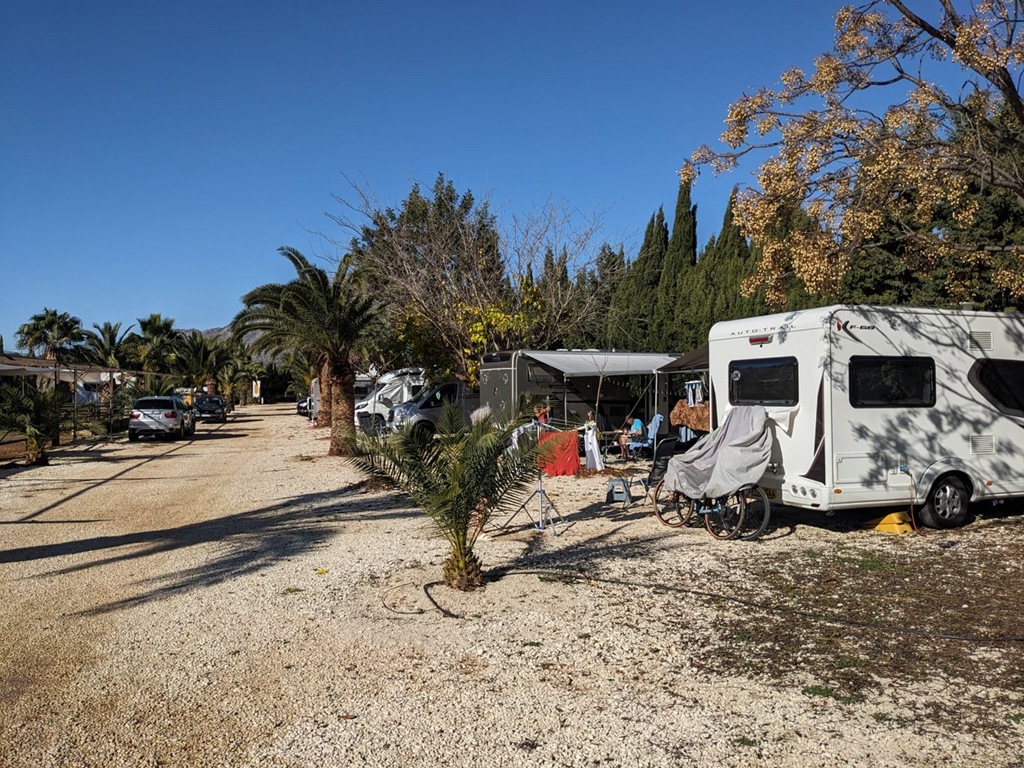
Since we were enjoying Baiona and the campsite, we wanted to stay on a little longer. It really was “a little” because sadly the site’s last day was Saturday as it was closing for the season. Nonetheless, we extended our stay from two nights to three.

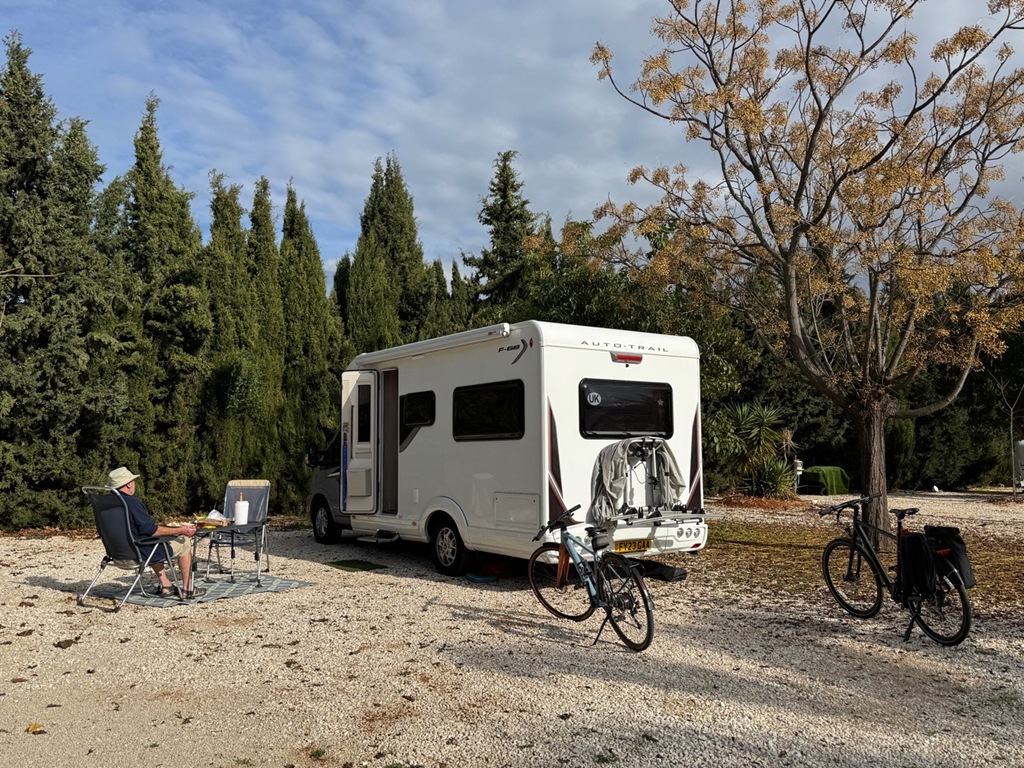
This morning we bade a fond farewell to three of our travelling companions, who were beginning their return journeys home. Two of us, plus tour leader Andy himself, were staying on for the last day at Camping Bayona Playa.

Keen on finding another seafood lunch, we got the bikes out and this time cycled into the town for midday-ish. There was bad weather on the way in the form of hurricane Gabrielle and we timed our ride poorly getting a tad wet in the advanced guard of some of Gabrielle’s rain. Given the weather and the fact that it was a Saturday, I suspected that the interiors of the restaurants would be busy and did not want to be late.

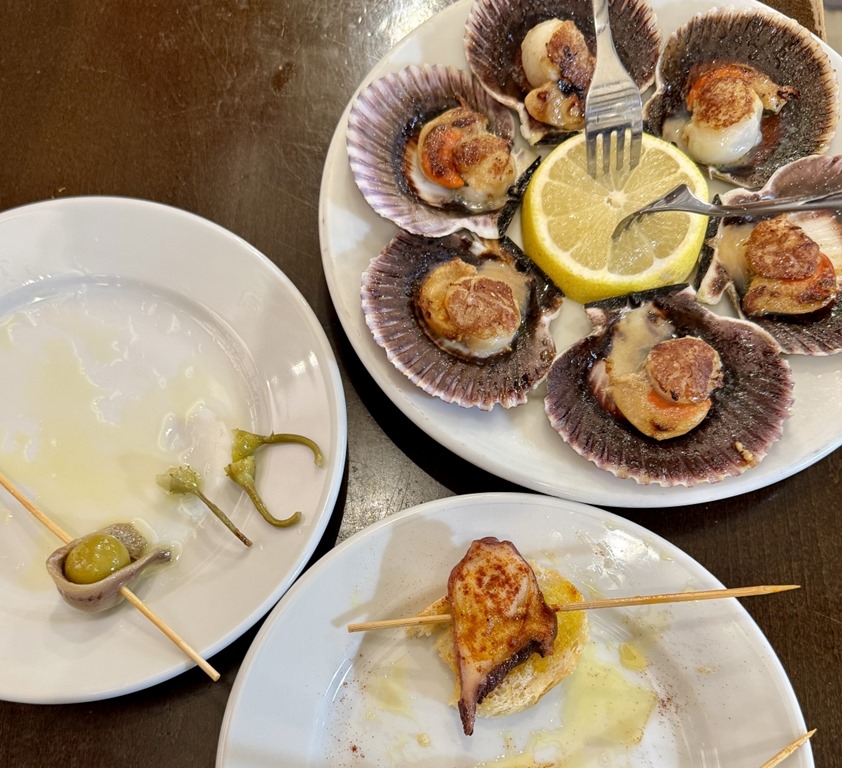
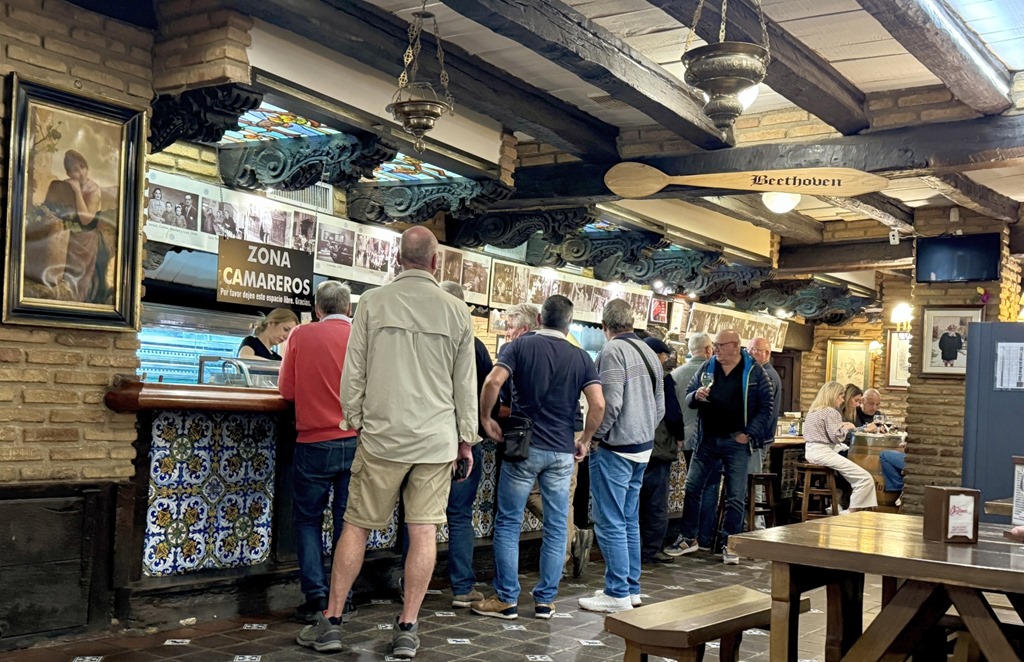
The rain abated and we studied some of the other restaurant menus but in the end felt that a repeat visit to Ladrón del Mar, our choice yesterday, could not be bettered. This time our original wine choice was cool enough so we had a bottle of that to wash down yet more pulpo con tetilla [octopus with tetilla cheese] together with mejillones en escabeche for a change, which sounded interesting [lightly pickled mussels]. The waiter was his usual charming self. He soon did have to turn away people because the restaurant was full. We’d been right not to dally.

PintaBaiona has a mixed history with connections both to Columbus and to Sir Francis Drake. In the harbour is a replica of the Pinta, supposedly the fastest of Columbus’s three ships comprising his 1492 expedition, which looks impossibly small for crossing the Atlantic. The Pinta arrived back at Baiona in 1493 bringing news of the discovery of the New World. [The native Americans, of course, had known of its existence for thousands of years and would come to regret the arrival of Columbus. And that was even before they knew about Trump.]

Baiona castleDrake raided Baiona’s castle in 1585 or, at least, attempted to but his raid was successfully repelled by the inhabitants. Take that, you privateer!

In a repeat of poor timing, our ride back to camp after lunch coincided with the arrival of some more of Gabrielle’s rain, though it was nothing compared to what would hit us later.

Gabrielle was forecast to affect a vast swathe of the Iberian peninsular. At one point Valencia, which has had more than its fair share of bad weather recently, was under a red warning for rain.

Weird light reflectionsBefore the force of Gabrielle made itself felt at Baiona, there was something of a sunset which produced a rather weird effect across our lagoon. Look at the reflections in this picture; many windows are reflecting the sun but there are no equivalent bright windows on the buildings above the shore line. I can only assume that the rays of the westering sun were hitting the glass of the buildings but not bouncing off directly towards our eyes, rather the rays were bouncing down to the water, thence to our eyes. It makes it look a bit fake but I assure you it’s not,

As the evening progressed a strong wind began blowing across the lagoon directly into the rear of Frodo. Along with it came lashing rain which increased in ferocity. Happily, since the wind was not hitting us side on, Frodo remained stable, though the bike cover did make a bit of noise flapping. One of our companions decided to move to a more sheltered pitch for some respite from the elements.

The wind and rain continued into the small hours of the morning but eventually abated. Tomorrow was forecast to be relatively pleasant.

Posted in 2025 Spain

Baiona #1

Andy’s last stop of his escorted tour was Baiona, just above the northern border of Portugal, and it turned out to be the best of the lot, in our opinion. Saving the best for last, eh?

Yellow-legged GullCamping Bayona Playa is an excellent campsite and, whether by design or fortune, we lucked out by getting pitches which overlooked a tidal lagoon favoured by several species of seabirds: gulls and waders. The pitches were not huge by our expectations but were, by Spanish standards, quite generous. I’d say they were about 8m x 8m so 64 m2. As the tide fell, the birds began foraging on the exposed grasses and sandbanks. I could happily have sat and watched the activity all day. [I think this one is a Yellow-legged Gull.]

The campsite seems to be suffering from the inexorable creep of cabin fever, so how long it will remain in its current state for touring campers may be debateable. Some of the current camping pitches may be lost.

Baiona processionOn our first full day we walked into the town of Baiona, guided by Andy. His walking tour began in the backstreets of the town where a religious procession was taking place, carrying effigies of saints. The procession was accompanied by my favourite of instruments [NOT!], bagpipes. These bagpipes, though, differed from the Scottish cousins in that they sported only one drone, whereas the Scottish version has three. I’m not sure if that makes the Spanish version only one third as irritating.

Escaping the bagpipes, our walking tour continued around a long circuit of the castle. Near to the beginning of the path, nestled in some uncomfortable looking rocks, I could not help but notice a sunbathing shapely lady with nary a stitch on. She was intent on smearing sun cream over the whole of her body. I’d have helped but time did not permit. [Smack – enough! Yes dear.]

Completing the castle circuit, refreshment was required at an accommodating bar to recharge the legs. Then it was time to go in search of a seafood lunch along a street that seemed to be restaurant alley. Knowing nothing about any of them, we popped into Ladr´n del Mar [Thief of the Sea], drawn by its menu which included pulpo con tetilla [octopus with tetilla cheese]. We added some grilled scallops, not for the first time. The waiter was very friendly and the food was terrific. We were going to opt for one of the more expensive albariños to wash it all down but the waiter pointed us to another, saying he’d only just received our choice and it wasn’t yet cool enough. Impressive.

Lagoon at nightOur tidal lagoon was entertaining at night, too, with lights on the opposite shore reflecting in the water at high tide.

Friday evening was our last official day of Andy’s escorted tour. By way of bidding fond farewell, Andy organized one of his group barbecues. We’d had only a few smackerels of seafood for lunch so had room for a burger with accompaniments. I was doing very well until someone started playing “Country Roads”. To add insult to injury it wasn’t even the John Denver original but an even worse cover version.

I retired to Frodo to watch the lights across the lagoon in peace.

Posted in 2025 Spain

Combarro

We were en route to the last stop of Andy’s escorted tour and on the way we called in to Combarro, a picturesque coastal village with it’s tourist trap shops scattered along a couple of streets clinging to a hillside frontage.

Combarro autocaravanasCombarro provides an amazingly good, free área de autocaravanas, a motorhome park, in a superb location overlooking the harbour, made more attractive by the addition of a few palm trees. You can stay for 24hrs. The approach is a little tortuous round a sharp 90° turn around the corner of a large building [with a mirror to assist, which I failed to notice] thence through a car park. The motorhome area looked wonderful. We were curious to see some of the car folks unloading rakes and trolleys from the boots of their cars as we passed through. There was also a motorhome service point at one end of the car park.

Cockle pickersOnce parked up, the purpose of the rakes and trolleys became clear, there were huge amounts of very industrious cockle-pickers [my assumption] raking about in the sand of the harbour uncovered by low tide. There were well in excess of a hundred of them dividing their efforts over a couple of different sections of beach.

CombarroWith the convoy gathered, we went to investigate the town itself, eventually threading our way through the gauntlet of tourist-tat shops. Liberally sprinkled among the tat were shops selling bottles of local wine, the default white grape in these parts being albariño. Our guides suggested the wine was quite reasonable and reasonably priced so we invested in a €14.50 3-bottle case. We’ll see.

Arriving at the main square, we gathered around some tables at one of the cafés only to discover that we had picked one with no coffee. Brilliant! I can only imagine that there was a problem with their coffee machine. It did, however, offer a few raciones including padrón peppers and pescaditos [small fish, sort of in between whitebait and sardines] which made a good lunch.

On our return to the motorhome park to continue our journey, one of our number noticed a pair of the industrious rakers rinsing cockles under a tap so my assumption about the harvest had been correct.

We resumed heading for Andy’s final stop of the tour, Baiona.

Posted in 2025 Spain

Santiago de Compostela

Santiago campsiteAfter Frodo’s scary adventure working his way through impossible cobbled streets in Mondoñedo, we eventually arrived at our campsite at Santiago de Compostela. This was a terraced campsite with each avenue of pitches being terraced above those below. The pitches were short – 9m max. – and very tight with little room between units. This is somewhere you come to sleep as a tourist, not somewhere you came for the joy of camping.

The following morning we all set off into Santiago de Compostela itself. We walked down our relative mountainside, passed my bit of sanity that was a Carrefour supermarket, and joined a footpath marked with brass scallop shells, one of the pilgrim caminos heading towards revered the cathedral of Santiago. Marked, that is, except for the various gaps in the paving slabs where various miscreant pilgrims had nicked the brass scallop shells. The scallop shell motive apparently stems from the early days predating a certificate when pilgrims went to Cape Finisterre to collect a scallop shell showing that they had completed the pilgrimage.

Today the pathway was filled with many pilgrims on their last leg, standing out from regular tourists because of their twin trekking poles. A local jogged past us bitching about the amount of the path we were taking up. On the paths in Santiago, the shells point towards the Santiago cathedral.

Santiago cathedralLeader Andy had organized a 2-hour guided walk around the sights of Santiago. We were wired for sound with earplugs, the better to hear our guide. We met her in the cathedral square. She was very good. Having talked us through a lot of the architecture of various faces of the cathedral, we headed off to see more of the town. To be frank, I found the architecture austere and dull but you know me with piles of old stones. OK, it isn’t my natural habitat but it was a couple of hours of entertainment.

Screenshot 2025-09-29 170119Rua do FrancoThe city tour following the cathedral led us down the Rua do Franco and Travesa do Franco, with which I had a natural affinity, especially as the rua was one of the main restaurant streets. Having nothing to do with me, the franco reference is to do with being the route to the cathedral from France. There are very many caminos to Santiago but these are the main ones. Once cut loose from our tour, we returned to Rua do Franco for some lunch concentrating on seafood.

Cathedral blingFrancine and a couple of travelling companions wanted to go into the cathedral. While they did, I happily remained outside guarding the small collection of rucksacks. Upon exit, Francine said that most of the cathedral interior was relatively plain but that the altar did possess lots of “bling”. This image shows the enormous incense burner to counteract unpleasant smells of the great unwashed, which weighs in, allegedly, at 100kgs. Don’t get hit on the head.

We walked back uphill via a handy-dandy bar for some refreshment. We managed to clock up 19000 steps today,  a mere spit compared to the steps required to follow one of the many pilgrim trails.

Posted in 2025 Spain

A Very Wrong Turn

On our way to Santiago de Compostela, our group planned to make an interim stop at Mondoñedo. Everything was going very smoothly, including finding a fuel stop, until we arrived somewhere near a motorhome parking area on the outskirts of town. You will notice the use of the phrase “somewhere near”.

To expand on that, we have Frodo’s built in satnav which, as a satnav is pretty good; it’s designed for motorhome use and you can set vehicle size to avoid inappropriate roads. Added to this, its directions are clear. Where it falls hopelessly flat on its face is that the GPS receiver is buried beneath lots of other apparently confusing electronic gubbins and frequently loses you, having not a clue where you are.

For more reliable positioning we have more frequently resorted to the use of Google maps navigation. This, however, has its own shortcomings – you can’t set vehicle size, you are just a car. Another issue seems to be that on Apple Carplay you can’t change the map resolution in flight.

We were approaching our intermediate stop on Google expecting a left turn. In front of us was a motor vehicle service point sign pointing left. We took it. In about 20m was a T-junction. Up and to our right I could see a square with motor vans. There was a no-entry sign in front of them. Google was telling us to turn left. Thinking it would send us around a block to approach from the other side, I duly turned left.

“Turn right”, instructed Google; OK.

“Turn right”, said Google again. Ah, no entry.

I did a 3-point turn intent on going back down the road I had just come up.

“Bollocks”, said Pooh, profanely. There was a no-entry sign there, too. The road we had come up was a one-way street. I went down the only road open to me.

truck obstructionThe roads were cobbled and seemed to be getting narrower. Google wittily asked me to turn left up a one-way street going in the opposite direction. Google suggested a few more illegal moves as I was shepherded inexorably down a maze of ever-narrower cobbled streets until we eventually were brought to a complete halt by a workmen’s truck parked beside scaffolding as they worked on a building front. [The picture is taken looking back up the road we were trying to come down.]

One of the chaps up on the scaffolding gesticulated at me to reverse. Yeah, right, you have to be kidding. Apart from being unable to make that manoeuvre there was not other way out that I could then take that I could remember. That’s why I’m where I am. I shrugged at him helplessly. The van was clearly there for the duration.

Shortly, a young man with his wits about him wandered past us and chatted up the truck driver. The driver first drove forward, then reversed up the street to the left unblocking our path and allowing me to approach the T-junction immediately in front. I praised him profusely through the windscreen. He must have thought these tourists are bloody mad. (He would’ve been quite right). Once again, I had but one way that I could go or, at least, might be able to go.

After a minor touch of the high-level no-entry sign mounted on the corner of the building up out of my sight – I was intently watching the steps directly in front of me – with both wing mirrors retracted, I managed to shuffle turn right around the corner, avoiding the steps in front of me, the truck to my left, the scaffolding to my rear and the building corner to my right.

parked cars and plantsThis new street was slightly wider. It must have been wider ‘cos two cars were parked ahead of me and to the right with, perhaps, just enough space to their left . I edged Frodo left, breathed in and began inching past the cars parked in front of a shop. Unhelpfully, the shop had two potted plants mounted in holders on its frontage reducing the space available. Watching the cars on my right, I grazed one pot plant and dismounted it. Francine, who was outside watching doing all she could to assist, retrieved the poor plant. She muttered “losiento” [sorry] to a nonplussed  man in the shop doorway as she handed back the plant, happily undamaged. We were racking up a goodly collection of disbelieving looks from various locals. [Again, this shot is taken looking back up the way we came down.]

cathedral squareShortly we approached another cobbled T-junction downhill, overlooking railings and the cathedral square below. Parked to the left of said T-junction was a Policia Locale car. Great! Now what? Mercifully, rather than being annoyed, the policeman proved very helpful, though he probably justifiably thought us utterly barking. In a rather pointless attempt to explain, I muttered “satnav”. He pointed us left around the junction (and his police car), then right around a 180° turn down into the cathedral square, across the front of the cathedral before exiting the square on a slightly wider road. We could then turn izquierda [left] onto something resembling a proper road, i.e wider and tarmac rather than cobbled.

We were finally out of the maze. If I hadn’t had to drive, I’d have been trembling with relief.

My phone rang. We were overdue and leader Andy wondered what was happening. What indeed? You’re never going to believe this. “We’ll be with you in a couple of minutes” (barring further disasters).

We arrived at the intended parking area, found the correct entry point and surveyed poor ol’ Frodo. The plant did no damage, mercifully, and the street sign made but a small, relatively superficial mark on the high off-side moulding.

Next time I’ll drop a U-turn, even if it means going back the wrong-way down a deserted one-way street. It’d be the lesser of two evils.

Now I was free to tremble.

Technorati Tags: ,,,
Posted in 2025 Spain

Foz

I’ll keep this one fairly brief.

Our campsite, FozCamp, was very pleasant with a slope that required judicious use of levelling ramps. It was essentially on the coast though there was a road in between the site and the sea. The couple running the site were delightful.

We actually had grass, for once, which we couldn’t make use of it because what was not pleasant was the weather; we had two days with frequent rain and wind.

Rocks and surfIn one of the breaks in the rain we took the coastal footpath into Foz itself, a meandering walk of about 30 minutes watching breakers on the coastal rocks. Foz itself I would probably describe as utilitarian, the buildings being not particularly attractive.

There is a more direct return route to the campsite on foot, cutting out the twists and turns of the coastal path, which takes about 15 minutes.

Leader Andy recommended one restaurant which, sadly, was one of those closed on a Monday. Francine and I wandered back in on Monday to look at other options intent on finding some seafood. We eventually settled on Casa Damian and chose a Parillada de Pescada, a fish platter. When it arrived, the platter was huge – too huge, truth be told.

Parillada de PescadaThe platter was mainly composed of several large sections of large fish, though it did include some token seafood – clams, which I thought were excellent though Francine found them too rich with butter and garlic, and scallops. A lot of this was always going to go back.

The restaurant was very busy with Spanish; we seemed to be the only foreigners there. The menú del día was very popular but with three courses these are usually too much food for us at lunch (said the man with a massive platter of fish). The idea of tinned peaches for dessert didn’t grab, either.

Once we could move again, we tried to walk off our excess of food.

Technorati Tags: ,,,,
Posted in 2025 Spain

Praia das Catedrais

Or Cathedral Beach, as we call it in English.

This is a tourist honeypot beach with some admittedly impressive rock formations. As you approach, you instantly know that it’s a honeypot because there is extensive parking rammed with cars and motorhomes. The approach paths are also full of humanity. There is only a two hour window when you can visit, that being an hour either side of low tide.

rainbowOur timing on this day really could not have been worse. The sky was heavy with rain clouds and it didn’t take long before they began discharging their contents. The only bright side was that a full rainbow appeared which Francine managed to snap.

people on beachYou have to make reservations to get a slot for your visit and Andy had booked us in for 11:00. We assembled and duly descended the steps down onto the rain-pitted sand of the beach to join many others, a lot of whom were sensibly holding umbrellas. We had our waterproofs with hoods.

Approaching the main photogenic formations there was something of a bottleneck. A slight scramble over some rocks was needed for those intending to keep their shoes (mainly) dry. The problem was that there was one preferred route over the rocks with a line of people waiting, or not, on either side. we needed road work traffic lights. Francine took off her shoes and waded through the side puddle to avoid the queue. She wanted a paddle in the sea anyway and pronounced the water warm, which was a bit of a surprise..

There is a single arch formation, a little like Durdle Door in the UK. Further on are a couple of aligned arches mirroring each other. Naturally, these are the formations everyone wants to photograph. Also naturally, many folks dangle around hoping for a people free shot while they, themselves, foil the attempts of others to get people free shots. How Francine managed to grab these without people I really don’t know but grab them she did.

archesarch

The rain continued al the time we were on the beach. The whole scene would be so much better in good weather but these were the cards we were dealt.

We made the rest of the journey to Foz.

Posted in 2025 Spain

Tapia de Casariego

For some reason the name of this place was proving difficult to hang on to. Francine had an aide memoire word: Tapioca. In my case, Tilapia sprang to mind.

Whatever it was called it was a long hop for this itinerary of about 200 kms but it was broken by a tour of Sidra Crespo. Leader Andy’s partner, Pati, is Spanish and did an excellent job of simultaneous translation as the head lady explained their processes.

sidra pouringSpanish sidra is a dry, flat affair but they have ways of trying to inject some life into it. These include pouring it into a glass from a great height or using a tabletop pump device which siphons it out of a botte into a glass in a holder. Either way, the trick is to pour only a mouthful at a time, which can be drunk before it loses the added air.

Following the sidra tour there was, of course, the obligatory gift shop where we bought a bottle together with some smoked cheese; leader Andy thinks cheese makes a good accompaniment.

After pausing at a bar in the nearby town for coffee and a bocadillo [sandwich], we headed off to our clifftop campsite at Tapia de Casariego. Levelling proved a bit tricky – could’ve done with higher ramps so Frodo was at a bit of an angle – but it was a well equipped campsite with the reception supplying bread avoiding the need to go downhill into town.

Tapia clifftop viewThe clifftop provided some great views of waves crashing on rock formations. I’d been wanting an opportunity to get the tripod out and play with my Big Stopper ND filter to smooth out the water. Here it was, though given all the long grass at the cliff edge, getting the tripod settled and stable – there was a stiff breeze – was quite a challenge.

wadersAt low tide, a modest collection of waders was working along the water’s edge.

pristine beachEarly on our second morning, I found Francine sitting on rocks at the top of the beach, not wanting to spoil the smooth sand with her footprints. I understood completely, it did look pristine.

Tapia harbourOur visit to Tapia de Casariego ended on our second evening with a great team meal down near the harbour in town. Naturally, we lubricated our taste buds first with a few drinks overlooking the harbour. After drinks, Andy’s restaurant choice kept us well supplied with a wonderful variety of raciones.

Everyone had to walk both ways in and out of town ‘cos taxis – there were apparently three – were notable by their absence, for a variety of reasons. The quality of the food was such that it was all worthwhile, though.

Posted in 2025 Spain

Ribadesella

Luxury, a 3-night stop. Our campsite was a couple of kilometres out of town. We managed to get a decent enclave in the campsite for our little collection of motorhomes.

On our first full day we walked down hill for a visit to the Tito Bustillo prehistoric cave. It is named after one of its discoverers who later died in a climbing accident. Numbers on tours into the cave are strictly controlled and leader Andy had a booking for 11:00.

Tito BustilloThis is archaeology and prehistory so it isn’t exactly my cup of tea but seeing some of the cave paintings was quite interesting. The tunnel into the main chambers of the cave was about 600m long. Photography is not allowed in the cave so you’ll have to use your imagination. The paintings featured horses and deer, for the main part.

Pulpo a la galegaWe’d been underground for about 75 minutes before emerging back into daylight and crossing the bridge over the river Sella into the main part of town for a coffee. After our coffee group split up Francine and I went in search of a restaurant for what leader Andy refers to as sea monsters; he is not a seafood fan. We found a pleasant but slightly windy restaurant and enjoyed yet more zamborinas [scallops] this time supplemented by a classic pulpo a la Galega [octopus on potatoes sprinkled with paprika]. Being on foot, we did, of course, have another bottle of white wine.

Orgasmos biscuitAndy did the group proud in the evening catering for a 12-person barbecue on relatively limited cooking facilities. Some of us chipped in to assist with other offerings including various salads and a bowl of padron peppers which I prepared for a starter. Afterwards I brought out my box of Orgasmos which turned out to be rather unexciting biscuits. They did, however, cause the required level of amusement. I have to say they are grossly oversold. What else did I expect?

We were left to our own devices for our second day in Ribadesella but of course, being seafood fans, Francine and again wandered down into town in search of lunch. We found a restaurant with an appealing menu in the more sheltered opposite end of the harbour area.

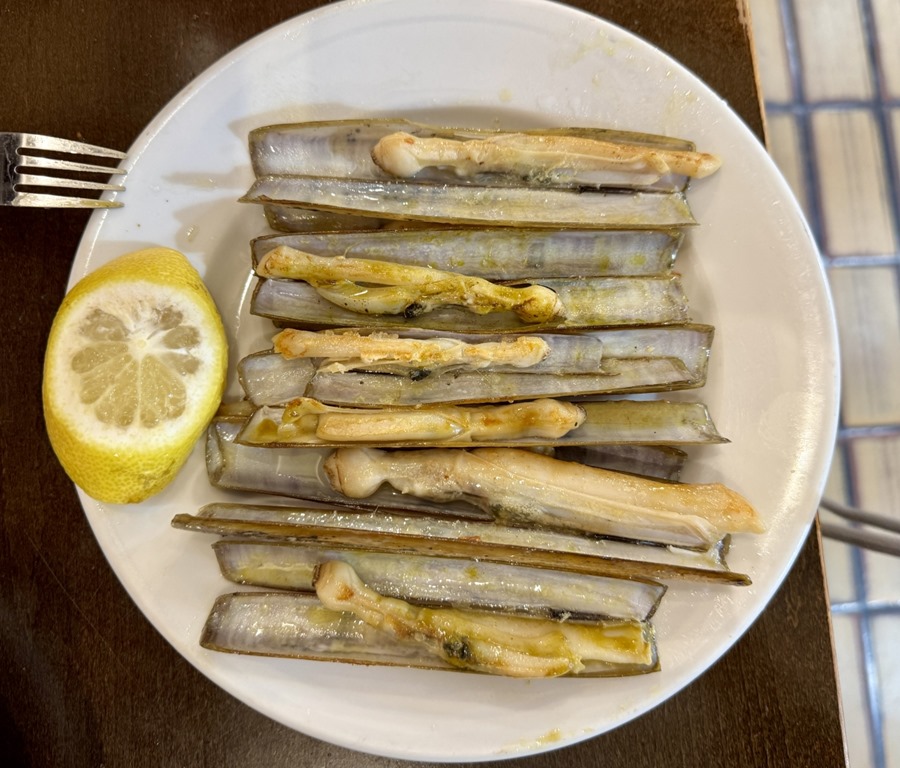
navajasOn the menu here were navajas [razor clams] which we had been keen to get for a while. Navajas literally means knives in Spanish. They do look a bit like a cutthroat razor. Ordered these without a second thought and when they came, they turned out to be the sweetest, most delicious navajas that we could remember eating. They can a little gritty but theses were not; quite superb.

Sea MonsterOur second choice was a bit of a disappointment, to be honest. We’d ordered calamar which should have been squid but what we were given was a chunky cuttlefish. This really was one of Andy’s sea monsters. I think this would more normally be called sepia. It was OK but it has to be said cuttlefish is not my favourite.

MorcillaWe’d ordered a third dish which was, in truth, a bit over the top. It was interesting though. This was a local morcilla [black pudding] which, we discovered, was wrapped in seaweed. The morcilla was fine but it was served on tortos, maize flour discs which were little more than sponges that soaked up lashings of cooking oil. Aubergine slices can soak up a lot of oil but it ain’t got nothing on tortos. Having taken an experimental bite, we didn’t eat them.

colourful stepsFrancine was aware of a curiosity in Ribadesella, which we went in search of. This was the escalera de colores, a coloured stairway. A local artist had the idea of people turning up, painting a step and writing a sentence on it. It’s a nice idea that was narrower than I expected, between a couple of buildings, but it’s quite long and does add a splash of colour to the neighbourhood.

Posted in 2025 Spain

Llanes

Llanes cliffsOn our way to Ribadesella, we made an intermediate stop at Llanes. There is a very useful but quite rough parking area for motor vans on the edge of town. Once parked and assembled we walked a circuitous route into town along the clifftops where there was some spectacular wave action against the cliffs. I wasn’t expecting such an opportunity and did not have my camera to play with its built-in ND filter function. Lose 10 points – should’ve known better.

We paused at a café for, yes, a coffee, where we could also watch the traditional art of high pouring sidra [cider] into glasses held much lower down. It was done behind a floor-standing shield device for protection. Spanish sidra is flat, rather like scrumpy, so it is poured about a yard above the glass to introduce some air (and spillage if the pourer is less than accurate). If they want it fizzy, why don’t they make it fizzy? Hmmm. Tradition, I suppose.

After coffee we were free to wander for a while and went In search of seafood for lunch. We found an interesting menu outside one restaurant and went in. Six of us sat at a table whereupon a waiter came over, opened one of the menus and proceeded to go through it deleting all the interesting stuff that had originally attracted us in, muttering “no possible”,“no possible”, “no possible”. We got up and walked out.

zamborinasThree of our number chose to wend their way back, things proving too difficult. Eventually we three remaining musketeers, found another restaurant ostensibly offering zamboriñas [scallops] and rabas [squid] served with squid ink allioli. They don’t seem to call squid calamari in these parts. Happily this restaurant did actually have what its menu offered. We sat and enjoyed a very decent lunch, though at lunchtime they do seem to expect you to order a larger meal.

Posted in 2025 Spain