I have often found it appropriate to comment, internally at least, that the world was rarely arranged by a photographer. Landscape photography frequently suffers from an unsightly man-made obstruction being plonked squarely within what would otherwise be a splendidly photogenic view. I can think of one “wildlife” example at Whipsnade Zoo [OK, not exactly wildlife] where the observation area to the lion enclosure is positioned such as to place the photographer facing upwards, the lions frequently sitting on a mound, directly into the sun.
Hold those thoughts for a moment.
I am not a fan of cities but I do find some appealing interest in Valencia. For a foodie, the covered market is an Aladdin’s cave of toothsome delights. Valencia’s other gem is the City of Arts and Sciences out to the east of the centre; it’s a photogenic collection of artistic architecture designed by Santiago Calatrava. The whole place is largely white concrete. We have visited twice before and were up for a third trip.
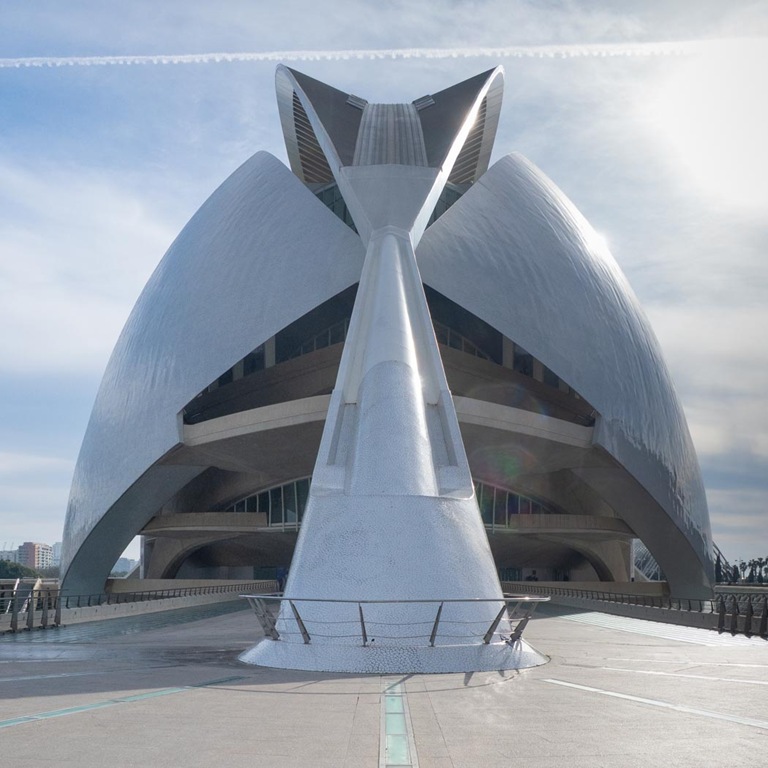 I think the three most photographed buildings are the science museum (formally, the Museu de les Ciéncies), apparently designed after a whale skeleton, the Hemisferíc, an IMAX theatre (more of which later), and the absolutely stunning Opera House (formally, the Palau de les Arts Reina Sofia) with its enormous cantilevered roof hovering above the main structure in an impossible-looking fashion.
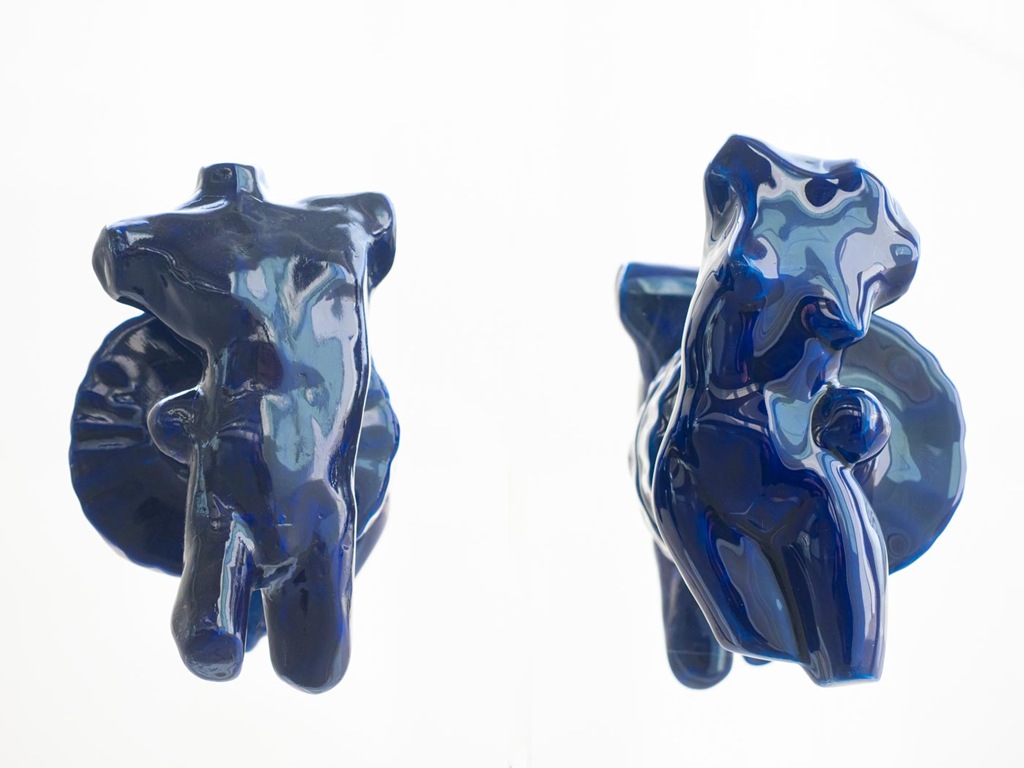 On this occasion, Francine was keen to go inside the Opera House, something we had not previously done. The first items of interest were the handles on the plain glass doors leading into the building; these were very tactile shiny blue human torsos, both male and female. You could be forgiven for just hanging around the doors caressing them. (I’ve removed the dividing lines between the two glass door panels to clean the image up.)
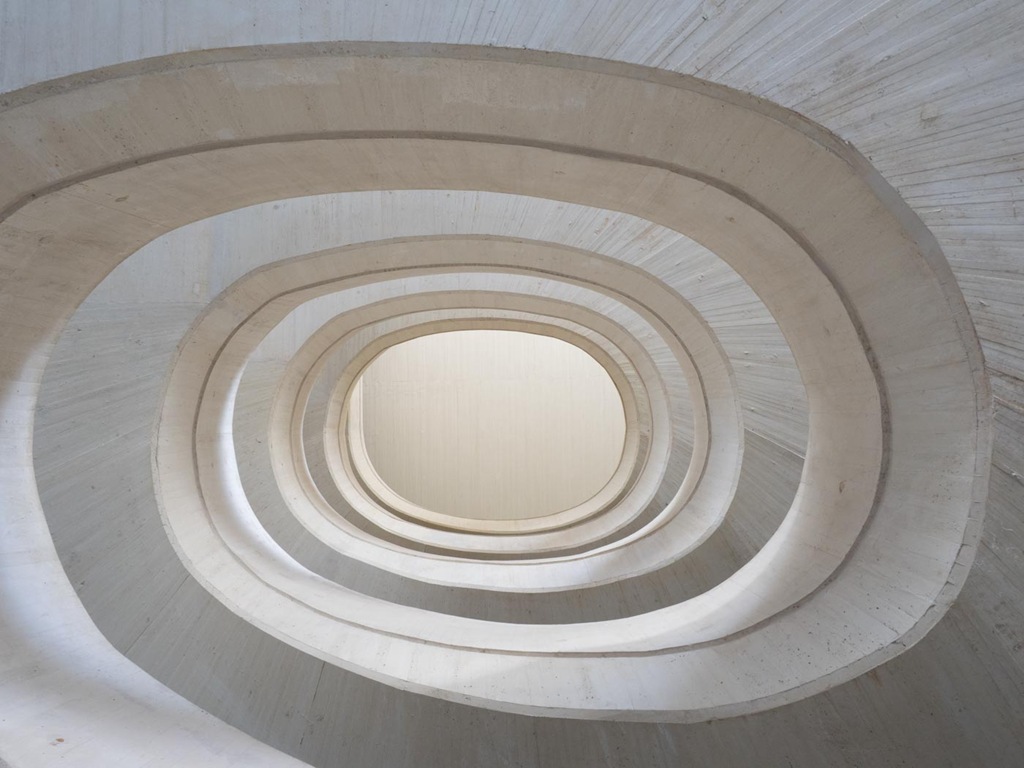
 We skipped any guided tour, which would have given us access to more of the internals, and eventually dragged ourselves away from the tactile door handles. We were primarily interested to find the spiral staircase and, to be honest, that was the most interesting feature of the internal architecture, though some of the balcony curves were also pleasing. It’s the staircase that is the real photographic magnet. On the left is a “straight” shot showing the detail whilst on the right is Francine’s more artistic twisting ICM shot.
On one of our previous visits we had gone into the science museum but we thought it rather dull. This time, with its external reflecting pool having been drained, the outside didn’t hold much interest either, so lets move on and talk about the Hemisferíc.
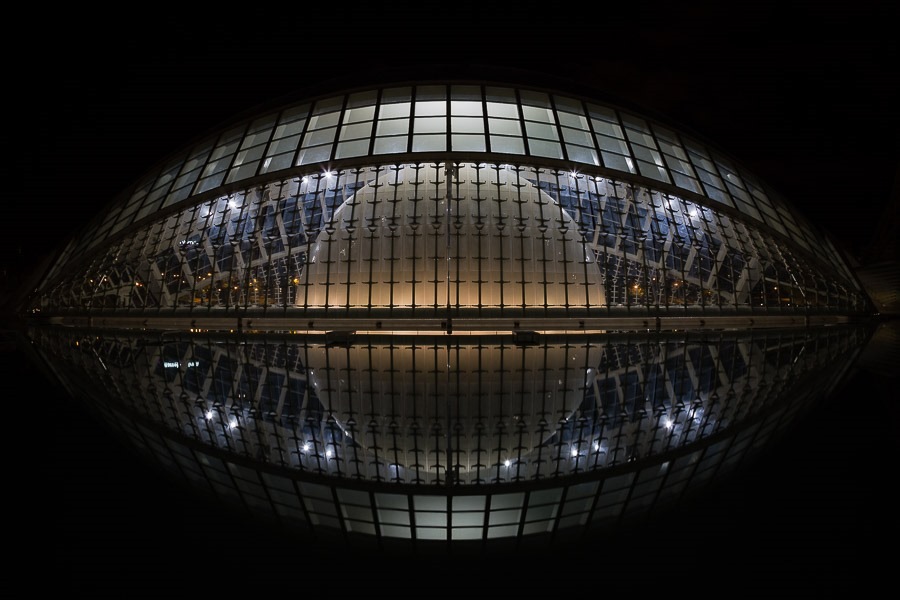 Back in 2017 we had made an evening visit to capture some of the impressive lighting. Francine in particular waited very patiently for conditions to settle and, at 23:00, manage to capture the classic reflection shot of the Hemisferíc when the whole image resembles a huge eye. It really was very striking and Francine did extremely well.
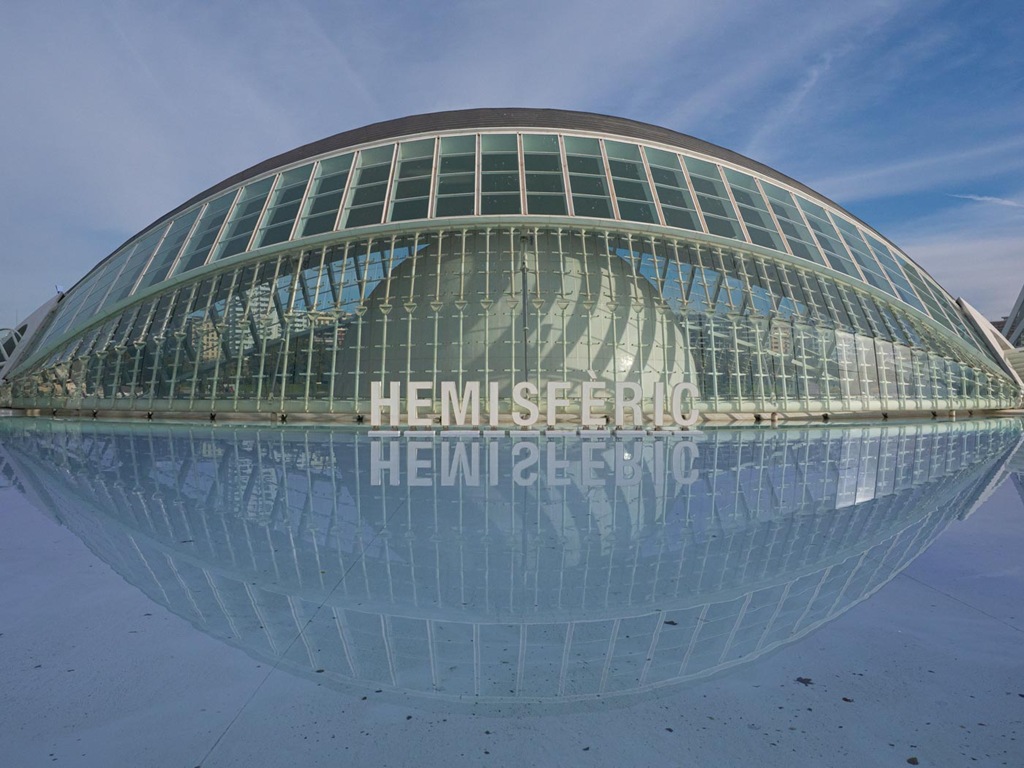 Imagine our horror when, confronting us this time, were huge letters in front of each building declaring its name. What absolute numbskull thought that ruining the buildings’ reflections with huge lettering could possibly have been a good idea? They’ve taken one of the most photogenic collections of modern architecture and utterly ruined it, photographically speaking. Here it is now, admittedly in rather more tedious daylight, but still … I can only say that this development makes Francine’s original shot more valued since it cannot be repeated.
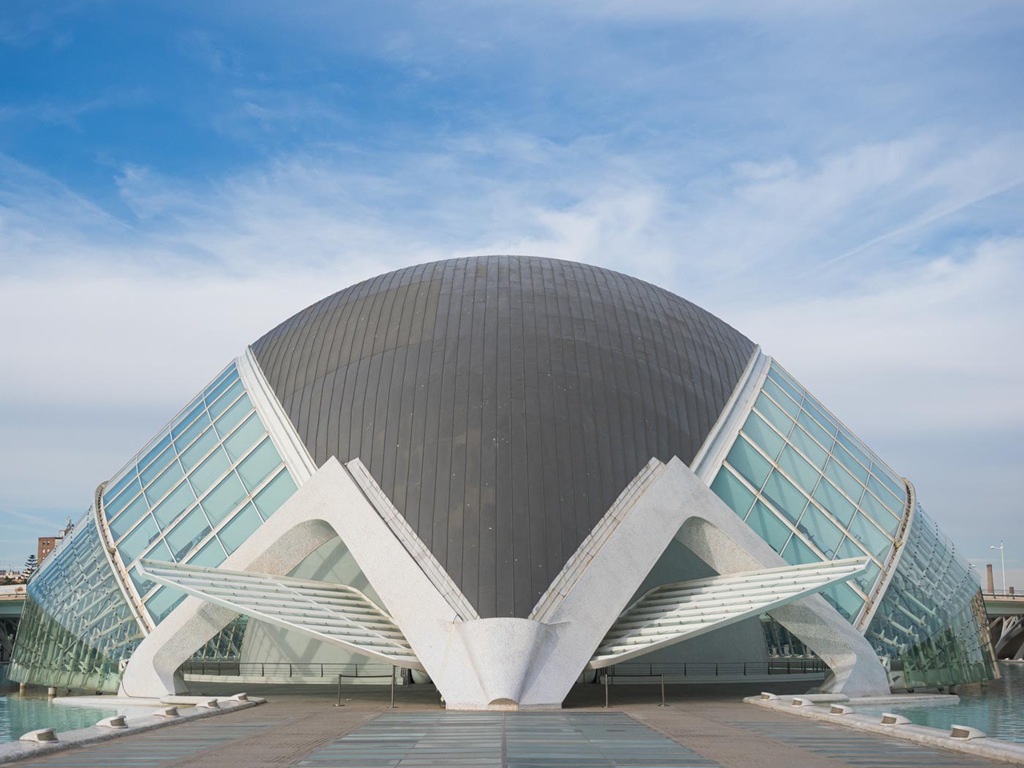 There is still an interesting angle on the Hemisferíc, which is end-on. I waited patiently for various groups of people and pushchairs to clear the scene before snapping what, to me, resembles something like the top of a helmet from Star Wars.
It remains an interesting place to visit with lots of detail to point a camera at but, really, what a travesty.
Recent Comments